CHICAGO - Want to spend less at the pump? Lose some weight. That's the
implication of a new study that says Americans are burning nearly 1 billion more
gallons of gasoline each year than they did in 1960 because of their expanding
waistlines. Simply put, more weight in the car means lower gas mileage.
Using recent gas prices of US$2.20 a gallon, that translates to about US$2.2
billion more spent on gas each year.
|
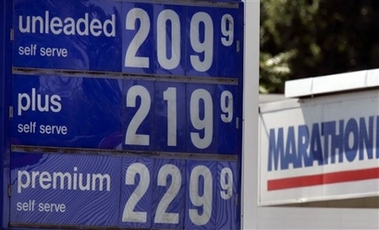
Gasoline prices are shown at a station in Indianapolis in
this September file photo. A new study says Americans are burning nearly 1
billion more gallons of gasoline each year than they did in 1960 because
of their expanding waistlines. [AP]
|
"The bottom line is that our hunger for food and our hunger for oil are not
independent. There is a relationship between the two," said University of
Illinois researcher Sheldon Jacobson, a study co-author.
"If a person reduces the weight in their car, either by removing excess
baggage, carrying around less weight in their trunk, or yes, even losing weight,
they will indeed see a drop in their fuel consumption."
The lost mileage is pretty small for any single driver. Jacobson said the
typical driver - someone who records less than 12,000 miles annually -
would use roughly 18 fewer gallons of gas over the course of a year by losing
100 pounds. At US$2.20 per gallon, that would be a savings of almost $40.
Outside experts said that even if the calculations aren't exact, the study
makes sense.
"If you put more weight into your car, you're going to get fewer miles per
gallon," Emory University health care analyst Kenneth Thorpe said Wednesday.
The same effect has been seen in airplanes. Research from the Centers for
Disease Control and Prevention found that heavy fliers have contributed to
higher fuel costs for airlines.
The obesity rate among US adults doubled from 1987 to 2003, from about 15
percent to more than 30 percent. Also, the average weight for American men was
191 pounds in 2002 and 164 pounds for women, about 25 pounds heavier than in
1960, government figures show.
The study's conclusions are based on those weight figures and Americans' 2003
driving habits, involving roughly 223 million cars and light trucks nationwide.
It will appear in the October-December issue of The Engineering Economist, a
peer-reviewed journal published by the American Society of Engineering Education
and the Institute of Industrial Engineers.
Jacobson, an industrial engineer, conducted the research with Laura McLay, a
doctoral student in his Champaign-Urbana lab who now works at Virginia
Commonwealth University.
They estimated that more than 39 million gallons of fuel are used each year
for every additional pound of passenger weight.
The amount of extra fuel consumption blamed on weight gain since 1960 -
938 million gallons ¡ª would fill almost 2 million cars with gas for an entire
year. However, that is only 0.7 percent of the total amount of fuel consumed by
US passenger vehicles each year, Jacobson said.
The estimates "are probably pretty reliable," said Larry Chavis, an economist
at the University of North Carolina in Chapel Hill. "I don't know if it's going
to encourage anybody to go out and lose weight to save gasoline, but even for
individual families, it could have an effect on their budget."
Dr. Jeffrey Koplan, former CDC director and chairman of an Institute of
Medicine report on obesity, said the findings are almost beside the point.
"The wrong fuel is being focused on," said Koplan, now at Emory University.
"If you're heavier, the most important fuel you use more of is food."
Eating less, driving less and choosing more active means of transportation
would reduce gas consumption, and also help reverse rising obesity rates, he
said.
