WASHINGTON - US President Bush keeps revising his explanation for why the
U.S. is in Iraq, moving from narrow military objectives at first to
history-of-civilization stakes now.
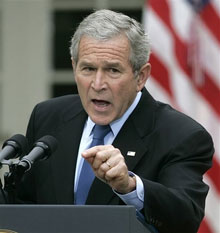
President Bush speaks during a news
conference in the White House in this October 11, 2006, file photo. Bush
said 'We can't tolerate a new terrorist state in the heart of the Middle
East, with large oil reserves that could be used to fund its radical
ambitions, or used to inflict economic damage on the West.
[AP] |
Initially, the rationale was specific: to stop Saddam Hussein from using what
Bush claimed were the Iraqi leader's weapons of mass destruction or from selling
them to al-Qaida or other terrorist groups.
But 3 1/2 years later, with no weapons found, still no end in sight and the
war a liability for nearly all Republicans on the ballot Nov. 7, the
justification has become far broader and now includes the expansive "struggle
between good and evil."
Republicans seized on North Korea's reported nuclear test last week as
further evidence that the need for strong U.S. leadership extends beyond Iraq.
Bush's changing rhetoric reflects increasing administration efforts to tie
the war, increasingly unpopular at home, with the global fight against
terrorism, still the president's strongest suit politically.
"We can't tolerate a new terrorist state in the heart of the Middle East,
with large oil reserves that could be used to fund its radical ambitions, or
used to inflict economic damage on the West," Bush said in a news conference
last week in the Rose Garden.
When no weapons of mass destruction were found in Iraq, Bush shifted his war
justification to one of liberating Iraqis from a brutal ruler.
After Saddam's capture in December 2003, the rationale became helping to
spread democracy through the Middle East. Then it was confronting terrorists in
Iraq "so we do not have to face them here at home," and "making America safer,"
themes Bush pounds today.
"We're in the ideological struggle of the 21st century," he told a California
audience this month. "It's a struggle between good and evil."
Vice President Dick Cheney takes it even further: "The hopes of the civilized
world ride with us," Cheney tells audiences.
Except for the weapons of mass destruction argument, there is some validity
in each of Bush's shifting rationales, said Michael O'Hanlon, a foreign policy
scholar at the Brookings Institution who initially supported the war effort.
"And I don't have any big problems with any of them, analytically. The
problem is they can't change the realities on the ground in Iraq, which is that
we're in the process of beginning to lose," O'Hanlon said. "It is taking us a
long time to realize that, but the war is not headed the way it should be."
Andrew Card, Bush's first chief of staff, said Bush's evolving rhetoric,
including his insistence that Iraq is a crucial part of the fight against
terrorism, is part of an attempt to put the war in better perspective for
Americans.
The administration recently has been "doing a much better job" in explaining
the stakes, Card said in an interview. "We never said it was going to be easy.
The president always told us it would be long and tough."
"I'm trying to do everything I can to remind people that the war on terror
has the war in Iraq as a subset. It's critical we succeed in Iraq as part of the
war on terror," said Card, who left the White House in March.
Bush at first sought to explain increasing insurgent and sectarian violence
as a lead-up to Iraqi elections. But elections came and went, and a
democratically elected government took over, and the sectarian violence
increased.
Bush has insisted U.S. soldiers will stand down as Iraqis stand up. He has
likened the war to the 20th century struggles against fascism, Nazism and
communism. He has called Iraq the "central front" in a global fight against
radical jihadists.
Having jettisoned most of the earlier, upbeat claims of progress, Bush these
days emphasizes consequences of setting even a limited withdrawal timetable:
abandonment of the Iraqi people, destabilizing the Middle East and emboldening
terrorists around the world.
The more ominous and determined his words, the more skeptical the American
public appears, polls show, both on the war itself and over whether it is part
of the larger fight against terrorism, as the administration insists.
Bush's approval rating, reflected by AP-Ipsos polls, has slid from the mid
60s at the outset of the U.S.-led invasion in March 2003 to the high 30s now.
There were light jumps upward after the December 2003 capture of Saddam, Bush's
re-election in November 2004 and each of three series of aggressive speeches
over the past year. Those gains tended to vanish quickly.
With the war intruding on the fall elections, both parties have stepped up
their rhetoric.
Republicans, who are also reeling from the congressional page scandal, are
casting Democrats as seeking to "cut and run" and appease terrorists.
Democrats accuse Bush of failed leadership with his "stay the course"
strategy. They cite a government intelligence assessment suggesting the Iraq war
has helped recruit more terrorists, and a book by journalist Bob Woodward that
portrays Bush as intransigent in his defense of the Iraq war and his advisers as
bitterly divided.
Democrats say Iraq has become a distraction from the war against terrorism ¡ª
not a central front. But they are divided among themselves on what strategy to
pursue.
Republicans, too, increasingly are growing divided as U.S. casualties rise.
"I struggle with the fact that President Bush said, `As the Iraqis stand up,
we will stand down.' But the fact is, this has not happened," said Rep.
Christopher Shays, R-Conn., a war supporter turned war skeptic.
The Republican chairman of the Senate Armed Services Committee, Sen. John
Warner of Virginia, said after a recent visit to Iraq that Iraq was "drifting
sideways." He urged consideration of a "change of course" if the Iraq government
fails to restore order over the next two or three months.
More than 2,750 members of the U.S. military have died since the beginning of
the war, most of them since Bush's May 2003 "mission accomplished" aircraft
carrier speech. Tens of thousands of Iraqis have died.
Recent events have been dispiriting.
The United States now has about 141,000 troops in Iraq, up from about 127,000
in July. Some military experts have suggested at least one additional U.S.
division, or around 20,000 troops, is needed in western Iraq alone.
Dan Benjamin, a former Middle East specialist with the National Security
Council in the Clinton administration, said the administration is
overemphasizing the nature of the threat in an effort to bolster support.
"I think the administration has oversold the case that Iraq could become a
jihadist state," said Benjamin, now with the Center for Strategic and
International Studies. "If the U.S. were to leave Iraq tomorrow, the result
would be a bloodbath in which Sunnis and Shiites fight it out. But the jihadists
would not be able to seek power."
Not all of Bush's rhetorical flourishes have had the intended consequences.
When the history of Iraq is finally written, the recent surge in sectarian
violence is "going to be a comma," Bush said in several recent appearances.
Critics immediately complained that the remark appeared unsympathetic and
dismissive of U.S. and Iraqi casualties, an assertion the White House disputed.
For a while last summer, Bush depicted the war as one against "Islamic
fascism," borrowing a phrase from conservative commentators. The strategy
backfired, further fanning anti-American sentiment across the Muslim world.
The "fascism" phrase abruptly disappeared from Bush's speeches, reportedly
after he was talked out of it by Secretary of State Condoleezza Rice and Karen
Hughes, a longtime Bush confidant now with the State Department.
Hughes said she would not disclose private conversations with the president.
But, she told the AP, she did not use the "fascism" phrase herself. "I use
`violent extremist,'" she said.
