BAGHDAD, Iraq - Suspected Shiite militiamen, some dressed as police, broke
into a television station and gunned down 11 Iraqi executives, producers and
other staffers Thursday, the deadliest attack against the media in this country,
where at least 81 other journalists have been killed in the past three years.
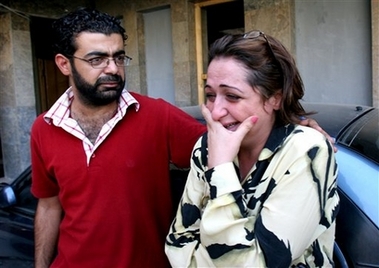
A Sunni-Arab Shaabiya satellite
television station employee comforts his colleague in front of the
station's building in Baghdad, Thursday Oct. 12, 2006. An unknown number
of gunmen pulled up at the station in seven cars, stormed quickly into the
offices and opened fire killing eleven station's employees.
[AP] |
The station, Shaabiya, was new and had not started full broadcasting. So far
it had aired only test programming of nationalist songs, including ones against
the U.S. military presence in Iraq. That may have led Shiite militiamen to
suspect it of a pro-Sunni ideology.
The brazen, morning attack underlined the danger for the media in a country
where causing offense to one side or another can be a death sentence - either by
Sunni insurgents or the Shiite and Sunni death squads behind sectarian violence.
In another attack on Iraqi media, the body of a Kurdish radio reporter was
identified at the Baghdad morgue. Azad Mohammed Hussein, 29, was kidnapped in
the capital Oct. 3 while on his way to Dar al-Salam radio headquarters. His body
was found Tuesday.
At least 51 journalists - mostly Iraqis have been kidnapped in Iraq,
according to Reporters Without Borders, a Paris-based journalist watchdog group.
The latest was the editor of weekly magazine Nabd al-Shabab, abducted Monday on
the way to work.
About two dozen gunmen, some in police uniform, pulled up to the Shaabiya
offices at 7 a.m. Thursday in civilian cars, stormed into the building and
killed most of those inside, said the station's executive director, Hassan
Kamil, who was not there at the time.
Staff members had been working around the clock to get the station ready to
begin broadcasting at the end of the Islamic holy month of Ramadan, in
mid-October. As a result, many people were in the office, some still sleeping at
the time of the attack.
The gunmen fired some 100 shots, Kamil said. But survivors reported not
hearing any shots and no windows were damaged, suggesting the attackers may have
used silenced pistols and killed their victims at close range, he said.
After the attack, blood stained the polished floors of the station building,
which housed Shaabiya's studio and offices, and pistol bullet casings lay
scattered around.
Among the dead were the station's chairman of the board, Abdul-Raheem
Nasrallah, along with station technicians and two guards, Kamil said. Several
employees managed to run away, and there were two wounded survivors - the
program director and chief producer, who were in critical condition.
Kamil said he could not speculate on who was behind the attack and said the
station had received no threats. He insisted the station had no sectarian bent
and pointed out that the staff was a mixture of Shiites, Sunnis and Kurds.
Nasrallah, the slain chairman, was a Shiite - a former military officer who was
jailed during Saddam Hussein's rule, fled to Norway after his release and then
returned after Saddam's fall.
"We have good relations with all political and religious parties and groups,
with the Sunnis and the Shiites, and we are keen to maintain such a balance,"
Kamil said in a telephone interview.
But there were signs Shiite militiamen were behind the assault. Many
kidnap-slaying of Sunnis have been carried out by gunmen in police uniforms and
Sunnis accuse the mainly Shiite police force of helping the death squads.
The test programming the station has done so far has included nationalist
songs, some of them denouncing "the American occupation" - a cause of the Sunni
insurgents, though also of some Shiite militia groups.
There were also rumors that the station was being financed by Libya.
Reporters Without Borders said the militiamen may have been seeking to avenge
the kidnapping of a revered Lebanese Shiite cleric, Imam Musa al-Sadr, 28 years
ago, an attack often blamed on Libya. Al-Sadr is a distant uncle of Muqtada
al-Sadr, head of the Mahdi Army, Iraq's most feared militia.
Kamil denied his station receives Libyan funding, saying it is still
struggling to get the money to start up. But even a false rumor could be a
motive for an attack.
Interior Ministry spokesman Brig. Abdel-Karim Khalaf blamed the slayings on
"a gang of criminals" and said investigations were under way.
At least 81 journalists, 60 of them Iraqi, have been killed in Iraq since the
March 2003 U.S. invasion of Iraq, according to an Associated Press tally based
on figures provided by the Committee to Protect Journalists, a New York-based
media rights group. That surpasses the 66 killed in Vietnam, and the 68 killed
during World War II.
In addition, 28 employees of media outlets have been killed, including
drivers, interpreters and guards - almost all of them Iraqis. The numbers do not
include the Shaabiya attack, since it was not immediately known how many of the
dead were journalists or support staff.
"Iraq is the most dangerous assignment in the world right now for
journalists," said Joel Campagna, head of CPJ's Mideast desk. "There really
aren't any battle lines. The danger begins right outside your door."
Not only are there no front lines in Iraq, but Western journalists are
targeted by insurgents who consider them as little different from combatants.
Baghdad's Palestine hotel, where many media organizations, including the AP were
based for extended periods of time, was attacked repeatedly; the attacks
included a triple suicide vehicle assault last October that was claimed by
al-Qaida in Iraq.
In one of the most graphic examples, an Iraqi television journalist, Atwar
Bahjat, and two of her colleagues were abducted and slain while reporting on an
explosion last February at a mosque in Samarra.
"The toll of journalists killed mounts from day to day," Reporters Without
Borders said. "We are also alarmed by the number of kidnappings of journalists.
Each week we learn of another journalist who has been abducted and then
executed. ... Local journalists are the chief victims."
The deaths come amid a wave of violence in Iraq by both insurgents and
militias. At least 34 Iraqis were killed in violence around the country
Thursday, including the attack on Shaabiya.
The U.S. command announced that one American soldier was killed and two
others injured in action in northern Iraq on Wednesday. The soldier's death
brings the total number of American troops who have died in October in Iraq to
41.
