WASHINGTON - For planning purposes, the Army is
gearing up to keep current troop levels in Iraq for another four years, a new
indication that conditions there are too unstable to foresee an end to the war.
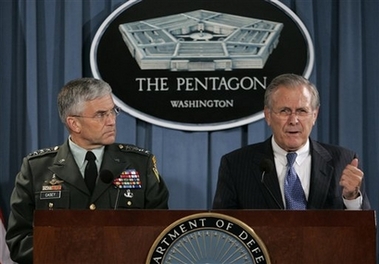
Defense Secretary Donald H. Rumsfeld, right, accompanied by
Gen. George Casey , the top US General in Iraq, gestures during a news
conference at the Pentagon, Wednesday, Oct. 11, 2006.
[AP] |
Gen. Peter Schoomaker, the Army chief of staff, cautioned against reading too
much into the planning, which is done far in advance to prepare the right mix of
combat units for expected deployments. He noted that it is easier to scale back
later if conditions allow, than to ramp up if they don't.
"This is not a prediction that things are going poorly or better," Schoomaker
told reporters. "It's just that I have to have enough ammo in the magazine that
I can continue to shoot as long as they want us to shoot."
Even so, his comments were the latest acknowledgment by Pentagon officials
that a significant withdrawal of troops from Iraq is not likely in the immediate
future. There are now 141,000 US troops there.
At a Pentagon news conference, the top US commander in Iraq, Gen. George
Casey, said that as recently as July he had expected to be able to recommend a
substantial reduction in US forces by now. But that plan was dropped as
sectarian violence in Baghdad escalated.
While arguing that progress is still being made toward unifying Iraq's
fractured political rivalries and stabilizing the country, Casey also said the
violence amounts to "a difficult situation that's likely to remain that way for
some time."
He made no predictions of future US troop reductions.
Appearing with Casey, Defense Secretary Donald H. Rumsfeld said he and other
senior Pentagon officials are still studying how the military might keep up the
current pace of Iraq deployments without overtaxing the Army and Marine Corps,
which have borne the brunt of the conflict. Rumsfeld said one option is to make
more use of the Air Force and Navy for work that normally is done by soldiers
and Marines.
Sen. Jack Reed (news, bio, voting record), D-R.I., a member of the Senate
Armed Services Committee, said Wednesday that the advance planning Schoomaker
described was an appropriate cautionary approach. However, he added, the
Pentagon should increase the overall size of the military to reduce stress on
troops repeatedly sent into combat.
"I applaud the new realism but I think they also have to recognize that this
(war) is going to put a huge stress on our forces," said Reed, a former Army
Ranger. Reed and other Democrats have called on President Bush to start bringing
home troops within a year to force the Iraqi government to take more
responsibility for security.
At his news conference, Rumsfeld was asked whether he bears responsibility
for what has gone wrong in Iraq or if the military commanders there are to
blame.
"Of course I bear responsibility," he replied in apparent exasperation. "My
Lord, I'm secretary of defense. Write it down."
In recent months the Army has shown signs of strain, as Pentagon officials
have had to extend the Iraq deployments of two brigades to bolster security in
Baghdad and allow units heading into the country to have at least one year at
home before redeploying.
The Army is finding that the amount of time soldiers enjoy between Iraq tours
has been shrinking this year. In the case of a brigade of the 3rd Infantry
Division, its deployment to Iraq was delayed by about six weeks because it
otherwise would have had only 11 months to prepare instead of the minimum 12
months. As a result, the unit it was going to replace has been forced to stay
beyond its normal 12-month deployment.
In separate remarks to reporters, Gen. Richard Cody, the Army vice chief of
staff, said soldiers need more than 12 months between deployments to Iraq so
they can do a full range of combat training and complete the kinds of
educational programs that enable the Army to grow a fully mature officer corps.
That kind of noncombat experience is necessary "so that we don't erode and
become an Army that only can fight a counterinsurgency," Cody said. He added
that North Korea's announced nuclear test "reminds us all that we may not just
be in a counterinsurgency fight and we have to have full-spectrum capability."
