WASHINGTON - President Bush's stalled anti-terrorism agenda edged forward
Tuesday, with a rebellious House member rewriting her bill on wiretaps more to
his liking and maverick Senate Republicans reopening talks over how to handle
detainees.
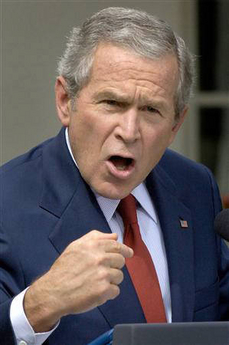
President George W.
Bush gestures during a news conference at White House in Washington,
September 15, 2006. Bush pledged on Friday to try to work with rebellious
members of the U.S. Congress over the treatment of foreign terrorism
suspects but warned 'time is running out' to pass legislation.
[Reuters] |
Rep. Heather Wilson, R-N.M., offered to substitute her original bill on
giving legal status to Bush's domestic surveillance program with a bill that
would grant a key administration request: allow wiretapping on Americans in the
event of an "imminent" terrorist attack.
In exchange, the administration would be required to share with Congress more
details of the nature of the threat, presumably with the House and Senate
Intelligence committees and some congressional leaders.
"Excesses are best prevented when intelligence activities are operated within
a framework that controls government power by using checks and balances among
the three branches of government," Wilson said in a statement.
The substitute, to be considered Wednesday by the House Intelligence
Committee, represents a possible breakthrough in a bitter, election-season rift
between the White House and GOP leaders on one side and Republican lawmakers
concerned about Bush's use of executive authority in his war on terror.
While the wiretapping question moved ahead, the second prong of Bush's
legislative war agenda - treatment of detainees also showed signs of progress.
The White House and a group of Senate Republicans continued Tuesday to swap
proposals on legislation authorizing the interrogation and prosecution of
terrorism suspects.
The two sides remained at odds over how to adhere to the 1949 Geneva
Conventions and at the same time allow the CIA to conduct effective
interrogations.
Sen. John Warner, R-Va., said "progress was being made in good faith," while
Majority Leader Bill Frist said he hoped to vote on a final measure by the end
of next week.
The Senate Armed Services Committee last week approved detainee legislation
written by Warner, the panel's chairman, and Sens. John McCain, R-Ariz., and
Lindsey Graham, R-S.C., but opposed by Bush. The White House has said the
committee's bill would put an end to the CIA interrogation program.
Bush's measure would let coerced testimony be presented at terrorism trials
but would deny defendants access to classified evidence in them. Bush also
favors a narrower interpretation of the Geneva Conventions that would make it
harder to prosecute U.S. interrogators for using harsh techniques.
White House spokeswoman Dana Perino confirmed Monday that the administration
was sending new language to the senators in hopes of reaching an agreement. The
revision was expected to address specifically the nation's obligations under the
Geneva Conventions, a major sticking point with the three Republicans.
The development came as a key part of Bush's argument on detainees lost some
of its edge. In letters obtained Tuesday by The Associated Press, two of the
service's senior lawyers backed away from a previous assertion that they did not
object to the president's plan.
"I believe that approach is not objectionable from a strictly legal
perspective" and would not "abrogate" U.S. treaty obligations, Maj. Gen. Jack
Rives, the Air Force judge advocate general, said in a letter to Graham.
However, Rives added that while the section would not reduce the nation's
commitment to Common Article 3 of the Geneva Conventions, "some could perceive
it as such."
Maj. Gen. Scott Black, the Army judge advocate general, agreed.
"I believe that further redefinition of Common Article 3 is unnecessary and
could be seen as a weakening of our treaty obligations, rather than a
reinforcement of the standards," Black wrote in a Sept. 15 letter obtained by
the AP.
"This could cause reciprocal action by other signatories, which is
particularly problematic while we are at war," Black added.
Support among House moderates for the White House proposal on detainees also
was faltering. GOP moderates Christopher Shays, R-Conn., and Mike Castle,
R-Del., said in a letter to House GOP leaders Tuesday that they support Warner's
bill.
Amid the whirl of developments, the prospects for congressional passage of
the wiretapping and detainee policies were unclear in the waning week-and-a-half
before Congress recesses for the Nov. 6 election. House Majority Leader John
Boehner, R-Ohio, said he expects Wilson's bill to come to the floor next week.
But even if it passes the House, the Senate must churn through three conflicting
pieces of legislation on the same matter.
Detainee legislation faces a similar crush in the House and Senate next week.
