DIWANIYAH, Iraq - Shiite militiamen battled Iraqi forces for 12 hours Monday,
leaving at least 40 people dead and underlining the government's struggle to
rein in an anti-U.S. cleric. The U.S. announced nine soldiers killed over the
weekend in separate fighting.
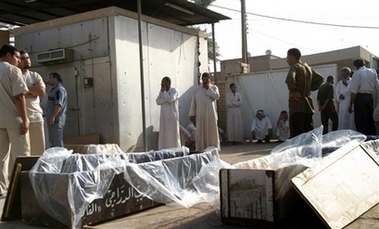
Iraqis wait for the
bodies of their relatives, killed in a drive-by shooting on the previous
day, to be handed over from hospital authorities, in Baqouba, 60
kilometers (35 miles) northeast of Baghdad, Iraq, Monday Aug. 28, 2006. A
group of gunmen traveling in three cars on Aug. 27, 2006, opened fire on
the civilians at the main popular market in Khalis the mostly Shiite town,
80 kilometers (50 miles) north of Baghdad.
[AP] |
The fighting in this southern city dominated a day that saw at least 19
people die in two suicide car bombings in Baghdad, one outside the Interior
Ministry and one on a line of cars waiting for fuel at a gas station.
Diwaniyah, 80 miles south of Baghdad, is a Shiite-dominated city where the
influence of firebrand cleric Muqtada al-Sadr's Mahdi Army has been gradually
increasing. The militia already runs a virtual parallel government in Sadr City,
a slum in eastern Baghdad.
But the government of Prime Minister Nouri al-Maliki, a Shiite, has found it
difficult to control al-Sadr, whose movement holds 30 of the 275 seats in
parliament and five Cabinet posts, and his forces. Al-Sadr's backing also helped
al-Maliki win the top job during painstaking negotiations within the Shiite
alliance that led to the ouster of Prime Minister Ibrahim al-Jaafari.
Many Sunnis have expressed disappointment that al-Maliki's government has not
moved to curb Shiite militias, especially the Mahdi Army, which have been blamed
for much of the sectarian violence that has followed the Feb. 22 bombing of a
Shiite mosque in Samarra.
A prominent hard-line Iraqi Sunni cleric, Harith al-Dhari, said Friday he was
willing to meet with top Shiite religious leaders, part of an initiative to curb
sectarian violence but also to press Shiite leaders into a response.
American forces also have been wary of confronting the militia, because of
al-Sadr's clout over the government and his large following among majority
Shiites. Al-Sadr mounted two major uprisings against the American-led coalition
in 2004 when U.S. authorities closed his newspaper and pushed an Iraqi judge
into issuing an arrest warrant against him.
The clashes in Diwaniyah began Saturday night after a rocket attack on a
Polish-run base earlier in the day, and then resumed Sunday night, said Lt. Col.
Dariusz Kacperczyk, a Polish military spokesman.
Sheikh Abdul-Razaq al-Nidawi, the manager of al-Sadr's office in Diwaniyah,
told The Associated Press that trouble had been brewing since Saturday night
when the Iraqi army arrested an al-Sadr supporter from the Jumhouri
neighborhood.
On Sunday, the army raided the same place and "a gunfight erupted between
them and the Mahdi Army," al-Nidawi said.
Army Capt. Fatik Aied said gunbattles broke out at about 11 p.m. Sunday south
of Diwaniyah, when Iraqi soldiers conducted raids in three neighborhoods to
flush out militiamen and seize weapons.
Al-Nidawi said "a big force of the army raided Jumhouri, Sadr and Askouri
neighborhoods and clashes broke out (again) between the army and the Mahdi
Army." He said the raids took place early Monday.
Fighting continued for most of the day, as the army brought in extra troops
from other cities to reinforce its soldiers, said Brig. Gen. Othman al-Farhoud,
commander of the 8th Iraqi Army Division.
By evening, the militia had set up road checkpoints and taken over seven
neighborhoods in the south and east of the city, while the Iraqi army was
controlling the northern and western parts, Aied said.
Late Monday, the U.S.-led military command issued a statement in Baghdad that
the Iraqi army and police "successfully fended off an attack by a large group of
terrorists" in three districts of Diwaniyah after a 12-hour battle.
Since the three districts in contention are in the city's south, it was not
immediately clear how to reconcile the U.S. statement with that of Aied, the
Iraqi army captain.
Dr. Mohammed Abdul-Muhsen of the city's general hospital said 40 people had
been killed - 25 Iraqi soldiers, 10 civilians and five militiamen. He said the
hospital treated 75 wounded, but could not immediately give a breakdown.
Aied said the militiamen used rocket propelled-grenades and automatic assault
rifles, and that at least 10 militiamen were arrested.
An indefinite vehicle ban was imposed in the city, said Adnan Abdu-Kadhim, a
member of the provincial council.
Coalition forces were not involved in the fighting, but provided support with
an aerial quick reaction force, using military helicopters as a show of force
and to prevent possible attacks from rooftops, Kacperczyk said. Coalition quick
reaction forces were also patrolling near the city, he said.
The U.S. military announced that nine U.S. soldiers were killed over the
weekend in and around Baghdad, eight by roadside bombs and one by gunfire.
About 100 Iraqi Shiite soldiers refused to go to Baghdad to support the
security crackdown there, marking the second time a block of Iraqi soldiers have
balked at following their unit's assignment, a U.S. general said Monday.
U.S. Brig. Gen. Dana Pittard, commander of the Iraqi Assistance Group, said
the problems stem from the Iraqi Army's regional divide, because soldiers are
recruited in their home area and expect to train and serve there.
Still, U.S. military authorities said there was less violence than before.
"We have reduced the amount of violence," U.S. military spokesman Maj. Gen.
William B. Caldwell told reporters in Baghdad. "We are actually seeing progress
out there."
"Whether it is shops opening, banks opening, neighborhood trash being
removed, women and children moving about in their neighborhoods ... Iraqi
security forces are making progress," he said.
On Monday, a suicide car bomber slammed into a police checkpoint outside the
Interior Ministry at midmorning, when traffic is usually heavy. The blast could
be heard more than a mile away, and smoke could be seen rising from the scene.
The blast killed 16 people, including 10 policemen, Police 1st Lt. Ahmed
Mohammed Ali said. He said 18 policemen were among the 47 people wounded.
Elsewhere in Baghdad, a suicide car bomber struck a line of cars waiting at a
gas station in the southern neighborhood of Dora, killing three civilians and
wounding 15, Lt. Ahmed Hameeed of the national police said.
Earlier in the day, a roadside bomb in the mainly Sunni western neighborhood
of Jihad struck a car transporting five barber shop workers. One person was
killed and another four were seriously wounded, police Lt. Maitham Abdul-Razzaq
said.
