Bali, Indonesia - A tsunami warning system is now in
place for Indian Ocean countries, but experts said Wednesday there is still room
for improvement in methods to convey the alerts to coastal communities.
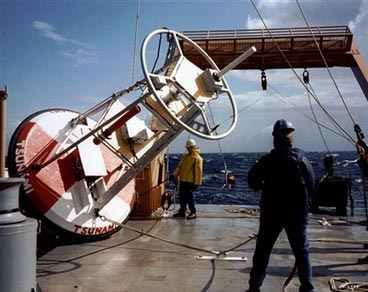
In this undated photo released by the NOAA
(National Oceanic and Atmospheric Administration), a Tsunami buoy on the
NOAA ship 'Ronald H. Brown' in the Pacific Ocean by the National Oceanic
and Atmospheric Administration. Within weeks of the devasting 2004 quake
and tsunami, governments across the Indian Ocean vowed to establish a
tsunami warning system that would protect their coastal residents from
another disaster, but 18 months later, the system remains largely in the
planning stage and remains years away from being fully implemented. [AP
Photo] |
A tsunami that killed 600 people in Indonesia two weeks ago exposed some
shortcomings in a system still being built after the Dec. 26, 2004 disaster that
killed almost 217,000 people in a dozen Indian Ocean countries, experts at a
UN-backed meeting said.
Two international agencies issued warnings that the powerful sub-sea
earthquake on July 17 could spawn destructive waves crashing into Java's
southern coasts. But Indonesian officials in the capital Jakarta did not pass
them on to local communities in time.
"The system is only as good as the response," Joseph Chung of the UN's
International Strategy for Disaster Reduction said after the three-day meeting
to assess progress on the $126 million Indian Ocean Tsunami Warning and
Mitigation System.
Patricio Bernal, executive secretary of the UN's Intergovernmental
Oceanographic Commission, described last month's disaster as "very frustrating."
Nineteen months after the 2004 carnage, 23 monitoring stations have been put
in place in the Indian Ocean to quickly measure the strength of underwater
quakes and assess the tsunami threat.
That information is sent to the Hawaii-based Pacific Tsunami Warning Center
and the Japanese Meteorological Agency, which then relay it to individual
countries at risk.
Bernal said an assessment must be conducted to determine areas
and populations that are most vulnerable. Then, he said, local officials must
draw up plans for their area, such as how to involve police or military, and whether
to install loudspeakers.
"You have to have a real down-to-earth plan on how to do it," he said.
"There's no way that the central authority can do that."
Indonesia, Pakistan and Iran are especially vulnerable to tsunamis because
they are near tectonic fault lines meaning waves can slam into coastlines within
minutes of a quake.
In those countries, especially quick reaction times must be built into
training, said Peter Koltermann, of UNESCO's tsunami unit.
In Indonesia "nobody has time to think because time is short," he said. "Here
the system is tested at full speed and no excuses."
Some experts said children in coastal communities should learn about the
threat of tsunamis in school, while signs on beaches and cards inside hotel
rooms should advise people to quickly move away from the coast if they feel an
earthquake.
Leaders in vulnerable villages should have plans in place to
quickly move vulnerable populations, such as the elderly or young children, away from the
shore, experts said.
Jan Sopaheluwakan, a geologist at the Indonesian Institute of Sciences, said
plans being discussed for the country included installing sirens on cell phone
towers and including mosques and harbor authorities in warning plans.
Officials also plan to better utilize television and
radio stations to get warning messages out faster.
