Medication mistakes injure well over 1.5 million Americans every year, a toll
too often unrecognized and unfought, says a sobering call to action.
|
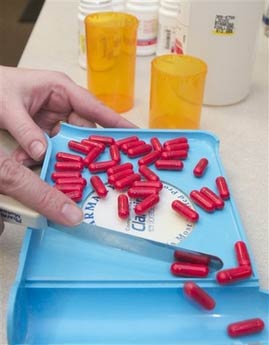
A
pharmacy worker counts pills in Omaha, Neb. on Tuesday March 16, 2004.
Medication mistakes injure well over 1.5 million Americans every year,the
Institute of Medicine said. [AP Photo] |
At least a quarter of the errors are preventable, the Institute of Medicine
said Thursday in urging major steps by the government, health providers and
patients alike.
Topping the list: All prescriptions should be written electronically by 2010,
a move one specialist called as crucial to safe care as X-ray machines.
Perhaps the report's most stunning finding was that, on average, a
hospitalized patient is subject to at least one medication error per day.
A serious drug error can add more than $8,750 to the hospital bill of a
single patient. Assuming that hospitals commit 400,000 preventable drug errors
each year, that's $3.5 billion, not counting lost productivity and other costs,
from hospitals alone, the report concluded.
"I'm a patient-safety researcher (yet) I was surprised and shocked at just
how common and how serious a problem this is," said Dr. Albert Wu of Johns
Hopkins University, who co-authored Thursday's report.
Worse, there's too little incentive for health providers to invest in
technology that could prevent some errors today, added Dr. J. Lyle Bootman, the
University of Arizona's pharmacy dean, who co-chaired the IOM probe.
"We're paid whether these errors occur or not," lamented Bootman, who
recently experienced the threat firsthand as his son-in-law dodged some drug
near-misses while in intensive care in a reputable hospital.
The new probe couldn't say how many of the injuries are serious, or how many
victims die. A 1999 estimate put deaths, conservatively, at 7,000 a year.
Even the total injury estimate is conservative, Bootman stressed. It includes
drug errors in hospitals, nursing homes and among Medicare outpatients, but it
doesn't attempt to count mix-ups in most doctors' offices or by patients
themselves.
There have been efforts to improve patient safety in the six years since the
IOM first spotlighted medical mistakes of all kinds, including recent bar-coding
of drugs to minimize mix-ups in hospitals and pharmacies.
But clearly more are needed, and the new report highlights how the nation's
fragmented health care system is conducive to drug errors, said Dr. Donald
Berwick, a Harvard professor who heads the nonprofit Institute for Healthcare
Improvement.
"This isn't a matter of doctors and nurses trying harder not to harm people,"
Berwick cautioned. "Safety isn't automatic. It has to be designed into the
system."
Medications' sheer volume and complexity illustrate the difficulty. There are
more than 10,000 prescription drugs on the market, and 300,000 over-the-counter
products. It's impossible to memorize their different usage and dosage
instructions, which may vary according to the patient's age, weight and other
risk factors, such as bad kidneys.
Plus, four of every five U.S. adults take at least one medication or dietary
supplement every day; almost a third take at least five. The more you use, the
greater your risk of bad interactions, especially if multiple doctors prescribe
different drugs without knowing what you already take.
Add doctors' notoriously bad handwriting and sound-alike drug names: Was that
order for 10 milligrams or 10 migrams? The hormone Premarin or the antibiotic
Primaxin?
Moreover, consumer instructions are woefully inadequate, the report
concludes. One study found parents gave their children the wrong dose of
over-the-counter fever medicines 47 percent of the time.
Then there was the newly diagnosed asthmatic wondering why his inhaler didn't
work. Asked how he used it, the middle-age man squirted two puffs into the air
and tried to breathe the mist. His original doctor had demonstrated the inhaler
without telling him to spray it inside his mouth.
Among the report's recommendations:
-- The government should speed electronic prescribing, including fostering
technology improvements so that the myriad computer programs used by doctors,
hospitals and drugstores are compatible.
Fewer than about 20 percent of prescriptions are electronic, said report
co-author Michael Cohen, president of the Institute for Safe Medication
Practices. E-prescribing does more than counter bad handwriting. The computer
programs can be linked to databases that flash an alert if the prescribed dose
seems high or if the patient's records show use of another drug that can
dangerously interact.
-- Patients and their families must be aggressive in questioning doctors,
nurses and pharmacists about medications. Get a list of each drug you're
prescribed, why and the dose from each doctor and pharmacy you use, and show it
at every doctor visit.
"Take active steps to make sure you know what you're getting, and is it what
you need," said report co-author Dr. Wilson Pace of the University of Colorado.
-- The nation should invest about $100 million annually on research into drug
errors and how to prevent them. Among the most-needed studies is the impact of
free drug samples, which often lack proper labeling, on medication safety.
-- The Food and Drug Administration should improve the quality of drug
information leaflets that accompany prescription drugs, but often have
incomplete information or are written in consumer-confusing jargon.
-- The government should establish national telephone hotlines to help
patients unable to understand printed drug information because of illiteracy,
language barriers or other problems.
The Institute of Medicine is an independent organization chartered by
Congress to advise the government on health matters.
