BOMBAY, India - Eight bombs exploded in first-class compartments of packed
Bombay commuter trains Tuesday, killing 190 people and wounding hundreds in a
well-coordinated terror attack on the heart of a city that embodies India's
global ambitions.
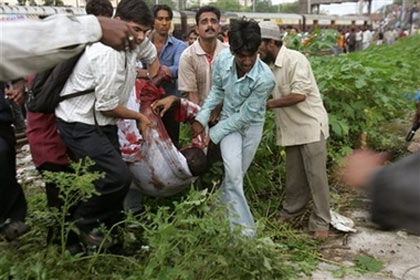
Rescue
workers carry an injured passenger after a bomb blast at the Mahim railway
station, in Bombay, India, Tuesday, July 11, 2006. Eight explosions ripped
through packed commuter trains during rush hour Tuesday in India's
commercial capital, killing nearly 150 people and injuring another 439 in
what officials said was a well-coordinated bomb attack by terrorists. [AP
Photo] |
Suspicion quickly fell on
Kashmiri militants who have repeatedly carried out nearly simultaneous
explosions in attacks on Indian cities, including bombings last year at three
markets in New Delhi.
Pakistan quickly condemned Tuesday's bombings. Even so, India alleges that
Pakistan supports the Muslim militants, and analysts said a Kashmiri link to the
blasts could slow ¡ª or perhaps even derail ¡ª a peace process that has gained
momentum between the nuclear rivals over the past several years.
Indian Prime Minister Manmohan Singh said "terrorists" were behind the
attacks, which he called "shocking and cowardly attempts to spread a feeling of
fear and terror among our citizens."
Security was tightened in cities around the world from New Delhi to New York
after the eight blasts, which struck seven trains within minutes of each other
during the early evening rush hour. The bombings appeared timed to inflict
maximum carnage in this bustling Arabian Sea port of 16 million, more than 6
million of whom ride the crowded rail network daily.
The Press Trust of India news agency said early Wednesday that police had
increased the toll to 190 killed and 625 injured. In the hours immediately after
the attacks, officials put the toll at 147 dead and 439 injured.
Emergency crews struggled to treat survivors and recover the dead in the
wreckage during monsoon downpours, and the effort stretched into the night.
Survivors clutched bandages to their heads and faces, and some frantically tried
to use their cell phones. Luggage and debris were spattered with blood.
The mobile phone network collapsed, adding to the sense of panic across the
city. With train services down until midnight, thousands of people were stranded
without any way of reaching their families.
There was no immediate indication if suicide bombers were involved. Police
inspector Ramesh Sawant said most of the victims suffered head and chest
injuries, leading authorities to believe the bombs were placed in overhead
luggage racks.
The Press Trust of India, citing railway officials, said all the blasts hit
first-class cars - a sign the assailants were targeting the professional class
in a city that has come to embody India's 21st century ambitions.
Bombay, also known as Mumbai, is the center of India's booming financial
industry and the home of Bollywood, a city that presents itself to the world as
a cosmopolitan metropolis where bankers dine with movie stars and fashion models
party until dawn.
While that image captures one side of life in the city, Bombay is also
crowded and largely poor. And across the city, the prosperous and downtrodden
worked together to aid survivors.
As police and rescue services struggled to reach the blast scenes through
Bombay's jammed, chaotic everyday traffic, bystanders pulled the wounded from
the debris, offering them water and bundling them into every available vehicle -
from trucks to three-wheeled auto-rickshaws.
Others wrapped bodies in railway blankets and carried them away. Police
collected body parts in white plastic bags streaked with blood and rain.
Those survivors who could walked from the stations to hospitals.
There, they found scenes of chaos and carnage.
Doctors and volunteers wheeled in the wounded and dead, one after the other.
"I can't hear anything," said Shailesh Mhate, a man in his 20s, sitting on
the floor of Veena Desai Hospital surrounded by bloody cotton swabs. "People
around me didn't survive. I don't know how I did."
Another man, bloody bandages over his eyes, held out a phone to a nurse,
begging her to call his wife and tell her he was OK.
The first bombing hit a train at Bandra station at 6:20 p.m. The blasts
followed down the line of the Western Railway at or near stations at Khar,
Jogeshwari, Mahim, Mira Road, Matunga and finally Borivili, which was struck by
two blasts at 6:35 p.m., according to the Star News channel. However, other
reports gave different timelines.
Some passengers reportedly jumped from speeding trains in panic.
In Washington, the State Department said it had no information about whether
there were any American casualties.
All of India's major cities were reportedly on high alert following the
attacks, which came hours after a series of grenade attacks by Islamic militants
killed eight people in the main city of India's part of Kashmir.
Reflecting the fears of coordinated or copycat bombings throughout the world,
even New York City increased its transit security Tuesday with hundreds more
officers patrolling the subways and more random bag searches.
"We take a terror attack in any place in the world, especially one on a
public transport system, as a serious warning," New York Mayor Michael Bloomberg
said.
US President Bush expressed outrage at the attacks and said the United States
stands with India in the war on terror.
"Such acts only strengthen the resolve of the international community to
stand united against terrorism and to declare unequivocally that there is no
justification for the vicious murder of innocent people," Bush said in a written
statement.
Commuter transit systems have been tempting targets for terrorists in recent
years, with bombers killing 191 in Madrid in 2004 and 52 in London last year.
Bombay suffered blasts in 1993 that included the Bombay Stock Exchange,
killing more than 250 people.
A senior Bombay police official, P.S. Pasricha, said Tuesday's explosions
were part of a well-coordinated attack.
Police reportedly carried out raids across the country following the blasts.
One TV station said a suspect was in custody.
India and Pakistan have fought three wars since the subcontinent was
partitioned upon independence from Britain in 1947, two over Kashmir.
Dozens of militant groups have been fighting Indian rule in Kashmir,
demanding the largely Muslim region's independence or merger with Pakistan. New
Delhi has accused Pakistan of training, arming and funding the militants.
Islamabad insists it only offers the rebels diplomatic and moral support.
Pakistani President Gen. Pervez Musharraf offered condolences over the loss
of life Tuesday, his Foreign Ministry said, adding: "Terrorism is a bane of our
times and it must be condemned, rejected and countered effectively and
comprehensively."
Accusations of Pakistani involvement in a 2001 attack on India's parliament
put the nuclear-armed rivals on the brink of a fourth war. But since then,
Pakistan and India have embarked on a peace process aimed at resolving their
differences, including the claims to all of Kashmir.
In Washington, a U.S. official who spoke on condition of anonymity because
the events were still unfolding said the coordination of Tuesday's attacks and
the targeting of trains at peak travel times match the modus operandi of two
Islamic groups active in India during the last several years: Lashkar-e-Tayyaba
and Jaish-e-Mohammad. The U.S. government has designated both terrorist
organizations and considers them affiliates of al-Qaida.
