Imad Talib lived in a Shiite-dominated district for many years until threats
by Shiite militiamen forced the Sunni Arab to move across town. Ahmed Khazim
left a mostly Sunni suburb for Sadr City, where his Shiite sect forms the
majority.
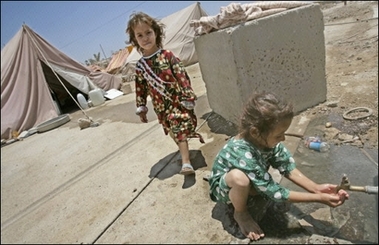
An Iraqi girl washes
her hands at a camp for displaced families in the Shiite al-Shaala
district of Baghdad. Iraq has said it has captured a Tunisian Al-Qaeda
militant allegedly behind the February bombing of a revered Shiite shrine
that unleashed a massive wave of sectarian
violence.[AFP] |
Religiously mixed neighborhoods of this sprawling city are gradually
disappearing as sectarian tensions are prompting Shiites and Sunnis to move to
areas where they are predominant.
The trend is raising concerns that Baghdad is slowly being transformed into a
divided city with a Shiite-dominated east and mostly Sunni west, separated by
the Tigris River that flows through the heart of the capital.
The independent newspaper Al-Mashriq cited the trend, warning in a recent
editorial against the "sick dreams of sick people" to redraw the map of Baghdad
"into two sectarian parts."
"Those acts (of violence) have convinced us that we are no longer welcome. We
prefer to lose our houses than to lose our families," said Khazim, who left the
heavily Sunni Abu Ghraib suburb and moved his 12-member family into a rented
apartment in Shiite-dominated Sadr City.
Talib, the Sunni, said he decided to move to a largely Sunni neighborhood in
western Baghdad after a Sunni neighbor was killed. The neighbor had ignored
warnings by the Mahdi army, the Shiite militia led by the radical cleric Muqtada
al-Sadr.
All that seems ominously like the days of the 1975-1990 Lebanese civil war,
when Christians held sway in the east of Beirut and Muslims dominated the west.
Roadblocks, high sand barriers and armed men kept the two religious communities
apart.
The situation in Baghdad, a religiously and ethnically mixed city of about 6
million people, is far from wartime Beirut. Nevertheless, many Iraqis fear a
divided future if sectarian violence cannot be contained.
Moves toward sectarian division began soon after the 2003 collapse of Saddam
Hussein's regime. The trend accelerated after the Feb. 22 bombing of a Shiite
shrine in Samarra. The bombing triggered reprisal attacks against Sunnis in
Baghdad, Basra and other religiously mixed areas.
Since the Samarra bombing, Interior Ministry official Satar Nawrouz estimates
that nearly 4,000 families or about 23,670 people have been forced to relocate
to other neighborhoods in the Baghdad area due to sectarian tensions.
In an effort to curb the sectarian flight, police Col. Ali Rashid said
authorities are adding checkpoints and patrols in the areas where armed groups
are threatening people in hopes of reassuring minorities they will be safe. He
said armed extremists from the rival camps want to establish "practically
separate neighborhoods on Sunni and Shiite basis" and establish "a clear
front-line between the two parts of Baghdad."
But many Sunnis complain that the Shiite-dominated Interior Ministry is at
the heart of the problem, alleging that it has been infiltrated by the militias.
The new government of Prime Minister Nouri al-Maliki has promised to crack
down on the militias. But the prime minister's promise has done little so far to
reassure ordinary Iraqis.
Instead, signs of a widening gap between Sunnis and Shiites are becoming
clearer.
Sunni taxi drivers who shuttled between Jordan and Syria are now telling
passengers living in Shiite neighborhoods that they will pick them up only in
Sunni areas. The route to Jordan and Syria goes through Anbar province, a
stronghold of Sunni insurgents.
Shiite taxi driver Jamal Nassir remembers roaming over all of Baghdad just a
few months ago in search of fares. Now he refuses to take passengers through
Sunni neighborhoods, fearing for his life.
No neighborhood in Baghdad is entirely safe, as the 66 deaths in a car bomb
Saturday in Sadr City attest. But many Iraqis find the prospect of death and
injury in random bombings less frightening than being hunted down and slain by
militiamen from a rival sect.
Many Iraqis who feel safe in their neighborhoods have begun to steer clear of
parts of the capital where they are in the minority.
Two months ago, Hakim al-Kinani, a Shiite, and three cousins were heading
home when their car was stopped at what they thought was a police checkpoint in
Azamiyah, a Sunni part of the capital.
As he approached the checkpoint, al-Kinani called his family on his cell
phone to say he would be delayed because of security checks. But he and his
cousins never showed up. The checkpoint was actually manned by gunmen in police
uniforms, their relatives said.
Their bodies were discovered the next day in the Baghdad morgue. Hakim's
brother, Jassim, said the family now avoids any route that takes them through
Azamiyah.
