Henry Kissinger called Japanese "treacherous sons of bitches" for wanting
normal relations with China, when he was trusted aide to president Richard
Nixon, according to declassified documents.
The outburst by national security advisor Kissinger came just before Nixon
met Japanese prime minister Kakuei Tanaka at a summit in Hawaii in August 1972,
according to transcripts of talks between the powerful negotiator and local and
foreign officials released by the National Security Archive.
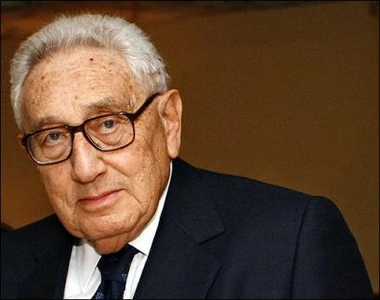
Henry Kissinger, seen here on 12 May 2006,
called Japanese "treacherous sons of bitches" for wanting normal relations
with China, when he was trusted aide to president Richard Nixon, according
to declassified documents. [AFP] |
When Kissinger learned that Tanaka was to travel to China to establish
diplomatic ties, he lividly reacted, "Of all the treacherous sons of bitches,
the Japs take the cake."
"It's not just their indecent haste in normalizing relations with China, but
they even picked National Day as their preference to go there," Kissinger said
at a meeting in his hotel room with then US envoy to South Vietnam Ellsworth
Bunker.
Kissinger was angry apparently because Japan, a key US ally, defied the
foreign policy of the United States, which at that time had diplomatic ties only
with Taiwan.
Tanaka established diplomatic relations with China on September 29, 1972, a
year after the United Nations expelled Taiwan.
It was seven years later that the United States restored formal links with
Beijing and severed official diplomatic relations with Taiwan.
Nixon however made a landmark visit to China much earlier -- in February 1972
-- to end 20 years of frosty relations between the two countries.
Kissinger's outburst against the Japanese is an example, confirmed by other
documents, of his often difficult, sometimes antagonistic, relationship with
Japan, a society that he had great difficulty understanding, said The National
Security Archive, a private, independent clearing house for declassified
documents, based at George Washington University in Washington.
The offending language used by Kissinger was "an extraordinary example in the
documents of how he gets acerbic sometimes and makes comments behind people's
backs," William Burr, a senior analyst at the archive, told AFP.
Burr edited "The Kissinger Transcripts: A Verbatim Record of US Diplomacy,
1969-1977," comprising more than 2,100 memoranda of conversations, many of them
near-verbatim transcripts, detailing talks between Kissinger and US and foreign
leaders and official.
Angry over the Japanese Prime Minister's prospective visit to China,
Kissinger also refused to meet a foreign ministry official from Tokyo who wanted
to discuss with him privately the trip's agenda, according to the documents.
The documents also showed that Kissinger told China in 1972 that the United
States might accept a Communist takeover of South Vietnam if it occurred after a
withdrawal of American troops.
"While we cannot bring a communist government to power, if, as a result of
historical evolution it should happen over a period of time, if we can live with
a Communist government in China, we ought to be able to accept it in Indochina,"
Kissinger told then Chinese Premier Zhou Enlai.
He told Zhou that, for credibility reasons, the United States could not meet
Hanoi's demand for the "overthrow" of South Vietnamese President Nguyen Van
Thieu.
But, once US forces had left Indochina, Kissinger declared, the White House
would accept the results of historical change, according to the documents.
All US military forces withdrew from South Vietnam in 1973, in accordance
with the Paris Peace Accords signed with North Vietnam. Saigon fell two years
later.
