VIENNA, Austria - European nations on Tuesday weighed adding a light-water
reactor to a package of incentives meant to persuade Tehran to give up uranium
enrichment ¡ª or face the threat of U.N. Security Council sanctions.
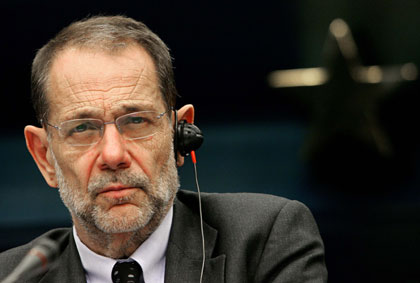
European foreign
policy chief Javier Solana addresses a news conference at the end of an
European Union foreign ministers meeting in Brussels May 15, 2006. The
European Union pledged on Monday to make Iran a generous offer of
technology, economic and other incentives but stressed Tehran must comply
first with international demands to halt sensitive nuclear activities.
[Reuters] |
Senior diplomats and European
Union officials said the plans were being discussed by France, Britain and
Germany as part of a proposal to be presented to representatives of the five
permanent U.N. Security Council members at a meeting in London. The diplomats
and EU government officials spoke on condition of anonymity because of the
confidential nature of the information.
In Washington, State Department spokesman Sean McCormack said a "package" was
being prepared for Iran's consideration that would give Tehran a choice between
intransigence and a "pathway of cooperation." He declined to say whether a
light-water reactor would be offered.
McCormack said Tehran would be required to halt its program of enriching and
reprocessing uranium on Iranian soil, saying the U.S. and others "do not want
the Iranian regime to have the ability to master those critical pathways to a
nuclear weapon."
Hojjatollah Soltani, second secretary of the Iranian Embassy in Venezuela,
said such a proposal would acceptable only if it "only if they recognize our
right to (use) nuclear technology" ¡ª including uranium enrichment.
Those in Europe who spoke to The Associated Press emphasized the possible
offer was tentative, complex and depended on demonstrated good nuclear behavior
by Iran over a protracted time.
"It's much more complicated than simply saying the EU is going to offer
light-water reactors" to Iran, said one European government official, declining
to elaborate.
A French official suggested everything depended on Iran's readiness to
discuss details in new negotiations between the Europeans and Tehran, and said
it could take years to build any such facility.
"We are not going to offer them a finished reactor," he told the AP. "For the
moment, one can only identify large general categories (of cooperation) and only
if they say that they are interested ... can we start to discuss the details,"
he said. "Otherwise, we are putting the cart before the horse."
The London meeting of Security Council representatives was originally
scheduled for Friday. But officials from several different nations told The
Associated Press on Tuesday that it might be delayed to next week to allow the
United States, Russia and China to work out their differences.
A light-water reactor is considered less likely to be misused for nuclear
proliferation than the heavy water facility Iran is building at the city of
Arak, which ¡ª once completed by early 2009 ¡ª will produce plutonium waste.
Still, light-water reactors are not proliferation-proof, because they are
fueled by enriched uranium, which can be processed to make highly enriched
"weapons-grade" material for nuclear warheads.
Iran recently managed to produce what is believed to be its first batch of
low-enriched uranium. Concerns were heightened last week by the revelation that
International Atomic Energy Agency inspectors found traces of uranium enriched
to levels higher than used for fuel ¡ª although not yet weapons-grade ¡ª at a
former research facility linked to the Iranian military.
Fears that Iran's nuclear program could be used to make weapons are at the
center of international attempts to strip Tehran of ambitions to enrich uranium
domestically. Any European offer of one or more light-water reactors would have
to be conditional on Iran setting aside its enrichment plans and accepting
foreign deliveries of low-enriched uranium for fuel ¡ª something it has
steadfastly rejected.
Washington has been at the forefront of moves to pressure Iran to give up
domestic enrichment and has in recent months swung behind a proposal from Moscow
to provide Tehran with fuel-grade uranium produced in Russia.
The United States was behind a similar offer to North Korea in the 1990s,
when it proposed building two light-water reactors if Pyongyang gave up a
plutonium-producing heavy water research reactor. The offer was ultimately
withdrawn after the United States claimed North Korea had embarked on a second,
secret weapons-development program.
John Bolton, the U.S. ambassador to the United Nations, said any tentative
offer "will be made as part of a package of carrots and sticks," adding that all
components were subject to approval by participants at the London talks.
Bolton has been a key proponent of tough Security Council action unless Iran
renounces enrichment, including a militarily enforceable resolution packing the
threat of sanctions. However, the United States last week agreed to a new
European effort to entice the Iranians back to the negotiating table in an
attempt to secure Russian and Chinese backing for tough council actions.
In the latest sign of persisting differences, Russian Foreign Minister Sergey
Lavrov said Tuesday that Beijing and Moscow will not vote for the use of force
in resolving the nuclear dispute.
In a gesture to Tehran, Lavrov also said Iranian President Mahmoud
Ahmadinejad will attend a summit next month in Shanghai of leaders from Russia,
China and four Central Asian nations.
"We cannot isolate Iran or exert pressure on it," Lavrov told reporters. "Far
from resolving this issue of proliferation, it will make it more urgent."
