Sectarian violence has forced about 100,000 families across Iraq to flee
their homes, a top Iraqi official said. At least 17 people, including an
American soldier, were killed Saturday in fighting.
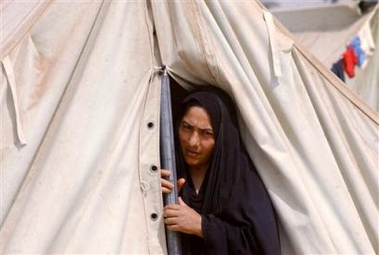
An Iraqi woman looks out of her tent at a
refugee camp Saturday April 29, 2006 in Diwaniyah, 130 kilometers (80
miles) south of Baghdad, Iraq. Sectarian violence has forced about 100,000
families across Iraq to flee their homes, a top Iraqi official said, as 14
more Iraqis were killed Saturday, including six who were tortured in
captivity. [AP] |
Adil Abdul-Mahdi, one of the
country's two vice presidents, estimated on Friday that 100,000 Iraqi families ¡ª
90 percent of them his fellow Shiites ¡ª had fled their homes to escape attacks
by rival religious sects.
Abdul-Mahdi's estimate was higher than any offered so far by Iraqi officials.
Dr. Salah Abdul-Razzaq, spokesman of a government body that runs Shiite
religious institutions, put the number of displaced Shiite families at 13,750
nationwide, or about 90,000 people.
That includes 25,000 Shiites who have fled since the bombing of a Shiite
mosque in Samarra on Feb. 22 triggered a wave of attacks on Sunni mosques and
clerics.
The hardline Sunni clerical Association of Muslim Scholars said about 980
Sunni families, or about 5,000 people, have left five mixed areas of Baghdad in
recent weeks and moved in with relatives in Sunni-dominated communities outside
the capital.
However, the U.S. military insists that even the lower estimates appear
exaggerated.
U.S. command spokesman Maj. Gen. Rick Lynch said this week that American
troops investigate all reports of displaced people and have found no evidence of
"widespread movement" away from religiously mixed areas.
Lynch said sectarian attacks in the Baghdad area had fallen by 60 percent
last week and were approaching the levels before the Feb. 22 bombing of a Shiite
shrine in Samarra, which triggered a wave of reprisal attacks against Sunnis.
Accurate counts are difficult because many people simply move in with
relatives. Despite U.S. claims, it is clear that substantial numbers of people
have relocated to areas where their communities form the majority.
About 400 Shiite families are in a camp near Khanaqin, a largely Kurdish town
near the Iranian border. Most fled Baghdad with only what they could carry.
The Human Relief Organization, an Iraqi NGO, has provided the refugees with
tents from the regional government and is talking with officials to get more
help.
"We get some every day," said Omar Mansour, an official with the relief
group. "I'm afraid the numbers will increase greatly when the school year ends
and people feel freer to flee. All these families have letters with death
threats. So they came here fearing for their lives, only to live in these harsh
conditions."
One letter was signed by "The Mujahedeen Brigades" and addressed to "The
Rejectionists" in Beiji, using a Sunni extremist term for Shiites.
"Leave our city now, because we don't want to have to kill you as Sunnis in
their regions have been killed. Go. You have been warned. The (Shiite) dogs
won't stop barking until their mouths are shut," it said.
U.S. officials are hoping a new national unity government can calm sectarian
tensions as well as lure disaffected Sunni Arabs away from the insurgency. Prime
Minister-designate Nouri al-Maliki has three more weeks to finalize his Cabinet
¡ª the final step in forming the unity government.
That is necessary before Washington can consider a substantial drawdown in
the 130,000-strong U.S. military presence.
Two former Cabinet members have emerged as contenders to head the key defense
and interior ministries, officials said Saturday.
Qassim Dawoud, an independent Shiite politician, was under consideration to
head the Interior Ministry while Hajim al-Hassani, a Sunni Arab, was being
discussed for the Defense Ministry post.
Both jobs are currently held by members of the same religious groups.
The officials, who spoke on condition of anonymity because of the sensitivity
of the negotiations, said the names of both candidates were raised with
Secretary of State Condoleezza Rice during her visit to Baghdad this week.
Rice raised no objections because both Iraqis are not affiliated with
political parties that maintained armed militias, the Iraqi officials said. U.S.
Ambassador Zalmay Khalilzad has insisted that the heads of those ministries have
no ties to militias.
U.S. officials believe the key to a stable Iraq is to abolish sectarian
militias and rid the army and police of their influence. Militiamen, including
some who have infiltrated security forces, are believed responsible for the wave
of tit-for tat killings by Shiite and Sunni militants that have raised sectarian
tensions and threaten civil war.
The Iraqi officials emphasized that no decision had been made on the two key
security posts and that other names were under discussion.
Dawoud served as minister of state for national security during the
administration of former Prime Minister Ayad Allawi. Al-Hassani, who lived for
several years in Los Angeles, was industry minister under Allawi and speaker of
the previous parliament.
Neither Dawoud nor al-Hassani has been tainted by accusations of corruption,
but each carries considerable political baggage within his own religious
community.
Followers of Muqtada al-Sadr have not forgiven Dawoud for his role in
Allawi's government during fighting between U.S. troops and the radical Shiite
cleric's Mahdi militia in 2004. Dawoud became the first Shiite figure to call
publicly for replacing Ibrahim al-Jaafari as nominee for prime minister, which
angered some Shiite politicians.
Al-Hassani broke with his own Iraqi Islamic Party in 2004 when he refused to
resign from Allawi's government to protest the American assault on the Sunni
insurgent stronghold of Fallujah.
The 17 people killed Saturday included six men found dead in the Dora section
of southwest Baghdad, police said. All were handcuffed, blindfolded and appeared
to have been tortured, police Capt. Jamil Hussein said.
The soldier's death in a bombing southwest of Baghdad brought the U.S. death
toll for April to at least 70 ¡ª the highest monthly figure since November, when
84 Americans died.