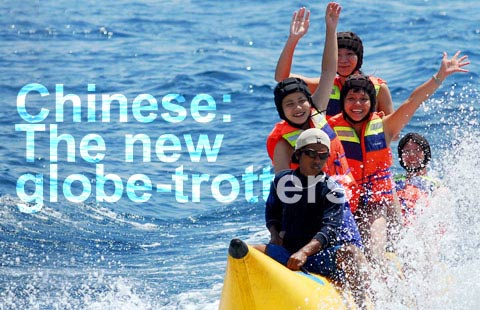
Last year, the growth in exports was slower partly because of the global economic downturn, he adds.
In 2001, China joined the World Trade Organization after long negotiations. The following year Yiwu's International Trade Mart opened its first district, where overseas traders could buy almost any kind of household item. Later, four more districts were added to the trade mart.

Yiwu had served as a hub for domestic traders in the 1990s and fed the economy of the Yangtze River Delta region in the 1980s. Its business grew exponentially from 1986 to 1991 because of an acute shortage of goods in other parts of China.
There are several theories on how much time it would take a person to complete the rounds of Yiwu's markets. Among them: One and a half years by way of spending three minutes in each of the 80,000 shops, excluding lengthy conversations between buyers and sellers.
There are about 120,000 vendors of artificial flowers, bathroom fittings, auto parts, cosmetics, fashion accessories, home appliances, kitchenware, neckties, sports equipment, stationery, toys, underwear, wall paint, watches and much more.
For the logistics arm of the Chinese company Decheng Group, the main buyers of such items are Yemen, Saudi Arabia, Jordan, Iraq, Egypt, Sudan and Syria, says the chairman, Yu Yangzhou, 32. For Syria, where a US-led coalition is fighting Islamic State militants, it is mostly basics - clothes, shoes, soap and toothbrushes.
The local government-run Zhejiang China Commodities City Group manages the wholesale enclaves that stay open from 8am-5pm daily.
The earliest foreign merchants in Yiwu arrived from Yemen and Pakistan 15 years ago, but the beginning was rough. They wanted to buy cheap products but were frustrated when the local sellers "showed them one thing and sold another", says Pradip Shetty, managing director, Yiwu P S Fashion Trading Co Ltd.
In contrast, Guangzhou in Guangdong province was a more professional marketplace at the time. Yet Yemeni traders, who sold the Chinese commodities in Saudi Arabia, continued to buy from Yiwu because, apart from low prices, people were friendly, Shetty says.
"The quality of products also improved (over time) and word started to spread about their business."
Eventually, Indian traders found their way to Yiwu, too.
Although Shetty, 54, largely exports Chinese-made goods to the Middle East and North America, the Indian businessman also sells incense sticks and sandalwood soaps from his country in Yiwu. The resulting scent trail makes it simple to search for his store among hundreds of others in one of the city's districts.
"Yiwu is China's modern-day marvel," he tells overseas friends who ask if he has seen the Great Wall.
Arabs, of whom there are more than 5,000, make up the largest single regional group of Yiwu's expatriate population, and South Koreans form the largest national group. Korean traders have been a constant feature since China and South Korea established diplomatic ties in 1993.
But it was in 1998, four years before Japan and South Korea were to co-host the football World Cup, that the game began to really change, with merchandise for the event being produced in the factories of Zhejiang. This brought Korean traders in large numbers to Yiwu to pick up the products for sale at home.
Today, the 6,000 Koreans here are mostly engaged in selling groceries, fashion accessories and garments, and working as agents between local sellers and Korean or foreign buyers. The United States is a leading customer, says Han Ki-jung, 50, chairman of the Korean Chamber of Commerce in China, Yiwu.
He spent several years doing business in Guangzhou and nearby Shenzhen city before moving to Yiwu recently. Although he is not from a traditional business family, as is the case with many of his peers, the man from Seoul appears to have adapted to the complexities of Yiwu's small-commodity trade.
"It's sometimes difficult to understand what works and what doesn't, but with time Chinese people become more open about their feelings," says Han, sitting in his office and speaking in Korean through a translator.
China is South Korea's largest export market, and bilateral trade is expected to touch $300 billion this year, which explains the presence of Korea City, a retail section in the Haungyuan wholesale clothes market of Yiwu, and the bustling Korean neighborhoods of Dongzhou Huayuan and Qiancheng.
Korean-Chinese, a minority ethnic group in the country, manage most Korean restaurants in Yiwu.
Coming across Western enterprises on streets replete with Arabic and Korean eateries is rare here. But that is gradually changing, says Nigel Cropp, 46. His Italian-themed restaurant and bar Divino, on the site of a former mobile phone store in downtown Yiwu, opened in 2012.
With no experience in the dining industry, the British trader who otherwise exports hot-bath tubs to countries such as Australia, the United Kingdom and Germany, plunged into this project, and things have gone well.
"This is a great location," he says, pointing to the area lined with hotels.
Cropp, who now has a Chinese wife, came to Yiwu a decade ago when very few Westerners were visible in the city.
But as Yiwu develops, he expects the nature of business to alter. The signs are already there, with material and labor costs rising this year.
The city government is now looking to turn Yiwu more into a global buyer of goods for consumption within China and elsewhere. To that end, the country's 350 million affluent middle class is a key target. Chinese from that income bracket spend between $2 trillion and $3 trillion every year on purchases abroad, research shows.
"We hope not only to sell Chinese items to the world, but also buy from outside and sell them from Yiwu," says Wang, head of the city's Bureau of Commerce.
In March, President Xi Jinping told a meeting of the nonprofit Boao Forum for Asia in Hainan province that the country would import goods worth more than $10 trillion in the coming years.
Beijing's initiative to revive the ancient Silk Road network of overland and marine routes also makes it important for Yiwu to seek that transition. Besides, more imports are expected to stimulate the currently slow domestic economy. But Wang clearly has his work cut out, as trade figures indicate.
Last year, while exports from Yiwu totaled $23.7 billion, imports made $480 million. And from January to July this year, imports were worth $150 million, while exports made $15.4 billion.
"So, you can see the imbalance," Wang says. "But from this year, a greater effort is being made to develop the new phase of business in Yiwu."
The bureau is studying how imports can be encouraged in raw materials and advanced machinery, he says, citing an example.
Calling his city a "test bed" for foreign trade in China, Wang says much has been achieved in exports. Yiwu's economy, growing at an average of 10 percent a year, is performing better than many other Chinese cities, thanks mostly to its exports.
In the first half of this year, exports grew 45 percent year on year, Wang says.
A few kilometers from the Bureau of Commerce is District 5, where, amid Yiwu's exports' empire, stands the International Commodities Market. Dedicated to imports, the market outlets are stacked with wines from France, Spain and Italy, food and beverages from the US and Europe, ceramics from Japan and handicrafts from Africa.
"Chinese love red wine," declares Wang Guihong, a stylishly dressed employee with one of the importers.
Although exports are the mainstay of her Hangzhou-based company, she says, customers from all over China buy wine in bulk at this shop. This seems to echo the bureau's findings that Chinese splurge on imported food, beverages and consumer electronics.
Business appears brisk at a nearby shop selling Japanese tableware made of clay, and down the hallway, Omar, a trader from Senegal, who sells masks and wooden items from his country, says he has regular customers from Shanghai and other big Chinese cities. A resident of Yiwu for five years, the man gives his lone name.
His young son is a star attraction among Chinese women working in the Africa wing of the International Commodities Market that opened in 2010. They volunteer to look after him when his father is busy.
Yan Yiqi and Sun Yuanqing contributed to this story.
Contact the writer at satarupa@chinadaily.com.cn
Special: Weekend Life (Sept 5)
|
|
|
|
|
|
|
|

Copyright 1995 - . All rights reserved. The content (including but not limited to text, photo, multimedia information, etc) published in this site belongs to China Daily Information Co (CDIC). Without written authorization from CDIC, such content shall not be republished or used in any form. Note: Browsers with 1024*768 or higher resolution are suggested for this site.
License for publishing multimedia online 0108263 Registration Number: 20100000002731 
















 Raymond Zhou:
 Pauline D Loh:
 Hot Pot
 Eco China
 China Dream
 China Face