 |
|
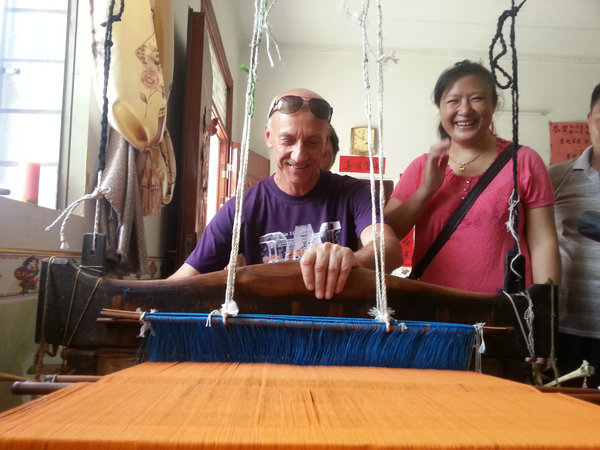
Victor Kuzmichev tries a traditional loom at a village home in Dawu county, Hubei province. [Photo provided to China Daily] |
A Russian teaches fashion in China
Clothing trends fascinate designer as tradition meets evolution
One of the things Victor Kuzmichev loves to do in his free time is to stroll along Hanzheng Street in Wuhan, Hubei province, the largest market in Central China.
The 60-year-old professor of Wuhan Textile University is keen to observe people in the market, and occasionally take their photos, which could later appear in some Russian textile and fashion journals.
"In the street, it's amazing to see how fast fashion spreads. For example, you'd see some design at the Paris Fashion Week, and one month later, you can see exactly the same design in the street, "he says, adding that "sometimes, you cannot tell which season the design belongs to, this year or last year."
Kuzmichev said weather is a factor that affects the spreading of fashion. In South China, it is warm almost throughout the year, so there is no need to wait for the fashion season to change. But in Russia and Europe, people have to wait.
For a scientist in the field of clothing, observing fashion in the streets can be a fun activity.
"I took photos of street styles. Some people look really good and their styles are unusual, so I would shoot them and publish the photos in journals. There are a lot of young people in Wuhan and they are very fashionable," he says.
Another of Kuzmichev's favorite hunting ground is the campus of Wuhan Textile University (WTU), where he has been teaching for the last 13 years.
Back in October 2002, when he took a bus from central Wuhan, arriving at the campus in Nanhu area, there were fields only.
"Sometimes, I would take a walk and there would be nobody around. Now it's hard to imagine the surroundings at that time. It has changed so much," the professor says.
In tandem with the transformation that has taken place in the Nanhu area in the past 13 years, the school of fashion in WTU has also taken big steps forward, with the help of this member of the Russian Academy of Sciences.
As the head of Garment Design Department at Ivanovsky State Polytechnic University in Russia, Kuzmichev helped to establish postgraduate education for the school of fashion in WTU with his experience there. The number of postgraduate students has risen from seven in 2004 to more than 100 today.
Cheng Zhe, 26, is going to graduate with a master's degree under the supervision of Kuzmichev. He says that after lectures, the professor will get students to his office one at a time to discuss academic questions, not only during the day, but also in the evening. Kuzmichev's students describe him as very strict, but a learned teacher and scientist. He starts work at 6 in the morning. He has supervised six PhD candidates so far.
"When we hang an exhibition board on the wall, we usually just judge whether it's slanted with our eyes, but he always uses a ruler, " Cheng says.
Kuzmichev is credited with starting new directions of clothing science and engineering at the university.
The history of pattern block making is very short in China. Pattern making is the key to clothes making, because it decides whether the clothes will fit or not. Generally, Chinese designers employ Japanese designers' method in pattern making because the two peoples are similar in body type.
"It's a very simple method. If China produces clothes only for domestic consumers, it will be enough, but it's not the case. If your pattern making is bad and the clothes don't fit, nobody will buy them," Kuzmichev says.
"So one of my jobs here at the beginning was to improve basic pattern making, to create new methods for pattern block making, taking inspiration from images of the human body," he says.
Besides the improvement of pattern block making, Kuzmichev and his students have also been looking for methods to make comfortable clothes with a human-body scanner.
"With my master students, we create a new classification of Chinese women's body types," he said.
"For example, full body bust. In pattern making, there is the size 84 according to the existing classification, but some women have a bigger chest and some have a bigger back, which have a strong influence on the comfort level and fitness of the clothes. So we try to improve the classification of Chinese body types," he points out.
Kuzmichev and his team use a body scanner to describe more exactly body shapes and pattern blocks.
The body scanner can create the image of a body and make clothes directly according to it, he says.
"I think this direction is very important because it's a high-level one that involves knowledge of the human body, pattern making and fashion design. It's a very wide direction, allowing me to recruit students from different educational backgrounds, such as fashion design, pattern making and computer science and engineering," he says.
Zhang Ni, 30, one of Kuzmichev's doctoral candidates, is now teaching at WTU. She is a member of his team.
"When we put on clothes, the body will have a kind of outline, which is different from the outline of the body itself. There is an inner space between the body and the clothes we wear, and the body and clothes will influence each other. We try to research this inner space and the mutual influence, which is a very different way from traditional ones," she says.
The university just acquired a new body scanner from Germany and installed it in Kuzmichev's office on the fifth ground of the building. On the fourth floor, the professor has another studio to direct students to combine traditional Chinese craftsmanship with modern fashion design.
On the ground floor of the building, there is a series of museums displaying not only the latest scientific achievements at WTU, but also the intangible culture heritage-traditional craftsmanship in Hubei province, including Han Embroidery and Hongan Large Cloth, and also the combination of this traditional craftsmanship with modern design.
"It's vital to save Chinese traditional culture. A nation has no future if it loses its tradition," as Kuzmichev puts it.
When Kuzmichev first arrived at the university, he was surprised to find that at a textile university, there was no museum to present Chinese traditional craftsmanship related to textiles.
At his suggestion, Ye Hongguang, another PhD student of his, established these museums step by step, and now he is the leader of the mission in Hubei province, to save the traditional textile culture.
Kuzmichev also noticed how fast China is being urbanized.
|
|
|
|
|
|
|
|

Copyright 1995 - . All rights reserved. The content (including but not limited to text, photo, multimedia information, etc) published in this site belongs to China Daily Information Co (CDIC). Without written authorization from CDIC, such content shall not be republished or used in any form. Note: Browsers with 1024*768 or higher resolution are suggested for this site.
License for publishing multimedia online 0108263 Registration Number: 20100000002731 





















 Raymond Zhou:
 Pauline D Loh:
 Hot Pot
 Eco China
 China Dream
 China Face