Tea time loses its popularity
|
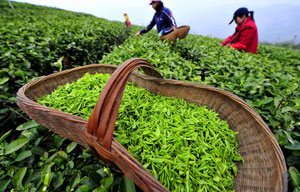
A woman picks tea leaves on March 20 at Buyang village, Sanjiang Dong autonomous county in Guangxi Zhuang autonomous region. Sanjiang area boasts more than 9,500 hectares of tea plantations and more than 200,000 tea farmers. Yang Ming / for China Daily |

|
A busy tea market trading mingqian tea in Songyang county, southwestern Zhejiang province. Liang Zhen / for China Daily |

|
A customer tastes mingqian tea in a Shanghai tea shop. Ding Ting / Xinhua |

|
A tea roasting technician judges the fragrance of tea leaves. Ou Dongqu / Xinhua |

|
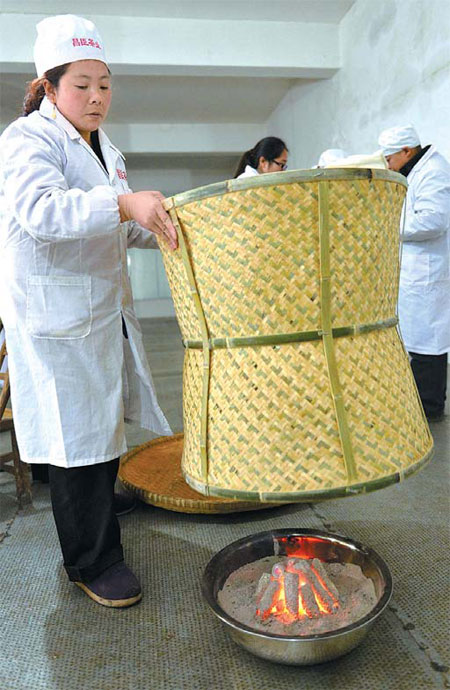
Tea roasting technicians use their traditional way to roast Wujiatai Gongcha, in Wujiatai village, Xuan'en county, Hubei province. The tea was once a famous tribute to the imperial court during the Qing Dynasty. The art of roasting the tea has been listed as a provincial-level intangible culture heritage in Hubei. Song Wen / Xinhua |
Farmers feel the pinch of official squeeze on spending. Wu Yiyao reports in Shanghai.
The early bird catches the worm, and that used to be the case for the producers of Longjing tea, as the early tea harvested before Qingming (Pure Brightness) Festival used to reap them high rewards. However, this year the bottom has fallen out of the market and prices have plummeted.
"This year the price of the premium Longjing tea picked before Pure Brightness Day is 50 percent less than it was last year. Last year it was 8,000 yuan ($1,300) per kilogram, this year it's 4,000 yuan," said Mei Chongliang, a tea producer in Meijiawu, one of the four famous tea-growing areas around Hangzhou, Zhejiang province.
The Longjing tea produced before Qingming Festival, which is known as mingqian tea, is regarded as the finest of teas, and Mei and his family have profited from the high prices the prized tea has fetched in previous years.
Mei is a certified tea roaster, and his family is involved in the entire tea production process, from cultivation of the plants to the roasting of the leaves. They have a three-story house, which is divided into living accommodation, a tea production room and a teahouse.
But not only will they get less for their tea this year, Mei said the costs have risen in every stage of the production process.
"The cost of cultivating and maintaining the trees is rising - about 10 percent in the last production cycle. We are paying the tea pickers 100 yuan a day this year, up from 80 yuan last year, and other costs such as the power for the roasting are also up," he said.
Like many of his neighbors, Mei blames the sharp drop in price on the shrinking orders from wholesale dealers.
The usual throng of tea dealers and visitors, which has crowded the narrow street through the village in previous years, has not been in evidence this year.
"Last year there were so many people between 7 am and 8 pm that my staff couldn't handle them and I had to hire six extra workers," said Weng Qianmei, a teahouse owner in the village.
The nationwide campaigns against extravagance and corruption are the reasons there are less buyers this year. Traditionally a portion of the production was reserved for government officials, and as a highly prized commodity the tea was also used as a gift or bribe.
"The price of our tea is high - but if you consider the costs, you'll see that it is reasonable," said Zhu Yundao, a 62-year-old tea farmer.
Zhu said if a kilogram of tea is sold to wholesalers for 8,000 yuan and then sold on to retailers for around 10,000 yuan per kilogram, these are reasonable prices.
"People work hard and get paid. But the high prices reported in newspapers and TV programs are not the real incomes of the farmers or dealers. What's the reason for the 120,000 yuan per kilogram the tea fetches at auction?"
In olden days mingqian tea was considered to be worth its weight in gold.
"It's a limited treasure," said Weng Qianmei. "There are 365 days in a year, but only 15 of them produce mingqian tea."
The high esteem of mingqian tea can be traced back to the days when the Day of Pure Brightness, the 104th day after the Winter Solstice, was the day the emperors received tributes from across the nation. Although voluntary at first, in the Tang Dynasty (AD 618-907) officials were dispatched to supervise the collection of tea, and the tea farmers had to rush the tea from the tea growing areas around Hangzhou to the capital Chang'an, modern day Xi'an, within 10 days to make sure the tea arrived on time.
This year, due to the warmer weather, production of mingqian tea began about two weeks earlier than usual. Some tea farmers started picking the leaves as early as March 10, instead of the traditional March 25, which means that the production period for ming-qian tea may be longer than usual.
"We can't wait, otherwise the fragrance of the tea leaves will disappear. The leaves grow too fat, and all the delicacy of the jade-like leaves fades away," said Ma Qingfang, a 46-year-old tea picker.
Picking the tea is hard work, the pickers have to nip off the leaves with their nails, and on days when the weather is favorable, dry but not too hot, they may be picking the leaves from early morning to the afternoon.
"It is exhausting and it requires sharp eyes to identify the leaves which are tender and mature enough to be picked," said Li Jinfang, a 35-year-old tea picker from neighboring Anhui province, who expects to earn about 2,000 yuan picking the tea this year.
Li said some years her employer gave the pickers a small pack of tea to try, so they can taste the difference. "But I think it would be better if I got the money instead of the tea - perhaps I could make another two or three hundred yuan," said Li.
Today, local tea pickers are rare in Meijiawu. Most of the tea pickers that were from the area have now retired, and the younger generation can afford to hire pickers from poorer areas.
Longjing tea leaves are roasted soon after picking to stop the action of the natural enzymes. This is a vital process that brings out the fragrance and flavor of the tea. It requires skill and experience to bring out the best in the tea, as the art of tea roasting is the manipulation of time and temperature. The tea leaves are baked in large metal woks, which can be up to a meter in diameter, and the roasters have to be sensitive to the heat and press the fresh tea leaves against the bottom of the wok to make the water evaporate. Too much heat may damage the delicate leaves.
"A working day for a tea roasting technician may last 20 hours, from six in the morning to two in the morning next day," said Mei Chongliang. This is because the roasting can't be paused, or the fragrance of the tea is lost.
Unlike previous years when the roasted tea was packed in fine china jars resting in silver-lined wooden cases, the tea this year comes in glass jars or moisture-proof cans. If buyers want extra, the sellers will give them a paper bag.
The hostels and hotels around Meijiawu village also have stores selling mingqian tea in 25-gram tins or 50-gram cans.
However, for Tao Enqian, a tea buyer from Shanghai, the drop in prices is good news as it means the good teas will be more affordable and not just reserved for officials and the wealthy.
"This year no one is snatching the good things from my hands," said Tao, who bought 3 kilograms of the Meijiawu Longjing tea this year to give to his family.
Tea enterprises are also preparing to lower the proportion of high-end tea and enhance sales of excellent middle-market tea, said Luo Liewan, who is in charge of the tea sector with the Zhejiang provincial department of agriculture.
"It is good for consumers and market players to see more affordable tea products. After all, tea is a day-to-day consumed beverage," said Luo.
|
|
|