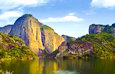
A traveler's treasure trove
 |
|
Top: Visitors clad in Miao costume enjoy the blooming forests of the Baili Azalea Belt in Bijie city. Above: Exploring rural Guizhou province offers a lot of fun. Photos by Zhu Xingxin / China Daily |
Related: Food & Drink
While poor in material wealth, Guizhou province is rich in culture, scenery and much else a visitor would desire. Craig McIntosh reports in Guizhou.

If you collected every article ever written about Guizhou province - news or travel - and used them to make a word cloud, it's a good bet that the two largest words would be "poverty" and "beauty". They certainly featured heavily in everything I read before heading out to this southwestern province. Going by people's incomes, Guizhou is certainly one of the poorest areas in China, largely because its rough, karst terrain has made it hard for industry to move in. It is also true that these same mountains, rivers and valleys causing the hardship are simply a delight to behold, while the area's temperate climate, and diverse and colorful ethnic population combine to create a priceless experience.
What I didn't read about is the mind-blowing food (in both senses of the word - glorious and spicy) and the copious amounts of baijiu (clear Chinese spirits) that I'd be expected to down at every meal.
For the vast majority of visitors, their introduction to the province is the airport or train station at Guiyang, the capital. The city has its fair share of attractions, such as the laidback Huaxi Park and the 400-year-old Jiaxue Tower. But like in other parts of Southwest China, the fun of Guizhou lies in the countryside.
Luckily, Guiyang is slap-bang in the center of the province, which makes it the perfect jumping-off point for anyone looking to explore rural China. Major highways lead north to the ethnic villages of Zunyi, west to the picturesque county of Kaili or southwest to the stunning Huangguoshu Waterfall and the Maling River beyond.
 On this occasion, as it was mid-April, I plumped for the blooming forests of Bijie, a city about 165 km away in the northwest.
Be aware that no trains run to these parts, so taking a bus or car are the only options - and even relatively short journeys can take time. If, like me, you're adverse to tedious road trips, have no fear. It's a pleasure just sitting and staring through the window.
Winding cliff roads, steep valleys and a green-blue horizon that looks like a tree-covered radio wave - you won't want to blink. I almost filled my camera's memory card within the first couple of hours.
I stayed in Qianxi, a county in Bijie that's fairly developed compared to other parts of the province. Although rather generic in looks, its redeeming quality is the nearby Baili Azalea Belt.
Stretching for about 50 km, the belt has about 40 different kinds of azalea, which together form kaleidoscopic peaks of pinks, reds, purples and yellows. It even boasts the biggest azalea shrub in the world, the "King of Azaleas", which is estimated to be 1,000 years old.
The flowers bloom in March and April, so expect the usual ren shan ren hai (a reference to crowds as "mountains and seas of people"). Despite the inevitable crowds though, there's lots of room to wander and plenty of pavilions offering hilltop views of the forest.
Bijie has been a pilot zone for tourism development since the late 1980s, when the Party secretary of Guizhou was a certain Hu Jintao, now the country's president.
It has obviously benefited from the large injection of cash, which explains why some parts have a recently built look. Yet the cash has also had another effect: It has allowed many migrant workers from these parts to return home.
Qianxi is full of family-run guesthouses ready to host the expected influx of Chinese and foreign guests. That means you're unlikely to struggle in finding cheap accommodation, and it provides a better chance of getting in touch with the local culture than staying at a hostel and hotel, especially in areas with ethnic groups.
The locals are extremely friendly and more than happy to share a historical tale or two to anyone willing to listen, although even Mandarin speakers will find the local dialect hard to follow.
Like Yangshuo, a backpacker retreat in the neighboring Guangxi Zhuang autonomous region also famed for its grassroots hospitality, the Qianxi countryside caters to all, from the hyperactive to the downright lazy.
Whether you want to walk, run or cycle through the rolling hills and colorful villages, or you want to simply enjoy a book by a field of rapeseed flowers, you can.
As well as the Baili Azalea Belt, the area has Caohai Lake, the largest natural freshwater lake. It's blessed with a plethora of plants and rare wildlife, including the red-crowned crane, the white stork and the white-tailed sea eagle. Close by is also Jiudongtian, a famous collection of valleys and limestone caves.
Heading back toward the capital, I stopped in Dafang, a town that tourism authorities have been working hard to return to its former glory.
The main street of this county town has been revamped to appear like it did 100 or so years ago, with several attractions along the way, such as the former residence of a Yi ethnic queen that has been converted into a museum.
Further out, there is also a massive replica of an ancient palace, which holds scores of exhibits covering the area's rich and diverse history. It's often used as a film location for period TV dramas.
However, what the urban center lacks in authentic charm, the outlying rural areas more than make up for in culture. Dafang is surrounded by ethnic villages - Yi, Miao and Bouyi - and each has its own rituals, snacks, wines and festivals.
During my stay, I was treated to a Yi fire party, which basically involves singing, dancing and telling stories around a large fire. Oh, and drinking cup after cup of baijiu and mijiu, another kind of rice wine.
Thinking back, it probably wasn't the best idea to have a hangover the morning I headed to Bijie's most famous landmark, Zhijin Cave.
Roughly two hours by bus from Dafang, the massive karst cave was formed about 1.2 million years ago but was only discovered in the 1980s. I'm told that, up until then, it was just somewhere the local ethnic Miao children played.
And what a playground!
Covering the length of more than 12 km (only half is open to visitors), it has more than 100 crystalline formations, each of which have been named according to its appearance. There's the "Pipa", the "Mushroom" and the "Drum", as well as the imposing "Silver Rain Tree", a stalactite that stands 17 meters high.
Sections are varied, with some wide and tall, others narrow and tight, while the lighting effects - green, red and purple - highlight the most important formations.
It's a must-see for visitors, but my advice would be to wear sensible shoes (that 6-km walk is the equivalent of walking down one hill and up another) and take a warm jacket.
Exhausted after my underground trek, I boarded a bus heading back to the capital.
All I wanted was to get some sleep, but that's the thing about Guizhou - close your eyes for a second and you could miss something amazing.
Contact the writer at craigmcintosh33@gmail.com.