The Yao ethnic group
Customs and Habits
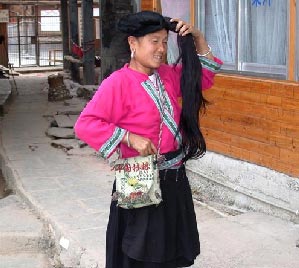
The Yaos have such unique life styles that the various communities are quite different from each other. According to the Book of the Later Han Dynasty (25-220), the ancient Yaos "liked five-colored clothes." Later historical records said that the Yaos were "barefoot and colorfully dressed."
In modern times, the Yao costumes maintain their diversity. Men wear jackets buttoned in the middle or to the left, and usually belted. Some men like trousers long enough to touch their insteps; some prefer shorts akin to knee breechs. Men's dress is mainly in blue or black. However, in places such as Nandan county in Guangxi, most men wear white knee-length knickerbockers. Men in Liannan county, Guangdong province, mostly curl their long hair into a bun, which they wrap with a piece of red cloth and top with several pheasant feathers.

Women's dress varies more. Some Yao women fancy short collarless jackets, cloth belts and skirts either long or short; some choose knee-length jackets buttoned in the middle, belts with both ends drooping and either long or short slacks; some have their collars, sleeves and trouser legs embroidered with beautiful patterns. In addition to the silver medals decorating their jackets, many Yao women wear silver bracelets, earrings, necklets and hairpins.
Rice, corn, sweet potatoes and taros make up their staple food. Common vegetables include peppers, pumpkins and soybeans. Alcoholic drinks and tobacco are quite popular. In northern Guangxi, a daily necessity is "oily tea." The tealeaves are fried in oil, then boiled into a thick, salty soup and mixed with puffed rice or soybeans. The oily tea serves as lunch on some occasions. Another favorite dish is "pickled birds." The cleaned birds are blended with salt and rice flour, then sealed into airtight pots. Beef, mutton and other meat are also pickled this way and considered a banquet delicacy.
A typical Yao house is a rectangular wood-and-bamboo structure with usually three rooms -- the sitting room in the middle, the bedrooms on both sides. A cooking stove is set in a corner of each bedroom. Some hillside houses are two-storied, the upper story being the sitting room and bedrooms, the lower story stables.
For those families who have a bathroom built next to the house, a bath in the evening is an everyday must, even in severe winters.
The Yaos have intriguing marriage customs. With antiphonal singing as a major means of courting, youngsters choose lovers by themselves and get married with the consent of the parents on both sides. However, the bridegroom's family used to have to pay a sizeable amount of silver dollars and pork as betrothal gifts to the bride's family. Some men who could not afford the gifts had to live and work in the bride's families and were often looked down upon.
In old Yao families, the mother's brothers had a decisive say in crucial family matters and enjoyed lots of other privileges. In several counties in Guangxi, for example, the daughters of the father's sisters were obliged to marry the sons of the mother's brothers. If other marriage partners were proposed the betrothal gifts had to be paid to the mother's brothers. This, perhaps, was a remnant of matrilineal society.
Festivals take place one after another in the Yao communities, at a rate of about once a month. Although festive customs alter from place to place, there are common celebrations such as the Spring Festival, the Land God Festival, the Pure Brightness Festival, "Danu" Festival and "Shuawang" Festival. The "Danu" Festival, celebrated in the Yao autonomous county of Duan in Guangxi, is said to commemorate ancient battles. The "Shuawang" Festival, held every three or five years in the tenth month by the lunar calendar, provides the young people with a golden opportunity for courtship.
The Yaos worshipped a plethora of gods, and their ancestors. Their belief in "Panhu," the dog spirit, revealed a vestige of totemism. Yao communities used to hold lavish rites every few years to chant scriptures and offer sacrifices to their ancestors and gods. In some communities, a solemn ceremony was performed when a boy entered manhood. Legend has it that at the ceremony he had to jump from a three-meter-high platform, climb a pole tied with sharp knives, walk on hot bricks and dip a bare hand into boiling oil. Only after going through these tests could he get married and take part in formal social activities.
With growing scientific and cultural knowledge, the Yaos have, on their own initiative, discarded irrational customs and habits during recent decades, while preserving healthy ones.
The Yaos cherish a magnificent oral literary tradition. As mentioned above, singing forms an indispensable part of their life. When a group of people are opening up wasteland, one or two selected persons stand aside, beating drums and singing to enliven the work. Young males and females often sing in antiphonal tones all through the night. Extremely rich in content, some of the folk songs are beautiful love songs, others recount the history of the Yao people, add to the joyous atmosphere at weddings, synchronize working movements, tell legends about the creation of heaven and the earth, ask meaningful questions with each other or tell humorous stories. In many of them, the words have been passed down from generation to generation.