The circle of life
 |
|
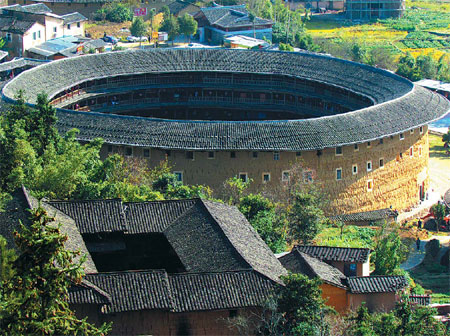
Occasionally referred to as "oriental ancient castles", tulou preserve Hakka culture in Fujian province and were added to UNESCO's World Heritage List in 2008. Photos by Bao Xinguo / for China Daily |
 |
|
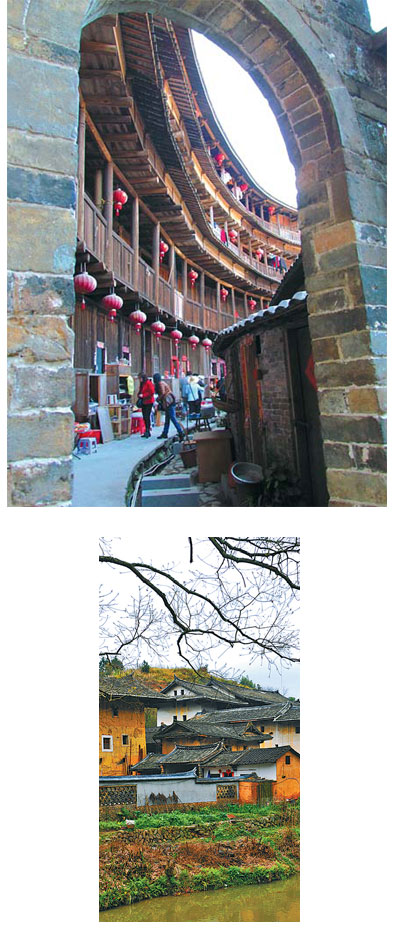
Above: The pace of life at Chengqi Lou is leisurely. Below: Hakka houses are found in western Fujian's mountain areas. Wang Huabin / for China Daily |

The Hakka people's distinctive homes, called tulou, have a storied past and one today is a prime tourist attraction. Zhang Yue reports in Yongding, Fujian province.
There's a joke about tulou, the distinctive homes of Hakka people in Fujian province, which goes a bit like this: Two men are talking and one of them boasts: "My house is so big, it's four stories high." The other responds: "That's nothing - 300 people live at my place." They continue arguing about who has the bigger house and only later, when they arrive home, do they realize that they actually live in the same place. Tulou means "earthen building" in Chinese and is a large communal building representative of Hakka culture. Most are three or four stories high and accommodate hundreds of people, often with the same surname.
Yongding county is an ideal place to experience this unique architecture. Tulou are one of the distinctive features of the countryside here and are scattered throughout the mountainous terrain.
There are more than 23,000 tulou in Yongding county. Many were built during the Ming (1368-1644) and Qing (1644-1911) dynasties.
It is thought the northern Hakka migrants originally constructed tulou because they wanted to safeguard themselves from invaders and burglars, and they built the structures out of clay and wood.
Yongding's tulou were added to UNESCO's World Heritage List in 2008 and are a big tourist attraction for both domestic and international visitors.
Chengqi Lou in Gaobei village is the first stop on our two-day tour of Yongding. The building is called the "King of Tulou" and has four concentric circles and 384 rooms. It was completed in 1708. Rooms on the first floor are used as sitting rooms and kitchens, while some also function as stores selling ginger sugar and oolong tea to visitors.
Every household has red Spring Festival couplets on their doors and lanterns hang in front of the porches, which add a bright splash of color to the wooden buildings.
When we arrive at Chengqi Lou at 4 pm, most households are preparing for dinner. People are chatting, and the doors of their houses are open.
"Hi, come in. Join us, and try some tea," Jiang Hongfeng, a 28-year-old resident, says as I look around.
Four of his relatives are drinking tea in the sitting room, while his wife cooks in the kitchen next door.
Afternoon tea is a daily routine, and planting tea was the main economic activity of residents before tourism boomed after 2006.
Jiang was born and raised in Chengqi Lou. His father, 65-year-old Jiang Youyi, is now the owner of the building, which used to house up to 800 people, all surnamed Jiang.
About 200 people - about 30 households - live in the tulou. In the middle of the tulou is a zutang, a hall where residents pay tribute to their ancestors.
Jiang started his tea business in 2006. He runs a store, while his wife works as a Chengqi Lou tour guide.
The building has granaries on the second floor, while bedrooms and living rooms are on the third and fourth.
"I show visitors our bedrooms and tell them about Hakka people's lives," Jiang's wife, Weng Jiandi, says. "This is what visitors are most interested in."
Since 2011, however, tourists are no longer allowed to go upstairs, as the building constructed with earth and wood is fragile.
But where there's a will, there's a way. I pay 10 yuan ($2) to a woman washing vegetables in the yard and she happily shows off her room upstairs, pretending I am one of her relatives.
But it is not until later that I really discover what life in a tulou is like, when we spend a night at another tulou named Shuiyuan Lou, an inn 40 minutes' drive from Chengqi Lou.
The 200-year-old, three-story building caters to tourists, since it was bought by a local businessman.
Shuiyuan Lou's 40 bedrooms are on the second and third floors and have public bathrooms, which are on the first floor.
When I take a shower downstairs and try to return to my room I get lost, because it is difficult to tell one stair exit from another.
"That happens quite a lot to tourists," Shuiyuan Lou's owner Hu Jun says. "Some walk into the wrong room. So, always remember your room number."
Spending the night there feels like celebrating the Lantern Festival, because the building has numerous lanterns hanging on the second and third floors. In the evening, residents play poker downstairs while visitors walk around.
In my room, I hear footsteps on the wooden porches. They sound as if they are nearby. I'm woken by footsteps at 6 am, which is when residents start preparing breakfast and set up for work.
Jiang says many of his old neighbors at Chengqi Lou have, in recent years, bought apartments in cities like Fujian's provincial capital Fuzhou.
"It is a modern way of living and more convenient. I thought of moving out about two years ago, but it feels like home here," Jiang says. "My family and me are used to living in a community."
Contact the writer at zhangyue@chinadaily.com.cn.