Beauty meets horror
 |
|
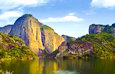
Intricate Gothic pre-12th century towers and houses with red-tiled roofs dominate the skyline of Prague. Photos provided to China Daily |
 |
|
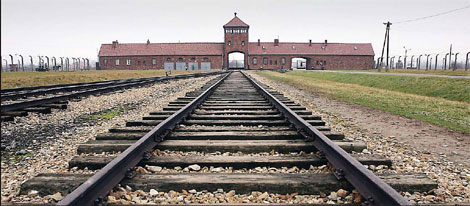
The entrance to the concentration camps of Auschwitz is designed to look like a train station. |
 |
| The Berlin Wall is one of the top attractions in Berlin. |
A weeklong trip to the Eastern European cities of Prague in the Czech Republic and Krakow in Poland, ending in Berlin, was a revelation, Yi-ling Liu discovers.
My idea of European travel used to be strolling along the brightly lit Champs Elysees, frolicking on the French Riviera or sampling cheese in quaint Sicilian bistros, served by waiters named Mario or Michelangelo.
When I thought of Europe, it was Western Europe, possibly because the people are so outspoken and the sun is so vibrant. It was as if everything above Austria belonged to the duckling's ugly sibling.
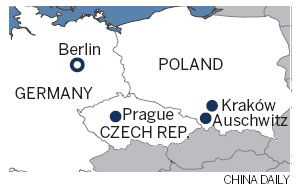
It was time to check out the east of Europe and as such I decided to participate in a weeklong trip, starting with Prague, Czech Republic, and ending in Berlin, Germany.
Soon after stepping off the plane in Prague, I noticed some obvious differences between the east and the west of Europe. In the east, it seemed to me, the people are more reserved and stoic, the architecture more utilitarian, the speech more guttural, the food more starch-filled and the lifestyles more wallet-friendly.
But in no way did Eastern Europe shine less vibrantly.
On our first day in Prague, we took a walking tour of the city with a rotund woman who carried a pink umbrella as our guide. The city was like a page ripped out of an ornate, leather-bound storybook, full of intricate Gothic pre-12th century towers, small houses with red-tiled roofs and antique bookstores.
Even the McDonald's by St. Vitus Cathedral, where the coronations of Czech kings and queens took place, had a stone-carved storefront. The golden arches meticulously assimilated into the vintage atmosphere.
We spent the entire afternoon walking along the cobblestone Charles Bridge to Old Town Square, the indisputable heart of Prague, a vast open space flanked by a blend of Gothic and Baroque architecture and the fairytale-like Tyn Church.
The market we went to served a melange of Czech snacks - cinnamon rolls, fist-sized strawberries dipped in chocolate, sauerkraut frankfurters, crisp roadside pizzas. By nightfall, I had gained weight and Nutella stains were around the corners of my mouth.
By the time we arrived in Krakow, Poland, the sun and warmth had disappeared, and scarves and raincoats were necessary. It was beautiful, nonetheless, in an almost antiquarian way.
Eastern Europeans are proud of Krakow - even the Soviets failed to leave their mark on the city center during 45 years of supervision.
Our guide, Tomacz, was sincere, witty and amicable. His friendliness was a welcome change from the hostile response we had received from hotel employees the night before.
From Tomacz, I learned the last pagan empire was in Lithuania, and Roman Polanski's film, The Pianist, was based on his own experiences in Krakow - so we retraced his steps.
We walked to the Jewish Quarter, an area of peeling facades, wooden shutters and dozens of cafes, all maintaining an air of pre-war timelessness.
We also had a lunch at the restaurant Steven Spielberg dined in when he was developing the Oscar-winning film Schindler's List.
Wieliczka Salt Mine, thrown together by the forces of nature around 15 million years ago, is massive. The mine features a 22,000-cubic-meter chapel, a salt lake that holds more than 300 grams of salt per liter and a hall big enough to fly a hot-air balloon in.
And everything was made out of salt - the mine guide explained to us that we could "lick everything except the tour guide and the statues".
Given this prompt, we excitedly ran our tongues across the salty walls like dogs lapping up buckets of water until we had to leave.
Our trip took a more somber turn when we visited the concentration camps of Auschwitz I and II, where an estimated 1.5 million people were brutally exterminated.
Before the trip, I thought I was well informed about the Holocaust. But I wasn't.
There is no way to understand history's most horrific genocide other than setting foot in Auschwitz. The sheer scale of the camps is overwhelming.
Auschwitz II hosted 300 barracks and held up to 100,000 prisoners. It was stunning in a horrific way, so immense, so systematic, so much like an industrial plant - a blemish on the map of Poland.
I walked around in a scene I had only previously seen in textbooks - the entrance designed to look like a train station in order to coax prisoners into entering the camp and the mangled remains of the crematoria. It was surreal.
The Auschwitz museum provided more insight. Without being heavy-handed, the history of Auschwitz was presented with poignancy and professionalism.
We saw the blocks where prisoners were held and the "Death Wall" where they were shot. But what alarmed me the most was the seven tons of human hair displayed in a glass room. Only then could I better understand the complete depravity of the Nazi death machine.
We arrived in Berlin exhausted and moody after an overnight bus ride, with several nighttime stops at lonely gas stations to satiate the pangs of nocturnal hunger. After a long nap, however, we awoke at noon in Berlin, a city that possesses a beauty more cosmopolitan than fairytale Prague.
Berlin is a city of contrasts: a fusion of a utilitarian East and a romantic West. On one hand, there are remnants of the Soviet's rigid, straight-backed architecture. On the other hand, there is the Reichstag, a stunning piece of architecture with Norman Foster's signature glass dome. And there is the Brandenburg Gate, where a man in a yellow chicken suit invited us to take photos with him.
As a fun-loving but frustratingly naive group of students, we bunched together and posed for the camera, unaware that he would later aggressively demand euros for his service.
It seemed only natural then to visit what was left of the Berlin Wall, which once separated East and West Germany. We went to the colorful Check Point Charlie Museum, jam-packed with dramatic stories of separated lovers, of freedom-seeking families and of fed-up senior citizens in the German Democratic Republic who breached the wall.
A lover of trinkets and memorabilia, I was tempted to buy an overpriced piece of the wall contained in a plastic box. Fearing it may not have been a part of the famous wall, but perhaps an ordinary chunk of cement, I relinquished the souvenir and took photos instead.
Berlin is also a hybrid of old and new, dotted with both medieval-era cathedrals and glossy modern structures like the Sony Center and the Daimler Chrysler complex.
Neues Museum on Museum Island epitomizes this blend of old and new. Devastated during the war, the museum was renovated in 2008 and designed in such a way that the bomb marks, the signs of destruction and the history of the museum itself are integrated into the modern architecture. It is a remarkable achievement.
Wansee Villa is a pristine white house in suburban Berlin, where the Nazis decided on "The Final Solution" - the decision to order the murder of an estimated 11 million innocent people. It was such a stark contrast - the tranquil, upper-class setting, and the horrific documents from the Wansee Conference. This is Berlin's final paradox: It is a city where goodness and atrocity have existed side by side, a city of both beauty and horror.
At Berlin airport, we stocked up on Haribo gummies and German chocolate in the hope of reliving the Eastern European experience when we returned home.