Domestics Affairs
Debate: Heating system
(China Daily)
Updated: 2010-11-22 07:49
 |
Large Medium Small |
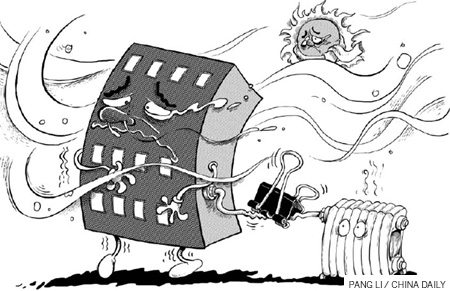
Does South China need a central heating system? "No", says one expert, because it would be an unnecessary drain on precious energy, while another says it is important to restructure the entire system to save energy.
Jiang Yi
South too warm for central heating
As winters get colder, more people are urging the government to build a central heating system in South China too. But few among these people have thought about factors such as efficiency and differences in climate in northern and southern China.
Since ancient times, Chinese people have recognized the Qinling Mountain Range and the Huaihe River as the geographical line dividing northern and southern China. North China needs a central heating system because its weather is much colder than that of South China. Winter in northern China is much colder and longer than in the southern parts. Winter lasts up to six months in Northeast China, where temperatures can drop to minus 40 C. Compared to the northern parts, winter in South China is warmer and shorter. Temperatures in South China are usually above freezing point in winter. In fact, in some places winter lasts little more than a month.
In other words, central heating is a necessity for people in North China, whereas it is needed in the southern parts to make people more comfortable.
True, people living just south of the geographical dividing line feel the harshness of winter as much as their northern neighbors. But then there has to be some point of reference for the geographical division, or else the boundary will keep shifting southward until it reaches the South China Sea.
In South China, the difference between indoor and outdoor temperatures in winter is less than 10 C. Indoor temperatures usually are around 14 C to 16 C, while outdoor temperatures vary between 6 C and 10 C. But in North China, the difference is far greater, often more than 20 degrees. Without proper heating, the cold in such places will take a toll even on people who stay indoors, reducing their efficiency and causing illness and fatalities.
Installing a centralized heating system in areas where indoor and outdoor temperatures don't vary much makes little sense. Instead, local heating with intermittent supplies should be enough to make winters relatively warmer indoors in such areas.
Take major cities like Nanjing and Shanghai in South China as examples. If people there use their air conditioners to keep their houses warm in winter, they would be using 6 to 8 kilowatts of electricity per square meter per month, which is equivalent to burning about 3 kg of coal. But 20 kg of coal would be required to keep one square meter of indoor space warm for a month through a central heating system.
This should give people an idea of how heavy the energy burden would be if central heating is introduced in the southern part of China.
Another factor worth mentioning is the change that central heating brings about in people's habits. Before central heating was introduced in the 1950s, people in North China used traditional means such as stoves or charcoal to keep their houses warm in winter and wore more clothes indoors than they today.
But the central heating system has made winter so warm indoors that people wear fewer clothes at home. Some houses are so warm that a person feels comfortable even in a T-shirt. Temperatures in some offices are as high as 30 C, and many department stores, malls and supermarkets often maintain temperatures above 20 C, when 18 C is enough to keep indoors warm in winter. This is unnecessary waste of energy.
If central heating system is introduced in South China, the same story would be repeated there, and it would be repeated for a something that is not necessary. This is against the energy conservation policy of the government.
Lessons can be learned from countries such as Japan, too, which don't have a central heating system even though the difference between outdoor and indoor temperatures vary little in that country's northern and southern parts.
A central heating system is not the required in China's southern areas because the weather there is much warmer that North China and to prevent unnecessary waste of energy. Besides, it will cost astronomical amounts to build, run and maintain a central heating system in South China. That would be unnecessary expenditure because, unlike the northern parts, the central heating system in South China would be operational for only two months.
Hence, a better and more environmentally friendly way of keeping houses, offices and factories warm in winter in South China would be to use local heating systems like fireplaces, air conditioners and stoves.
The author is a professor at the School of Architecture, Tsinghua University.
Deng Qingguang
Heating system should be more efficient
People who have moved from the country's southern parts to work in the northern areas are becoming increasingly envious of the central heating system in winter in their work places and homes. This has started a debate about whether a central heating system should be built in southern China, too.
But considering the country's energy saving policy, it is not necessary to build a central heating system in South China. On the contrary, policymakers should think of making the central heating system in North China more efficient to save energy.
The central heating system is necessary for work efficiency and people's livelihoods in North China (especially areas north of the Yellow River). The area comprises 17 provinces, municipalities and autonomous regions, has a population of more than 700 million and accounts for about 60 percent of the country's territory.
The energy needed to run the central heating system in North China accounts for about one-fourth of total energy consumption of the country and costs about 70 billion yuan ($10.54 billion). That's why it is important for the authorities to see if there is room for reducing energy consumption to help the country save energy and reduce greenhouse gas emissions.
The central heating system is a 24-hour service, but a considerable portion of the heat generated by the system is wasted. For example, office workers are away from home for an average of 11 hours a day on weekdays, which means 45 percent of the heat generated in their homes is wasted. Energy used to generate heat in most offices and industrial areas is wasted, too, because nobody works between 8 pm and 7 am. Besides, some offices, homes and factories become so warm because of the heating system that people have to open windows to maintain a comfortable temperature indoors.
That means there is no need for the central heating system to be operational 24 hours a day. It is thus necessary for the authorities to find a way to keep houses and workplaces warm only when people are there and to turn off supply when they are not to save energy and reduce emissions. They also have to replace dysfunctional and inefficient parts and rusty pipes in the heating supply network to ensure that the central heating network runs smoothly.
More importantly, the authorities should consider replacing the central heating system with wall-mounted gas boilers, which consume less energy and are more efficient and convenient. Wall-mounted boilers are multifunctional home appliances that provide hot water as well as heating. Like air conditioners, a boiler gives the option of setting different temperatures in different rooms of a house or work place, or even shutting down heating supply to a room.
The central heating system, based on the social welfare principle of the earlier planned economy, is at odds with today's market economy and social development. Many new urban and suburban communities have already introduced household-based heat supply meters. In fact, it is a social, economic and environmental necessity to introduce a household- and unit-based system, just like electricity, gas and water supply meters, for the heating system.
On the other hand, the authorities have to ensure that the heating system covers people in rural areas, too. This is important to protect rural residents from the toxic gases produced by stoves placed under adobe sleeping platforms and the burning of coal and ensure that they lead a better life.
Since efficiency has become the buzzword in almost every field of Chinese society, there is all the more reason for the authorities to take steps to make the heating system more efficient and environmentally friendly. And since energy shortage poses a serious challenge to China, the authorities should introduce separate meters for the heating system for households and commercial/industrial units.
The author is a senior engineer who specializes in heating systems.