Debt-equity swap's impact in focus


 |
|
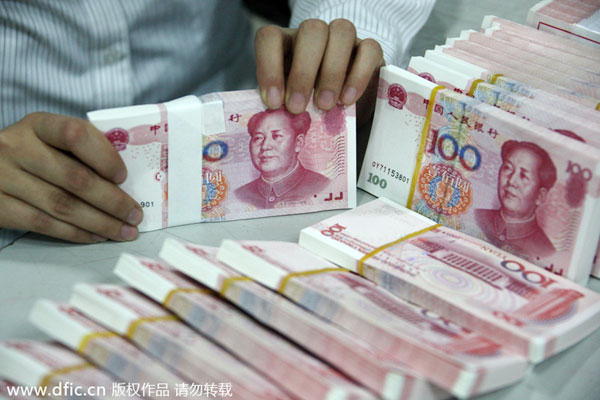
A clerk counts yuan bills at a bank in Huaibei, East China's Anhui province. [Photo/IC] |
Allowing a large number of companies to convert debt into equity would help not only enterprises with huge borrowings on their books but lenders, analysts said.
For that to happen, however, more clarity on the eligibility criteria for the debt-to-equity swap scheme is needed, they said.
A large number of participants would make the whole process less risky. Besides, it would limit any potential adverse impact on the stock markets, and help allay investors' concerns over feared risk of defaults, they further said.
An Oct 10 circular by the State Council detailed the regulations concerning the debt-to-equity swap scheme. The so-called "zombie" enterprises are not allowed to convert their debt into equity.
On the other hand, lenders and institutions that offered loans to corporates, including insurers, State-owned capital investment companies and asset management companies, can agree to accept equity corresponding to their loans. Private investors are also encouraged to participate in such swaps, the circular said.
"This will likely send a strong signal that the debt-to-equity swap plan will be market-oriented, investment-like, and not a procedure imposed on lenders to force them to bear all the risks. Bad debts ought not to become bad equity," said Luo Qinyuan, manager of Shanghai-based Kunyuan Asset Management Ltd.
Nuanced regulations would also help allay investors' concern that the collective corporate debt, estimated at 1 trillion yuan ($149.3 billion), could flood the A-share market in the form of post-swap equity, adversely impacting the stock markets, said Luo.
"The measures (to reduce corporate debt) come against the background of proactive fiscal policy and prudent monetary policy, indicating that ample policy support will continue, aimed at maintaining GDP growth around the 6.5 percent target," said Marie Diron, a senior vice-president at Moody's Investors Service, a leading credit ratings and risk analysis agency.
The Oct 10 guidance stipulates that only companies with a positive outlook, and capacity or potential to recover from cyclical downward pressure, can opt for the debt-to-equity swap. Every step during the swap process should be market-oriented, without any expectation of financial help from the government.
"Zombie enterprises, including loss-ridden firms that are conceivably beyond recovery, or with opaque debt, or with potential to increase output or inventory for sectors with overcapacity ... they are forbidden (from the swap scheme)," said Lian Weiliang, deputy director of the National Development and Reform Commission.
The government will not offer financial backing merely because the post-swap equity does not generate positive returns. So, pricing and diligent matching of borrowers and would-be equity-holders are going to be key, said Lian.
A research note by Sinolink Securities said the government has indicated that market forces will have a bigger say in tackling growing corporate debt, as reflected in the case of the State-owned Dongbei Special Steel Group. The firm's proceedings for bankruptcy were approved last Monday.
Enterprises with potential to recover, however, may use the swap route to tide over difficulties. For, the State Council circular said "high-quality" firms that play a leading role in their respective sectors, particularly high-growth, high-tech or strategic industries, are allowed to use the option, to overcome "temporary setbacks".
Such enterprises, however, must have plausible plans for reform and recovery, and should not have any record of defaults.
China's corporate debt surged 465 percent over the past decade to 165 percent of GDP last year, according to Bloomberg data.
An S&P Global Ratings note said if corporate debt continues to grow at the same alarming pace, the ratio of bad loans could triple to 17 percent by 2020.
A score of enterprises have already been "simulating" the swap process as of this month, according to the information office of the State Council.