Seeking balance in sector capacity


 |
|
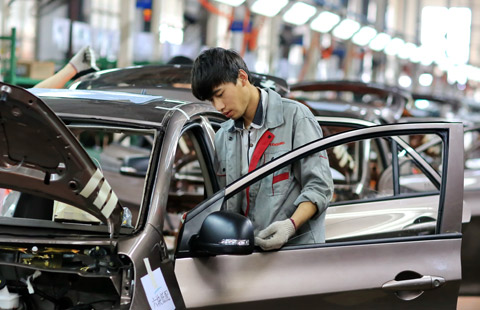
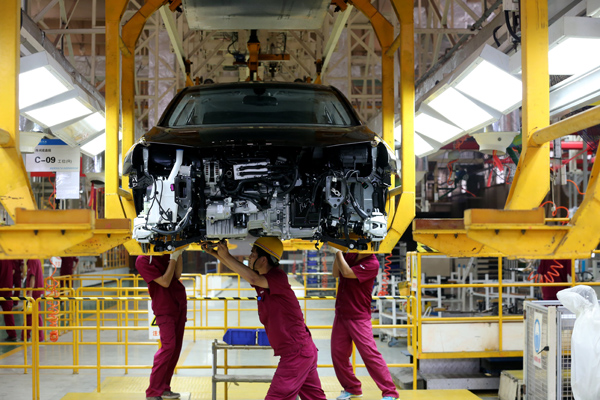
Workers are busy assembling cars at the workshop of a car company in Anhui province.[Photo by Xu Congjun/China Daily] |
The central government has halted approval of fuel vehicle manufacturers, releasing an official statement ceasing the production expansion race in the world's largest automotive market.
China's State Council said on Oct 8 that no more approvals would be given to conventional energy vehicle makers "in principle", two days ahead of Beijing-based CH Auto Technology receiving approval as the third independent new energy passenger car maker.
Industrial insiders believe this action has been taken to relieve structural overcapacity in the automotive sector, and help guide more resources into the manufacturing of new energy vehicles.
"Overcapacity may materialize around 2022, if conventional vehicle makers continue expanding their production capacity," said Cui Dongshu, secretary-general of China Passenger Car Association.
He predicted that the conventional car market would reach a peak around 2022, according to Shanghai Securities News. Cui saw the government's action as a way to prevent this potential overcapacity from happening.
The National Development and Reform Commission found that the passenger car production capacity utilization rate remained at 81 percent, 52 percent for commercial vehicles, among 37 major auto companies and groups in 2015. Statistics showed that annual vehicle manufacturing capacity reached 31.2 million units by the end of last year.
"In-building car manufacturing capacity will add another 6 million units to the nation's annual capacity, exceeding foreseeable vehicle consumption growth," Wu Wei, an official at NDRC, was cited as saying. "The commission's concern mainly relates to investment fever driven by capital."
The State Council's words came as delayed testimony, as not a single fuel vehicle maker has been established in the past eight years, and new players have entered the field only through taking over a bankrupt predecessor, according to sources familiar with the matter. Much capacity exists only in statistics, because the companies have long been inactive, awaiting takeover bids.
Zhang Suixin, executive vice-president of Volkswagen Group China, said: "Volkswagen sometimes has to take over local zombie companies, claiming a certain capacity, so as to get the green light from the local government before starting local production."
However, the world's second-largest carmaking group by volume acquired decades-old equipment and assembly lines, for which the capacity was completely obsolete and useless, he said in a group interview earlier.
Zhang added: "It is unnecessary for the government bodies to worry about automakers' production capacity. An automaker always has its target-to make money. In the event of not making money, it won't make the decision for expansion."
The capacity topic heated up last year and triggered an extensive discussion in the industry. However, major carmakers did not agree on overcapacity.
Carlos Ghosn, chairman and CEO of Renault-Nissan Alliance, the world's fourth-largest carmaker by volume, noted that "it depends on how you define capacity and overcapacity. We need capacity reserves."
"Planned production capacity is usually calculated in three work shifts for peak time demands. During the conventional business period, many plants are operating in one or two shifts."
Jochem Heizmann, member of the board of management at Volkswagen and president and CEO of Volkswagen Group China, sees production capacity as a flexible and adjustable resource.
"Plants in China are producing not only for the Chinese market. Many parts made in China are exported," he said.
Besides, the international carmaking giant allocates and adjusts capacity worldwide. Heizmann added that now capacity is meeting Chinese demands as a priority, and finished products could also be shipped overseas when the domestic market is saturated in the future.