Scientist fixes his gaze on fruit fly
Updated: 2013-10-20 08:02
By James Gorman(The New York Times)
|
|||||||


SEATTLE - To hear Michael Dickinson tell it, there is nothing quite as wonderful as a fruit fly.
And it's not because the fly is one of the most important laboratory animals in the history of biology, often used as a simple model for human genetics or neuroscience.
"I don't think they're a simple model of anything," he said. "These animals, you know, they're not like us. We don't fly. We don't have a compound eye. I don't think we process sensory information the same way. The muscles that they use are just incredibly much more sophisticated and interesting than the muscles we use.
"They can taste with their wings," he went on. "No one knows any reason why they have taste cells on their wing. Their bodies are just covered with sensors. This is one of the most studied organisms in the history of science, and we're still fundamentally ignorant about many features of its basic biology. It's like having an alien in your lab.
"And," he said, pausing, "they can fly!"
Dr. Dickinson, 50, studies the basis of behavior in the brain at the University of Washington, in Seattle. In practice he has targeted the fruit fly, Drosophila melanogaster, and its flying behavior for studies that involve physics, mathematics, neurobiology, computer vision, muscle physiology and other disciplines.
Early on Dr. Dickinson and a mentor solved a longstanding physics problem of insect flight, and he has continued to investigate. His influence on new research extends from basic neuroscience to robotics. Researchers at Harvard University who built a fly-sized flying robot earlier this year, for example, based it partly on his work.
His research for his dissertation at the University of Washington was on fly development and neurobiology, but, he said, "I was almost instantly much more interested in the function of the whole fly than the more mechanistic but probably more well-posed problems of how the little axons grow to the brain."
After he left one postdoctoral position, he began working with Karl Georg Gotz at the University of Tubingen on insect flight. "We built this very, very simple model of a wing flapping back and forth in 200 liters of sugar water," Dr. Dickinson said. What they found was that when the wings flap, "they generate this flow structure called a leading-edge vortex."
At the time, the nature of insect flight was still a puzzle, the basis of the myth that engineers had proved that bumblebees could not fly. "We were able to measure the forces," he said, and to "make simple calculations that, you know, actually insects can fly."
He was hooked. "Fly flight is just a great phenomenon to study," he said. "It has everything - from the most sophisticated sensory biology; really, really interesting physics; really interesting muscle physiology; really interesting neural computations. Just the entire process that keeps a fly hovering in space or flying through the air - it links to ecology, it links to energetics."
When Dr. Dickinson moved to his first faculty position, at the University of Chicago, he said, "I tried from that day on to set up a lab that worked in this very integrative way."
His graduate students and postdoctoral researchers in that lab and others have come from backgrounds including engineering, physics and biology.
Gwyneth Card, who was a researcher in Dr. Dickinson's lab at the California Institute of Technology, said it was a rich environment for a graduate student.
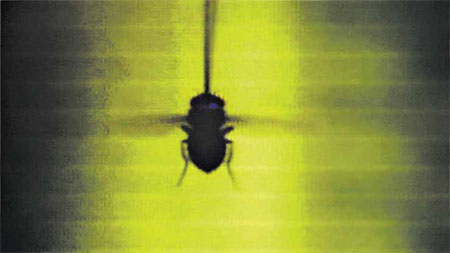
"He'll set you a great problem," she said. "For me he kind of picked out takeoff in flies." She set up a system for taking infrared video at 7,000 frames per second of flies taking off spontaneously and also when they were frightened by an image of an apparent predator.

What she found, and reported in Current Biology in 2008, was that when a predator loomed, the takeoff was not just a reflex action. The flies made preliminary leg movements to prepare for takeoff away from the predator, so somewhere in the fly's brain the best response to a threat was being computed and a decision being made.
In Dr. Dickinson's lab at the University of Washington, there are micro-treadmills for the flies and macro tanks of viscous fluid for robotic wings. His lab has worked with flies that are tethered and engaged in a kind of virtual reality theater, where the flies react to video of stimuli, which they use as targets during flight. Sometimes the flies can control the display, as in a video game.
Neuron for neuron, Dr. Dickinson said, the fly brain has a wider range of behavior than more complex mammalian brains. One reason seems to be that the presence of different chemicals called neuromodulators in the fly brain can change how a given group of neurons acts at different times.
"One of our more recent observations is that drosophila can read the sky compass," he said, "so they have the same capability that monarch butterflies have of being able to basically look at the sky" and figure out direction based on the polarization of light.
With this ability, there's no need to see the whole sky or star patterns. "It works even when you have only a tiny patch of blue sky," he said. "It's a solution vertebrates didn't come upon, humans didn't come upon, but insects did."
The New York Times
|
Michael Dickinson, at the University of Washington, in Seattle, studies fruit flies, combining fields like physics, neurobiology and engineering. Photographs by Zach Wise for The New York Times |

(China Daily 10/20/2013 page11)