Threat of the threatened
Updated: 2013-10-06 07:06
By Yang Yao(China Daily)
|
|||||||


Better insurance payouts for villagers and making them stakeholders in conservation would protect the elephants and benefit the local communities in Yunnan, as Yang Yao discovers.
For many, elephants are loveable creatures: obedient, careful and calm. But for the villagers in Xishuangbanna it is a different story.
Ten years ago a rogue elephant came into village from the hills and trampled Yan Han's mother to death while she was working in the rice fields.
Now the nightmare has returned to the village.
|
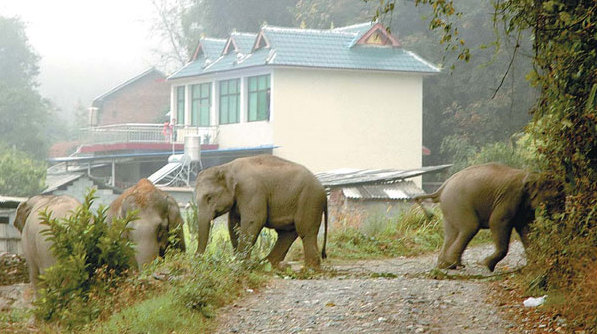
Wild elephants on farmland near houses in a village in Xishuangbanna, Yunnan province on Feb 16, 2013. Dai Zhenhua for China Daily |
|
Wild elephants in Xishuangbanna National Natural Protection Area cross a creek. Zhang Guoying / Provided to China Daily |

Yan Han, a quiet middle-aged farmer in Mengman village in Xishuangbanna told China Daily that wild elephants rampage through the villages, crushing crops and damaging farms two or three times a year.
Yan said there is a growing conflict between the villagers and elephants over land, and because of the greater frequency of encounters there is a growing risk that more people will die, as each year people are injured.
"The elephants are active at dawn and dusk, and moving in the elephants' territory at these times can seem threatening to the elephants," he said.
Yunnan Province is the last habitat for China's remaining wild elephants and they are protected under Chinese wildlife laws. According to Yan Xun, the State Forestry Administration's chief engineer for wildlife conservation, conflicts between elephants and humans over land was a leading cause in the species' historical decline, but thanks to the enhanced efforts of the government to protect the elephants in recent years, their number has been on the rise.
However, at the same time as the elephant population has been growing, there has been ever greater depletion of their natural habitat due to human activities. Xishuangbanna has been experiencing dramatic forest loss due to the conversion of the lowland tropical forests, which are the elephants' natural habitat, into rubber plantations. This has resulted in growing antagonism from the villagers toward the elephants, as every year the elephants destroy crops and houses and injure people.
"The long-term survival of the wild elephants depends on the development of a scheme to compensate farmers adequately for the damages they suffer as a result of the raids by elephants," Yan said.
The compensation provided at present is far from enough, he explained.
According to Yan, rice can be sold at a price of 0.3 yuan per kilogram, and normally 0.67 hectares of land can harvest 350 kg rice. But if elephants destroy the rice, they only receive compensation for half the amount of rice they would have produced at half the market price.
Official data shows that between 1991 and 2010 the direct economic losses caused by elephants were 270 million yuan ($4.4 million) but the total compensation the villagers received was 38.39 million yuan.
Li Zhongyuan, head of the local elephant conservation administration says that the current compensation relies on insurance companies, but the insurance companies are not happy because they are losing a lot of money despite funds from the government.
Last year the government paid 20 million yuan to the insurance companies, but the money they paid out to compensate farmers was more than that, and they ended up losing more than 40 million yuan .
"The elephant damage is happening more and more often, and the insurance companies lack the incentive to cover the risks," said Yan Si, head of the village, "I don't know if they will carry on insuring us."
The current insurance is managed in a traditionally centralized way that hinders the effective mitigating of human-elephant conflicts in Xishuangbanna, according to Chen Shu who in a paper for National University of Singapore argues that to optimize funds and improve mitigation efficiency an insurance cost-sharing mechanism jointly paid by government, rubber farmers and Chinese tourists should be introduced.
"It is important to make sure that multiple stakeholders are willing to be involved and support elephant conservation in the long run," Chen concludes.
One of the key stakeholders to protect the elephants and mitigate human-elephant conflicts in the long run must be the local people, as the elephants have a significant influence on the local communities.

(China Daily 10/06/2013 page7)