Research accepted, along with a check
Updated: 2013-04-21 07:50
By Gina Kolata(The New York Times)
|
|||||||


|
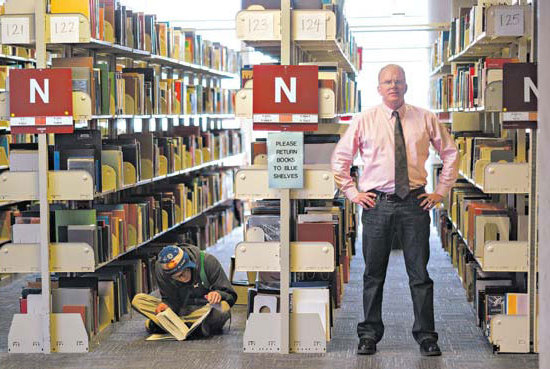
Jeffrey Beall, a research librarian at the University of Colorado at Denver, has developed a blacklist of "predatory open-access" journals. Kevin Moloney for The New York Times |
The scientists who were recruited to appear at a conference called Entomology-2013 thought they had been selected to make a presentation to the leading professional association of scientists who study insects.
But they found out they were wrong. The prestigious, academically sanctioned conference they had in mind has a slightly different name: Entomology 2013 (without the hyphen). The one they had signed up for featured speakers who were recruited by e-mail, not vetted by leading academics. Those who agreed to appear were later charged a hefty fee for the privilege, and almost anyone who paid got a spot on the podium that could be used to exaggerate a resume.
"I think we were duped," one of the scientists wrote to the Entomological Society.
Those scientists had stumbled into a parallel world of pseudo-academia, complete with prestigiously titled conferences and journals that sponsor them. Many of the journals and meetings have names that are nearly identical to those of established, well-known publications and events.
Steven Goodman, a dean and professor of medicine at Stanford University in California and the editor of the journal Clinical Trials, which has its own imitators, called this phenomenon "the dark side of open access," the movement to make scholarly publications freely available.
The number of these journals and conferences has exploded in recent years as scientific publishing has shifted from a traditional business model for professional societies and organizations built almost entirely on subscription revenues to open access, which relies on authors or their backers to pay for the publication of papers online, where anyone can read them.
Some researchers are now raising the alarm about what they see as the proliferation of online journals that will print seemingly anything for a fee. They warn that nonexperts doing online research will have trouble distinguishing credible research from junk.
"They will not know from a journal's title if it is for real or not," Dr. Goodman said.
Researchers also say that universities are facing new challenges in assessing the resumes of academics. Are the publications they list in highly competitive journals or ones masquerading as such?
And some academics say they have found it difficult to disentangle themselves from these journals once they mistakenly agree to serve on their editorial boards.

Jeffrey Beall, a research librarian at the University of Colorado in Denver, has developed a blacklist of what he calls "predatory open-access journals." There were 20 publishers on his list in 2010, and now there are more than 300. He estimates that there are as many as 4,000 predatory journals today.
"This is easy money, very little work, a low barrier start-up," he said.
Journals on what has become known as "Beall's list" generally do not post the fees they charge on their Web sites and may not even inform authors of them until after an article is submitted. They barrage academics with e-mail invitations to submit articles and to be on editorial boards.
One of the most prolific publishers on Beall's list, Srinubabu Gedela, the director of the Omics Group, has about 250 journals and charges authors as much as $2,700 per paper. Dr. Gedela, who lists a Ph.D. from Andhra University in India, says on his Web site that he "learnt to devise wonders in biotechnology."
Open-access publishers say that the papers they publish are reviewed and that their businesses are legitimate and ethical.
"There is no compromise on quality review policy," Dr. Gedela wrote in an e-mail.
Paulino Martinez, a doctor in Celaya, Mexico, said he was gullible enough to send two articles in response to an e-mail invitation he received last year from The Journal of Clinical Case Reports. They were accepted. Then came a bill saying he owed $2,900. He was shocked, having had no idea there was a fee for publishing. He asked to withdraw the papers, but they were published anyway.
The journal offered to reduce his bill to $2,600. Finally, after a year and many e-mails and a phone call, the journal forgave the money it claimed he owed.
Dr. Martinez said: "I am a doctor in a hospital in the province of Mexico, and I don't have the amount they requested."
The New York Times
(China Daily 04/21/2013 page11)