From rags to riches
Updated: 2013-01-13 07:51
By Zhang Kun(China Daily)
|
|||||||


|
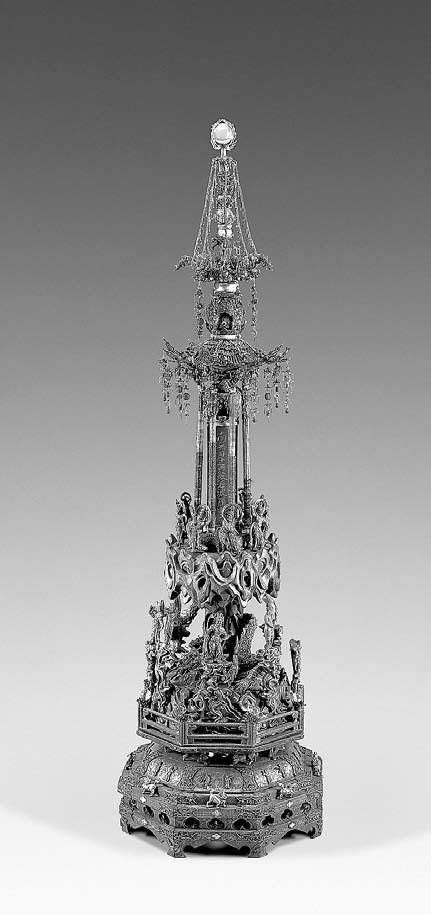
The Pearl Pillar of the Buddhist Shrine is tower-shaped and features engravings, precious gems and other fine decorative elements. Photos Provided to China Daily |
|
The sculptures of deities in auspicious clouds have facial features that appear to be more Indian than Chinese. The coiled dragon with nine heads is woven with silver thread and hundreds of small pearls to look like scales. |

Among the most important exhibits at the I.M. Pei-designed Suzhou Museum, Zhang Kun reports, are two Buddha statues discovered by three children in Ruiguang Pagoda
Three young treasure-hunters got lucky and made an important discovery at a deserted pagoda in Suzhou, Jiangsu province, on April 12, 1978.
According to Suzhou Museum, the three boys, all under 9, broke into the shuttered Ruiguang Pagoda to catch sparrows and collect their eggs.
They pushed aside some dried grass and found a slate slab, which they pulled up, revealing an alcove containing two Buddha statues.
The clay statues were brightly colored and so fascinated the children that they wrapped them up in rags and took them home.
Proudly, they showed off their treasures, but the villagers were worried they would be in trouble for damaging State relics.
So, their parents informed local officials, who contacted Suzhou Museum. The institution investigated further and soon made plans for restoration of the building.
Ruiguang Pagoda was originally part of a temple that was built around 241 AD. According to documents found in the temple, the pagoda was built from 1004-1030, when the temple was named "Ruiguang" (which means "auspicious light").
The temple was repeatedly destroyed and restored over the years, until the Taiping Rebellion in 1863, when heterodox Christian rebels destroyed many Buddhist and Taoist temples and statues. Ruiguang Temple was completely destroyed this time, leaving just the pagoda.
By the 1950s, the pagoda was closed because of safety fears. It was not until after the children found the statues that repairs were carried out and completed in 1990. It has been open to the public since then.
The pagoda is a fine example of old Chinese architecture. About 53.6 meters high, it has seven stories and each roof was constructed so it had eight angles.
The building has stone sculptures of lions, clouds, and people; and visitors can now climb all seven levels of the building.
"It's a fine example of a brick-wood tower from the Song Dynasty (960-1279) and an important example of how towers evolved in the Yangtze Delta," says Wang Huixiang, a curator at Suzhou Museum.
Among the findings at Ruiguang Pagoda, the most significant is the Pearl Pillar of the Buddhist Shrine.
It was preserved in two wooden cases and the inner case had vivid paintings of the Four Heavenly Kings - Buddhist gods that guard sacred mountains.
According to the inscription, the paintings were done in 1013 and they were so finely rendered that the wooden case was classified as a National Treasure.
The Pearl Pillar of the Buddhist Shrine is tower-shaped and about 122.6 cm tall. Its main body is made of nanmu wood. It also has engravings, precious gems and other fine decorative elements.
Eight silver lions are on the base, styled after Mount Sumeru, according to Indian legend. Each lion is just 3-4 cm tall, but are presented in distinctive postures, such as jumping, squatting, yawning, looking back and scratching the ear.
Also on the base is a coiled dragon with nine heads. It is woven with silver threads and hundreds of small pearls, and looks like scales.
Above the dragons are sculptures of deities in auspicious clouds. They have facial features that resemble Indians more than Chinese.
A canopy featuring fairies and deities, Buddha's name and words of blessing form the central part of the shrine, the Octagonal Sutra pillar.
Hidden inside the pillar was a small ceramic bottle that contained nine grains of Sarira beads, pearl-like objects found among the cremated ashes of Buddhist spiritual masters. These Sarira beads are regarded as the most sacred objects found in Buddhism pagodas.
Also found at Ruiguang Pagoda were Buddhist scriptures, plus bronze and clay Buddha statues - among them the ones found by the young treasure hunters.
Discoveries from Ruiguang and the Pagoda of Yunyan Temple at Huqiu are among the most important exhibits at Suzhou Museum.
The exhibition takes up two of the most prominent halls at the new museum, designed by internationally acclaimed architect I.M. Pei.
Contact the writer at zhangkun@chinadaily.com.cn.

(China Daily 01/13/2013 page15)