|
|
 |
|
News
On the Way Home
Festive China
Festival at Quake Zones
World Celebrations
Photo Gallery
Video
Slideshow
Year of the Ox
Spring Festival Traditions
Festivals around China
Chen Weihua:
Optimism defeats slowdown in Shanghai  Op Rana:
Wishing all a healthy Lunar New Year   Liu Shinan:
Going home: In pursuit of a better life  Hong Liang:
HK govt facilitator of economy  Bull market for ox pictures
By Zhu Linyong (China Daily)
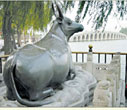
Updated: 2009-01-21 10:22 The ox has long been a favorite subject for artists. For instance, archaeological excavations in the 296-m-long Altamira cave in Spain have found polychrome rock paintings of herds of bison created some 18,500 years ago.
 Archaeologists have also found in the Lascaux Caves of France, some of the most remarkable Paleolithic cave paintings in the world, featuring images of bulls, horses and stags. The Lascaux paintings are believed to be at least 15,000 years old. An ox-shaped stone sculpture, 10.5 cm by 17 cm, in the National Museum of China collection, indicates Chinese during the late Shang Dynasty (c.16th century-11th century BC) also created artworks featuring oxen. During the Spring and Autumn Period (770-476 BC) objects such as wine vessels were made in the shape of oxen. A precious bronze zun vessel, 33.7 cm by 58.7 cm, from this period is in the Shanghai Museum collection. Oxen can often be found in Chinese ink paintings. The most famous is probably the Five Oxen Picture by artist Han Huang (AD 723-787). Han was a dignitary in the Tang Dynasty (AD 618-907) who studied painting and calligraphy in his spare time. Contemporaries praised his works as "having exhausted all beauty circuitously". In the picture, five oxen have different postures. One looks up, another looks back. One is walking, another is grazing, while the fifth is ruminating. With free and easy but commanding and somewhat deliberate strokes, the painter delineates the powerful physique of the oxen to suggest their slow, plodding movements. The meticulous rendering of the eyes seems to bring the oxen to life. The picture is a fine example of freehand brushwork used extensively in traditional Chinese painting. With its simple and sure style, sense of scale, perspective and proportion, the picture represents the apex of traditional animal paintings in the Tang Dynasty. Five Oxen is believed to be the only known work on flaxen paper extant paintings and was produced in the Tang Dynasty. Another well-known ox-themed ink painting is Lao-tzu Riding an Ox by Ming Dynasty painter Zhang Lu (1490-1563). Zhang was also well known for his paintings of birds, flowers, bamboo and animals. In this painting, Lao-tzu, author of the Tao Te Ching, is seen riding on the back of an ox. It refers to the story of Lao-tzu wishing to leave home because of corruption but being asked to write down his ideas for the benefit of others, resulting in the Tao Te Ching. Zhang Lu's brushwork is precise and descriptive. The artist mixes some ochre pigments with his ink to define Lao-tzu's face, hands, scroll wrapper and the ox's eyes. Li Keran (1907-1989) is arguably the most prestigious modern ink master, famed for both his imposing landscapes and lovely water buffaloes. Li drew buffaloes and buffalo boys in a simple manner. It seems that he not only wanted beautiful images but also used them to symbolize good temperament and the spirit of Chinese people. For centuries, folk artists across China have created all sorts of folk art works, such as quilt work, knitting, pottery, wood and bamboo carvings, pillows and paper cuttings, either in the shape of oxen or featuring images of oxen. Catering to today's youth, folk artists have developed such ox items as necklaces, cell phone holders, mugs, and small toys that hang in cars. China Post Corporation and China Mint Corp have reportedly produced various ox-themed works for Year of the Ox, such as first-day covers, stamps, and gold coins. To mark the coming Year of the Ox, Chinese museums and galleries are holding exhibitions featuring images of oxen. In Beijing, visitors can also see vivid oxen depicted in porcelain, paper, bronze ware, jade and root sculpture at the Capital Museum and National Art Museum of China during the Spring Festival season.
 |
              |
主站蜘蛛池模板: 插插射啊爱视频日a级| 人妻系列中文字幕精品| 成年片免费观看网站| 视频一区视频二区中文字幕| 中文字幕在线精品人妻| av深夜免费在线观看| free性开放小少妇| 一区二区三区毛片无码| 性高朝久久久久久久久久| 亚洲国产另类久久久精品小说| 九九久久人妻精品一区色| 天天躁夜夜躁狠狠喷水| 亚洲一区二区三区影院| 亚洲成人av在线系列| 亚洲天堂欧洲| 中文字幕亚洲男人的天堂| yw尤物av无码国产在线观看| 亚洲av永久无码天堂影院| 国产亚洲精品AA片在线播放天 | 亚洲熟女精品中文字幕| 精品视频一区二区福利午夜| 四虎永久在线精品无码视频| 亚洲色av天天天天天天| 精品一区二区三区在线播放视频| 国产精品偷窥熟女精品视频| 少妇人妻偷人精品系列| 亚洲国产精品一区二区久久| 久久精品免视看国产成人| 爱性久久久久久久久| 国产午夜福利在线观看播放| 日韩精品 在线 国产 丝袜| 亚洲v欧美v日韩v国产v| 在线看免费无码的av天堂| 亚洲成年av天堂动漫网站| 少妇久久久被弄到高潮| 国产精品久久香蕉免费播放| 西西大胆午夜人体视频| 亚洲成人av免费一区| 久女女热精品视频在线观看| 另类欧美日韩| 欧美高清狂热视频60一70|