A new generation of enthusiasts is tearing up the fairways as China looks to become a major player in global golf. Xu Junqian reports from Shanghai.
When Zhang Lingxin was studying at the Hunan Golf and Tourism College in Changde, in Central China's Hunan province, his coach gave him a tip that changed his game: focus on the ball and aim long, but at the target, or the hole, not the ball.
However, last year, when the 23-year-old finished school and started looking for a job, he did the exact opposite.
Having spent a few months working as a caddie at a golf club in Guangzhou in South China's Guangdong province, carrying clubs and collecting balls for some of the country's richest businessmen, Zhang decided to change the focus of his career and aim for the most unlikely group: junior golfers.
"Before I applied to the golf college, my parents were concerned that I would not be able to make a living from my major. And I didn't want their fears to come true," said Zhang, a native of Huaihua, about three hours from Changde by train.
His decision to concentrate on teaching juniors came on the back of arguably the most dramatic change China's golf industry has experienced in the three decades since the game was revitalized as an essential leisure and networking activity by businessmen from Hong Kong and Macao.
Since late 2013, golf, along with extravagant wining and dining, has been a major casualty of President Xi Jinping's anti-corruption campaign.
China's golf industry experienced an abrupt suspension in 2014, and last year saw a significant decline for the first time since the 1980s, according to a white paper published in March by the Forward Group, a specialist golf management company based in Shenzhen, Guangdong.
The company estimated that there were approximately 390,000 "core golfers" - defined as those who play at least eight times every year - in China last year, a decline of almost 5 percent from 2014.
More than 100 of the country's 600 or so golf courses have closed, and about 50 percent of those that made the cut are in debt, the paper said.
Despite the bleak overall picture, one man in Shanghai is attempting to rescue "the sport that builds up a career as well as personality". Moreover, he plans to use his 10-year-old son and the boy's millions of peers throughout the country to achieve his aim.
"It could be a good opportunity to give golf a facelift in China. It has been wrongly associated with 'aristocrats' and corruption for too long," said Mi Yao, founder of the Yao Shine Golf School, where Zhang is now employed to coach juniors.
Getting in the swing
Mi is not the first person in China to attempt to make a business out of teaching children golf, but the 36-year-old Shanghai native is definitely the first to partner with public primary schools in the city to make the game accessible, if not free, to children from "non super-rich families", as he put it.
By April, Mi had convinced the principals of 11 schools to put the game on their syllabuses as an option for PE lessons or afterschool exercises. He estimates that 2,000 students have made their first swing with a golf club because of his program, which started in September.
Zhao Jinghan, vice-principal of Yangpu Primary School, which began listing golf as a free extracurricular activity this semester, said the move has been welcomed by parents and children alike: "The kids are thrilled to try, and parents would be more than ready to pay extra for frequent practice sessions to improve their skills."
Because of limited space and a lack of coaches, the school's PE teachers and Mi's coaches selected 30 of the school's 580 students to play golf. Although it was a reasonable move, the selections disappointed a large number of parents who hoped their children would be chosen, according to Zhao.
She noted that there has been a vital shift in attitude toward sports among the new generation of parents. When they were at school, sports were usually the province of academically poor students who hoped their sporting skills would enable them to earn a living.
Now, though, with increasing peer pressure on students and a growing desire among parents to send children to study overseas, sports - especially Western games - are considered a plus, a gilding of the lily to make a resume look better when students apply to study at schools overseas.
Xu Ling, whose 8-year-old daughter was one of the 30 students selected at Yangpu Primary School, said the fact that playing golf could be advantageous when applying for prestigious universities overseas is never the decisive factor.
"It's an additional benefit. More important, by exposing her to such a solitary game twice a week, I hope my daughter can be tempered, as an easy life now makes most of them rather weak," said the 42-year-old, who works as an administrator at the Shanghai University of Finance and Economics, where she also studied.
In addition to the free 60-minute session her daughter enjoys at school every Friday afternoon, Xu also pays 200 yuan ($31) to send her daughter to the golf course Mi has rented at a local stadium every weekend.
Xu said the cost is insignificant compared with the 50,000 yuan she spends annually to "enrich her (daughter's) extra-curricular activities", which include chess, painting and learning the pipa, a traditional Chinese musical instrument.
"It's too early to say she will develop a career or anything out of these. But I believe those who excel at sports or music can also be outstanding academically," she said.
Rising interest
Peng Keng, an event manager at IMG China, the agency that manages junior golf games organized by HSBC, has witnessed rising interest in the game among Chinese parents.
He recalled that when his team first helped start the HSBC games in 2006, they traveled around the country to find children who could swing a club, but only managed to net 30. However, for the 2016 tournament, the first round of which kicked off in Guangzhou in March, they had to raise the threshold for participants.
"Some parents pay for air tickets and accommodation (so their children) can participate in every game," he said. Peng estimated that around 100 games are tailored for junior golfers in China, but that still doesn't meet the surging demand from eager parents.
A report by Dazheng Golf, a golf services and marketing agency that's part of Beijing Dazheng Chengping Culture Communication Co, shows that by the end of last year, there were 3,381 registered junior golfers in China. The points they score throughout the year are collated to determine a ranking at the end of the season.
The number of junior golfers, especially those younger than 12, is rising by 30 to 40 every year.
However, there is a high dropout rate among children ages 15 to 17, who are unable to combine golf with their increasingly heavy academic workload, according to Peng.
"The biggest challenge in growing golf is the limited number of courses that offer affordable access to players," he said.
In 2004, the central government guaranteed land for agricultural use by issuing a restriction prohibiting developers from building new golf courses. But according to a report by Professor Han Lie-bao, from Beijing Forestry University, the number of courses continued to rise, from 178 in 2004 to 521 in 2013. Many of these "black courses" were disguised as resorts or green land when they were being built.
The Forward Group also surveyed about 10,000 "pan-golfers" (those who have only played once, or only play occasionally) and "non-golfers", people who have never played but have spent a minimum of 200 yuan to play other sports.
Affordability and lack of time are major factors that discourage people from investing in the game, both financially and physically. For non-golfers, badminton, basketball and swimming remain the three most popular sports.
Own worst enemy
Golf's "biggest enemy" for both children and adults, is the game itself. It needs to fight with its old corrupted self to gain a new place in China," said Mi, who added that if the cost were to be reduced from 600 yuan to 200 yuan per round, "new golf" would be very likely to win.

"It means that if a kid plays once a week, the annual cost is equal to a Louis Vuitton bag, which should be acceptable for my target group. I call it 'affordable golf'," he said.
Mi plans to raise the number of schools offering golf to 100 by the end of next year, and expand his program to the neighboring provinces of Jiangsu and Zhejiang, and eventually nationwide.
"I am not trying to get every kid playing golf. I just want to make golf an available choice, just like tennis or swimming," he said, adding that the beauty of golf is that the game can be played alone, and up to the age of about 80.
Mi joined HSBC's marketing department immediately after graduating and worked for the company for 12 years, before quitting last year. He was one of the key decision-makers in 2005 when the bank decided to sponsor a tournament in China - the HSBC Golf Championship.
"Together with my colleagues back at HSBC, we helped build what golf is today, or before 2014. And now it's high time to give it a rebirth," said Mi, who still wears a black polo shirt embroidered with the HSBC golf tournament logo every day.
Government intervention and a nationwide passion to get out of the house for daily exercise are believed to be major drivers of the growth of affordable golf and other sports.
Accelerated development
In October 2014, the State Council, China's Cabinet, issued a guideline to accelerate the development of the domestic sports industry. The move aims to capitalize on the sector's economic potential, which is projected to reach 5 trillion yuan by 2025 and account for approximately 1 percent of China's GDP, up from the current 0.6 percent.
Hao Dazhao, an associate at the Hong Kong office of the global financial services company Credit Suisse, attributed the bullish prediction to two key growth engines.
The first is the room for growth in areas such as sponsorship, ticket sales and the purchase of broadcasting rights for sports events in China, using the example of the NFL and its annual revenue of $10 billion.
The other is the country's large base of sports fans. Hao estimates that there are 6 million sports fans in China, with about 2 million of them exercising regularly. Moreover, there are about 120 million people with the money to spend on attending sporting events and participating in related activities.
"My parents are from the ping-pong generation," said Zhang, the junior coach. "For them, sports are enjoyed free of charge in the backyard. Nevertheless, they are glad I am making a living from sports," he said.
Contact the writer at xujunqian@chinadaily.com.cn
Western sports making an impact in China
Rugby
As a popular team game that has been adopted as part of on-campus education in many Western countries, rugby - especially the "sevens" version - is a growing presence in Chinese schools, where parents regard it as a positive way of developing children's physical and mental toughness.
A number of amateur junior clubs have been founded in at least eight cities, including Beijing, Shanghai and Qingdao, Shandong province, where children practice sevens and "touch" rugby (which involves minimal physical contact).
The National University Rugby Sevens Championship has been played annually since 2013, with last year's event attracting 12 male and eight female coll-ege teams from across the country.
Fencing
Inspired by the gold-winning feats of Chinese fencers at recent Olympic Games, the sport is gaining a foothold in schools, despite its combative nature and the expensive equipment required.
The Primary and Secondary Schools Fencing Championships have been held in Beijing since 2014, and last year's event attracted about 1,000 participants from 30 schools. Some local education authorities, such as those in Jiangsu province, have cooperated with commercial fencing clubs to provide on-campus training for students and PE teachers.
Sailing
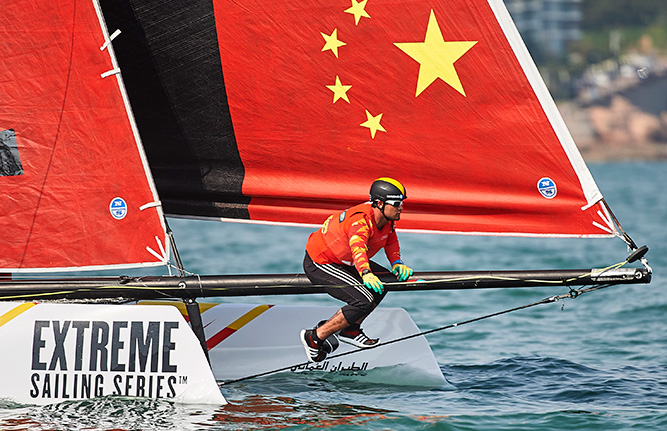
As the location of the sailing events at the 2008 Olympic Games, the coastal city of Qingdao in Shandong province introduced the sport as an extracurricular PE program in local schools in 2006 to raise public awareness. More than 20,000 primary and secondary students have now received on-campus and offshore training in the sport's history, equipment and the physical and technical requirements.

|
Top: A girl practices under the guidance of a coach at the Yao Shine Golf School in Shanghai on April 9. A growing number of primary schools in the city have put the game on their curriculums as an option for PE lessons or as an afterschool activity. Above: A boy learns how to swing a club at the Yao Shine Golf School. Photos By Gao Erqiang / China Daily |
(China Daily 05/09/2016 page6)

Copyright 1995 - . All rights reserved. The content (including but not limited to text, photo, multimedia information, etc) published in this site belongs to China Daily Information Co (CDIC). Without written authorization from CDIC, such content shall not be republished or used in any form. Note: Browsers with 1024*768 or higher resolution are suggested for this site.
License for publishing multimedia online 0108263 Registration Number: 130349