Comments
  Print
Print  Mail
Mail  Large Medium Small
Soccer and samba are the two passions which dominate the Brazilian soul, entwined as in a marriage.
In just more than three months' time it will be Brazil's soccer stars who take the stage for a first home World Cup since 1950.
But first, Rio de Janeiro and much of the rest of the country will sway this weekend to a samba rhythm as the non-stop beat of Carnival affords the populace a pre-Cup chance to have a ball.
The link between samba and soccer represents a fundamental pillar of Brazil's cultural identity.
Samba has its roots in the African slave trade going back much further in time than soccer. But both became mass phenomena in the 1930s as Brazil's main southeastern cities of Rio and Sao Paulo underwent industrialization.
Both became a magnet for former slaves from the plantations and their descendants seeking paid work.
It was during this period that Rio's black working class founded the samba schools that today organize Carnival in its current form.
Soccer, meanwhile, started out as the amateur preserve of well-off white people. Only slowly did the sport open its doors .
"Soccer, samba and Malandro (a rascal or scoundrel) made up the cultural basis of Brazil's popular classes," wrote academic Antonio Jorge Soares, co-author of The Invention of Football Countries.
"The prestige of popular music and Brazil's World Cup victories acted as a kind of counterweight to the deep discredit into which political institutions had fallen," said historian Bernardo Borges Buarque de Hollanda.
The political class was not slow to pick up on both popular passions as a way of offering the masses a distraction, like the "bread and circuses" of the Roman Empire.
The populist regime of Getulio Vargas accelerated the professionalization of soccer during the 1930s.
That was "a means of attracting the support of athletes and the popular classes" by having them "believe there existed a kind of racial democracy in Brazil", Marcos Guterman wrote in his book Football Explains Brazil.
The Vargas regime, inspired by the Italian model of fascism, also decreed that "samba enredos," or song form samba for Carnival parades, should exalt Brazil's history and national values.
The military dictatorship that ruled Brazil from 1964 to 1985 maintained the tradition, with samba schools closely monitored.
Each victory of the Pele-inspired Selecao national soccer side at the 1970 World Cup was similarly hailed as Brazil sought to prove the giant nation's potential.
Legends abound, most emanating from Brazil's black community, on how the Selecao elevated the skill of dribbling a soccer ball to a fine art, using all kinds of tricks and feints to glide past the most dogged opponent.
"In soccer, as in politics, a feature of the Brazilian racial blend is a taste for bending the rules, an element of surprise or frills calling to mind dance steps and capoeira (the martial art which borrows from dancing)," Brazilian sociologist Gilberto Freyre suggested as early as the 1940s.
Mario Filho, author of The Black In Brazilian Football, explained that in the 1920s and 1930s referees would not call fouls by white players on black rivals but did if the fouling boot was on the other foot. Black players therefore had to develop the skill of avoiding contact.
"I was afraid of playing because I had often seen a black player get struck on the pitch for committing a foul," recalled Domingos da Guia, a 1930s international.
"But I was a very good dancer and that helped me on the pitch. I invented the short dribble by imitating the Muidinho, a form of samba."
From Elza Soares, via Jorge Ben Jor to Wilson Simonal, countless Brazilian artists have paid lyrical homage to soccer-samba.
Perhaps the most famous example was composed after Brazil won its maiden world title in Sweden in 1958.
"The World Cup is ours; nobody can do anything to stop the Brazilian," said the lyrics.
"The Brazilian has shown off true football abroad; he has won the World Cup dancing the samba with the ball at his feet."
(China Daily 02/27/2014 page24)
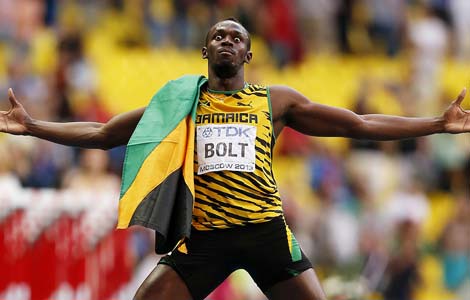
 Bolt, Serena spearhead 2014 Laureus award
 Welcome home, champions!
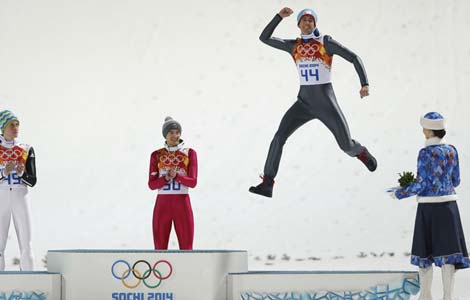 Top 10 moments of podium celebration in Sochi
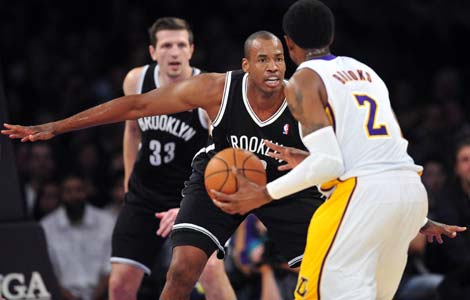 Nets' Collins becomes NBA's 1st openly gay player
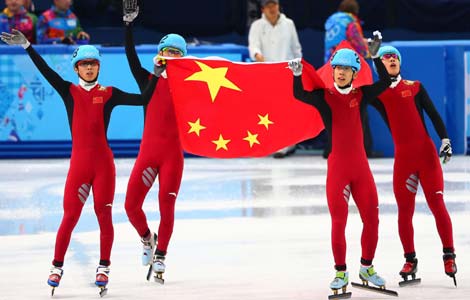 Young talent prevails in China's Sochi journey
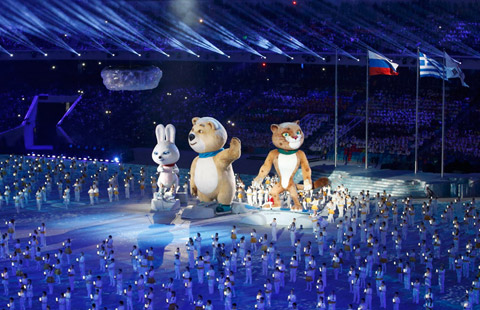 Sochi closes Olympics, clearing shadows of doubt
 Highlights of Sochi Olympics on Feb 23
 China lands 2 silver, 1 bronze on short track

Copyright 1995 - . All rights reserved. The content (including but not limited to text, photo, multimedia information, etc) published in this site belongs to China Daily Information Co (CDIC). Without written authorization from CDIC, such content shall not be republished or used in any form. Note: Browsers with 1024*768 or higher resolution are suggested for this site.
License for publishing multimedia online 0108263 Registration Number: 20100000002731