|
|
Chinese President Xi Jinping (center) visits Port of Duisburg of Germany March 29, 2014. [Photo/Xinhua] |
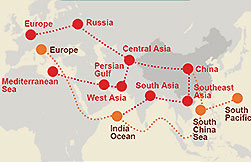
As the top priority for China's peripheral diplomacy in the new era and the major region of activity for the Silk Road Economic Belt and the 21st Century Maritime Silk Road, Southeast Asia occupies a special place in China's "Belt and Road Initiative".
But the initiative faces some challenges. The first is some countries' concern over the Belt and Road. Some people say the initiative smacks of neo-colonialism because they wrongly assume its purpose is to exploit energy and mineral resources in the region, which will harm the regional economies and the environment. There are also cultural concerns that Chinese investment might change the cultures and lifestyles of some countries.
The major concern, however, is geopolitical. Some say the Belt and Road Initiative is akin to the "Marshall Plan" and "String of Pearls", and part of China's grand strategy to change the regional and global orders and seek hegemony. And as neighbors, the members of the Association of Southeast Asian Nations are concerned about China's strategic intentions.
The second is investment risk. Some ASEAN members are undergoing transformation and even facing unrest at home, affecting their relations with China. This poses investment risks that could even end in failure. Typical examples include the abandonment of the "Rice for Train" treaty with Thailand, and the suspension of the Myitsone Dam project and interruption in the Kyaukpyu-Kunming railway project in Myanmar. On China's side, some enterprises do lack professionalism, with a few not having even the basic idea about the laws and customs of the countries they have invested in.
The third challenge is big-power rivalry in the region. As the US pushes ahead with its rebalancing to Asia strategy, it has significantly strengthened its alliances and partnerships with some Southeast Asian countries, as well as consolidated its military presence in the region. The US has been holding military exercises with regional countries more frequently, involved itself in Myanmar's democratic transformation, signed a defense agreement with the Philippines, and relaxed the restrictions on exports of weapons to Vietnam. Washington has also got increasingly involved in the South China Sea disputes on the pretext of defending freedom of navigation but actually to internationalize the disputes and criticize Beijing's reclamation project on the Nansha islands.
Japan and India, too, are taking a lot of interest in the region. Japan has deepened its defense cooperation with the Philippines through a defense agreement and military drills. And India has been closely cooperating with Vietnam on arms sales and exploration and exploitation of oil and gas in the South China Sea. External powers' involvement in the region has intensified tensions, which could be counterproductive for the Belt and Road Initiative.
Given these challenges, China and ASEAN need to strengthen cooperation to promote the Belt and Road Initiative. First, the two sides should cooperate more closely on the security front to build mutual confidence. And to ease ASEAN members' suspicions and concerns, China should be more patient and frank with its security policy and take concrete measures to promote regional security. The two sides can also coordinate and cooperate on specific defense issues like strengthening military exchanges, and holding more joint training programs and drills.
Second, the two sides need to strengthen economic cooperation. China, on its part, should pay special attention to ASEAN members' demands and needs, and take measures to integrate its economic strategies with them on the principle of "jointly built" in order to allay fears over China dominating the projects. Also, it is important for Chinese enterprises to learn about and observe local investment policies and rules, and ensure the projects serve the interests of the local people by, for instance, spreading education and creating jobs.
Third, the South China Sea issue has to be properly handled. China and ASEAN can cooperate on maritime security under the "dual-track" approach. Maritime disputes can be negotiated through bilateral dialogues, while China and ASEAN can have multilateral maritime cooperation on issues such as resource development and protection, freedom of navigation, maritime research and rescue operations.
This being the Year of China-ASEAN Maritime Cooperation, the two sides should seize the opportunity to develop the action plan for the 21st Century Maritime Silk Road.
The author is with the National Defense University of the Chinese People's Liberation Army.
Related Stories
Copyright 1995 - . All rights reserved. The content (including but not limited to text, photo, multimedia information, etc) published in this site belongs to China Daily Information Co (CDIC). Without written authorization from CDIC, such content shall not be republished or used in any form. Note: Browsers with 1024*768 or higher resolution are suggested for this site.
License for publishing multimedia online 0108263 Registration Number: 130349