|
|
Chinese President Xi Jinping (C, front) poses for a group photo with the delegates attending the signing ceremony for the Articles of Agreement of the Asian Infrastructure Investment Bank (AIIB) at the Great Hall of the People in Beijing June 29, 2015. China will hold a 30.34 percent stake in the Asian Infrastructure Investment Bank (AIIB), the Finance Ministry said on Monday, making Beijing the largest shareholder in a bank that is expected to project the country's growing influence. [Photo/Agencies] |
Financial leaders of 57 states gathered in Beijing on Monday to sign the agreement for establishing the Asian Infrastructure Investment Bank (AIIB), expected to become the region’s largest investment bank in the 21st century.
Seventy years ago, the World Bank was established, led by the US and its close western economic and political allies, as the first global financial institution. Along with the World Trade Organization and the International Monetary Fund, the western powers have commanded world financial and trade order for more than half a century. Even the Asian Development Bank (ADB), established 20 years later after the World Bank, has been largely controlled by Japan, backed by the US and other western economic powers.
China benefited from the global and regional development and financial institutions in the initial stage of economic reform and openness. As China expanded its economic strength it has aggressively contributed to financing them. However, despite its financial contribution to these institutions rising significantly China still has limited influence over management and operation.
China’s desire to influence world financial order and its inability to do so have been due to the governance structure of these institutions where China is not only a minority shareholder but its voting rights are marginalized.
Since the world financial crisis, triggered by the US subprime mortgage crisis and the EU’s debt problem, China’s relative importance in the world economy has risen rapidly. By 2010, it surpassed Japan to become the world’s second largest economy, and by 2012 it overtook the US to become the world largest trading nation as well as the largest producer and consumer of motor vehicles.
Apart from China’s second-to-none manufacturing capability, it holds the world’s largest foreign exchange reserves which have to be used effectively so they can generate a financial return and make appropriate contributions to infrastructural development in Asia, the largest and fastest growing region among all continents.
In addition, China, India, Russia and other initial AIIB member states have the financial strength and managerial confidence to create a new financial institution similar to the World Bank and ADB. For the initial $100 billion fund to be pledged, China has agreed to contribute 29.7 percent, India 8.3 percent, Russia 6.5 percent, Germany 4.4 percent and South Korea 3.75 percent. Other major contributors include the UK, Australia and Indonesia.
Both the US and Japan have not expressed their intention to join AIIB although many US political and economic allies have come to Beijing to sign the agreement, particularly the UK, Germany, France, Italy and Australia. The diversion of these countries' attention away from the US to China and Asia not only reflects ever rising business opportunities in Asia, but also the relative decline of the US-led western influence on the global economy and financial order.
The apparent shift of economic gravity from the West to the East reminds me of my personal experience in the past. Thirty year ago, I was awarded a World Bank scholarship from a university in Hainan to study in the UK in 1985. At that time, the salary of a Chinese university lecturer was less than 1 percent of his UK counterpart. Today, all the top Chinese universities are able to pay significantly more than the equivalent UK or US salaries to attract overseas talents to work in China. In addition, numerous university teachers in China can easily apply for more research funding than their western counterparts.
Although China is still a developing economy by definition, it has exceeded many western powers in a number of areas such as equipment manufacturing, high-speed railways, nuclear power, construction, infrastructure engineering and space technology. In 2014, Chinese scientists produced the second largest number of high-impact academic journal papers in the world.
China started the first high speed railway 30 years later than Europe, but by 2014, has built 16,000 km of high-speed tracks, twice as long as the total length of all the EU countries put together. BYD, one of China’s private auto makers, has marched to California to build electric buses for the local market.
India is racing to follow in China’s footsteps. Its economy was growing as fast as China in 2014 and is set to overtake China’s growth in 2015. However, India’s transportation systems are so poor that they are evident constraints on the country’s development. It is expected that India will require $1 trillion to improve its transportation systems, and the establishment of AIIB will be helpful to its development needs. Other Asian countries face similar problems of investment for roads, railways, airports, seaports, telecommunications and internet.
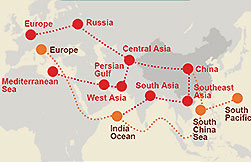
AIIB will become a potent propeller to accelerate economic and social development in Asia. Along with the Silk Road Fund and the Brics Bank, China will use AIIB to implement its “one- belt and one-road” regional and global development strategies.
The Silk Road Economic Belt and the 21st Century Sea Silk Road will cover more than 60 countries surrounding China, and many will benefit from China’s outward-looking investment and development strategies. Under Xi Jinping’s leadership, China has gained increased support from neighbouring countries in Asia and many others in Latin America, Europe and Africa, thanks to its persistent foreign policy of peaceful cooperation, mutual benefit and common prosperity.
The future operation of the AIIB may face many challenges and uncertainty, but the AIIB has signified the rapid emergence of China, India and other developing and transitional economies. The determination and confidence for success through the AIIB and other newly created financial institutions suggest that the world financial and political order will be different from now, as the overwhelming dominance of the World Bank and ADB in Asia and the world financial systems will inevitably decline in the future.
The author is a professor of economics, Chongqing University and the University of Nottingham.
Related Stories
Copyright 1995 - . All rights reserved. The content (including but not limited to text, photo, multimedia information, etc) published in this site belongs to China Daily Information Co (CDIC). Without written authorization from CDIC, such content shall not be republished or used in any form. Note: Browsers with 1024*768 or higher resolution are suggested for this site.
License for publishing multimedia online 0108263 Registration Number: 130349