-
-
MSNBC Marquee

Rihanna’s dad cut out of her life ‘over nothing’
Rihanna and her father both spoke to the press about their most recent estrangement.
Hot Pot Column
Saintly Sinner
By Raymond Zhou (China Daily)
Updated: 2009-11-27 09:58
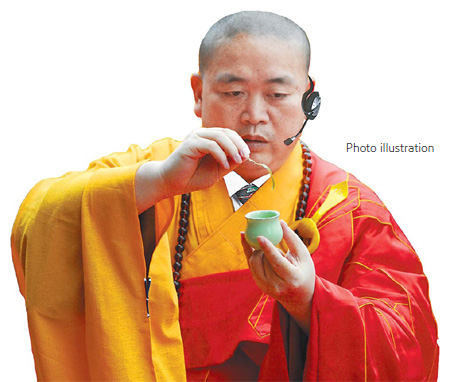
Shaolin Temple's website recently took on a new look.
First, hackers splashed the slogan: "Die, Shi Yongxin, you evil rebel of Shaolin Temple!" on the website. Then it was replaced with a "letter of contrition", supposedly from Abbot Shi, complete with a photo. In it, Shi "apologizes" for commercializing the temple and its kungfu traditions.
I liked the second approach better because it was ironical and reminded me of something that happened in the 1980s. A bunch of local officials had taken all the slots for housing, back when they were dispensed as employee benefits. Regular employees, out of frustration, complained to the press. But nobody listened.
Then, one of them came up with an alternative idea. He wrote to another newspaper, praising his bosses for "giving all the housing units to those in need and not taking one for themselves". The paper published the letter, without verifying it, adding a comment that extolled the noble stance of the cadres.
The "positive" story essentially undid the officials, who were hurled into the public domain by the unintentionally satirical article. Eventually, they had to return what they did not deserve in the first place.
If the cyber-attackers who hacked into the Shaolin site harbored similar intentions, they may comfort themselves
by the fact that Shi claims to have been "spurred on" by the incident.
This was a brilliant choice of word. "Biance" refers in Chinese to a form of encouragement if you do something right, or punishment if it is something wrong. It did not infer that Shi would change his ways and he showed his contempt by calling the attack a "joke".
I must admit, Shi was steadfast in the face of such cyber-age adversity. Had he flown into a rage he would have vindicated his enemies by proving himself un-Buddhist. Yet his composure was not a sign of detachment from worldly troubles, but rather a diplomatic coup in defending the practices for which he had been vociferously criticized.
Shi added his salary is between 100 and 200 yuan a month ($14.60-$30), while some monks, supported by secular donations, may earn up to 1,000 a month.
This is a typical case of partial truth. It's like the recently revealed salary list for some of China's biggest stars, which range from 1,000 to 3,000 yuan a month. It defies logic. I know of some junior monks in my hometown who make 10 times as much as the abbot. What he referred to might be the base salary, but it accounts for a negligible fraction of his real income.
On the other hand, I must add that cyber-attacks are wrong. Rumor-mongering is worse. The Internet story that Shi wines and dines and keeps mistresses has not been independently corroborated. His lavish new robe (the gold thread alone costs 50,000 yuan, or $7,300) could be seen as a work-related expense. And the government award three years ago of a Volkswagon worth over 1 million yuan seems fair enough, in view of what he has achieved for the county.
Shi, arguably China's best-known Buddhist, is loved and hated in equal measure. As a business executive, he is among the best in the country, and probably wildly underpaid. But as a religious leader, he has an image problem because of his secular activities.
Before Shi, Shaolin Temple existed mostly as a legend in Hong Kong kungfu flicks. He is largely responsible for turning it from a myth into an institution. Tourists, Buddhist or not, can buy a ticket for 100 yuan to visit the temple. They can enroll in one of its many martial arts schools even if they have never been to Henan province, by dropping in on one of its branches around the world, operated as a kind of franchise, or catch one of its touring performances. There is even a movie on the way, starring Jackie Chan and Andy Lau, produced by a company set up by the abbot.
No wonder the local government in Henan has been showering the master monk with accolades and prizes. Shaolin has become a big brand and an important business.
But at what cost?
If you care to ask anyone who has recently visited the temple, you'll learn that they tend to find distress rather than peace in the supposed halls of harmony and tranquility. Everything comes at a price. It's just like another money-grabbing venture. There is little room for spirituality.
Nobody criticizes a business for being profit-oriented, on condition it abides by laws and ethics. But religion, like education, usually falls into the non-profit category. You don't want practitioners to starve, but you don't expect them to roll in cash. It simply does not seem right.
Shi's fame and fortune are not unique. Many temples function as tourist attractions. In the United States, televangelists build up their brand names and channel immense wealth into their deep pockets.
Shaolin is synonymous with martial arts and its history is punctuated with occasional forays into secular dealings. Its warrior monks helped a Tang (618-907) emperor quell a rebellion and, in return, got his majesty's license to kill and eat non-vegetarian food.
In a sense, the temple under CEO Shi's management thrust itself onto the battlefield of wheeling and dealing. It became commercial just as large numbers of people wanted to flee from the rat race of job seeking, stock-price speculation and bottom lines.
Buddhists engage in long spells of meditation; Shaolin monks excel in ass kicking; its commander-in-chief becomes a globetrotting guru determined to turn the temple into a multinational conglomerate. Tranquillity? Yes, it's available - for a price.
Is this sacrilegious? I don't know. I'm not in a position to judge because I'm not a Buddhist.
It appears, Shi has to have two faces: As an abbot he must act serene and dignified, giving only cryptic answers to mundane concerns; but as a manager he has to deal with cost-benefit analysis and expansion plans. He should have hidden the second face behind the first. His sin, if it can be so called, is his inability to switch gears seamlessly.
What can he do in such a dilemma - except resorting to hypocrisy?
I once interviewed a Tibetan entrepreneur who had a hard time convincing his sales people that what they did agreed with their religious beliefs. "When you sell $1 of goods, you're committing 10 cents to the happiness of your afterlife because you earned it ethically. If you make money by evil means, you'll add 10 cents to your record of evil," said Dawa Dunlop. "Doing good and doing well can overlap."
Shi Yongxin's true calling is make money. Just don't see him as anything but a business leader.