Unmanned robots delivering a smart future
( China Daily )
Delayed food and drink deliveries could soon be a thing of the past as autonomous delivery robots start to appear in shopping malls and office buildings, making deliveries faster, smarter and more cost-efficient.
Segway Robotics, a wholly owned subsidiary of Beijing-based high-tech startup Segway-Ninebot has launched an autonomous delivery robot in Chaoyang Joy City in Chaoyang district of Beijing.
Wang Ye, president of Segway-Ninebot said the robot can carry 50 kilograms and travel at a maximum speed of 1.2 meters per second. It can work for 10 hours a day, travel in elevators on its own, avoid pedestrians and obstacles intelligently at any time, as well as design optimal paths.
"When the robot arrives at an elevator, it will send instructions to the central control system of the elevator via a wireless network, and then the doors will open," Wang said.
The application of the delivery robots will be extended from buildings to outdoor spaces, and the company will mass produce such robots and launch more delivery robotics services with its partners in the future, according to Wang.
Segway Robotics is a privately held company that focuses on developing and commercializing personal robots. Founded in 2015, the company has notable backers including Sequoia Capital, Intel Capital and Xiaomi Corp.
It has partnered with Meituan-Dianping, China's largest on-demand service provider, to accelerate the application and commercialization of unmanned delivery technologies.
Similar robots have also appeared in the State Development & Investment Corp Ltd building in northeast Shanghai. The SDIC building sought cooperation with startup Yogo Robot for the latter's Kago series of food delivery robots in late August.
By typing their phone number on a screen installed on the top of the robot, people working in the building can access food deliveries stored in the "belly" of the robot, eliminating the need for throngs of deliverymen waiting at the gate of the office building.
According to Geng Yongjun, head of Guotou Real Estate Management Co's Shanghai branch, the robot is connected to the office building's access control system and the lifts. When the lift doors open, the robot will enter once it confirms there is no obstacle inside. It will also sound greetings to warn people of its presence. In one month, the robot has delivered up to 30 orders.
"We used to have a box in the corner of the lobby for food deliveries. This got rid of the lines of deliverymen waiting at the gate, but we could not keep the food warm or the box clean and tidy. With this robot, such problems can be easily solved," he said.
Zhao Ming, founder of Yogo Robot said that robots are designed to change people's way of life and make their lives more interesting. This is why they have been introduced to take care of indoor deliveries as they can help office buildings better manage the process, he said.
Founded in January 2016, Yogo Robot raised more than 10 million yuan ($1.5 million) 10 months later.
Before the launch of the Kago series of food delivery robots, Yogo rolled out the Mingo robot in 2016, which specializes in providing information to hotel guests and taking orders at restaurants. In late 2016, Mingo robots were put into operation at the Crown Plaza in the Dishuihu area of Shanghai.
"Robots themselves are of no value unless they are used in valuable industries to solve certain problems," Zhao said.
Beijing-based Yunji Technology has also rolled out a similar robot named Run. Introduced to the market in January 2016, the robot has mainly been used in hotels. To date, the robot is employed in 400 hotels worldwide, including Singapore, Australia and South Korea.
The robot mainly runs errands, bringing all kinds of things to guests' rooms. Just like a human employee, the robot also gets paid each month-about 5,000 yuan-according to Zhi Tao, chief executive officer of Yunji Technology. From time to time, it even gets tips, she said.
"Robots for commercial services will improve industry efficiency and provide more pleasant working and living environments for people. Although such robots are in their infancy at present, their roles will certainly grow in the future," she added.
According to the Ministry of Civil Affairs, the number of people over 60 years old will reach 243 million by 2020, accounting for more than 17.2 percent of the population. It is expected that this figure will surpass 300 million in 2025.
The rapidly aging population will lead to a decrease of labor supply in the catering and hospitality industry, which will result in rising labor costs.
More and more enterprises are aware of the significance of adopting unmanned delivery robots, which is becoming the new driving force for the transformation and upgrading of traditional industries.
Experts say that with the advent of the AI era, unmanned delivery robots could undertake tedious work, such as handling orders and deliveries, freeing people to be engaged in more valuable work.
Statistics from market consultancy Analysys show the market scale of China's service robots will reach 12.29 billion yuan in 2018, an increase of 27.2 percent year-on-year.
Keenon Robotics Co Ltd, another Shanghai-based intellectual service robot manufacturer has launched autonomous service robots that can be used for shopping, providing information, food and beverage delivery and other services.
Equipped with a fully autonomous positioning and navigation system, the company's Peanut delivery robot has the ability to navigate precisely, allowing it to move freely in a complex indoor environment.
Such delivery robots have been introduced in some restaurants and hotels, with the aim of upgrading workflow, reducing operation costs and helping enterprises achieve intelligent management.
Li Tong, CEO of Keenon Robotics said: "Robots need to coexist with people when working in restaurants, so we should give top priority to security. Moreover, the robots should be efficient and stable, without hardware and software breakdowns."
Li said the robot's smart voice recognition system could receive users' orders accurately and give responses quickly, and its infrared perception system could detect the status of goods in its pallet.
"The delivery robot returns automatically, as quickly as a person, to clear away empty dishes, while multiple robots can cooperate with each other effectively in the same working environment," Li added.
In addition, autonomous delivery robots have been introduced in outdoor environments. China's e-commerce giant JD launched robot deliveries in Beijing's Haidian district in June. With a maximum speed of 15 kilometers per hour, the robots, which are equipped with radar and sensors to help them recognize traffic lights and their surroundings, can carry up to 30 parcels at a time.
Customers receive a message from JD when the robot is about to arrive, and are able to collect their parcels using facial recognition, by inputting a code or using a mobile phone app.
"Unmanned deliveries represent a potential development direction of future logistics, which is one of the reasons why e-commerce and logistics enterprises are actively experimenting at present," said Wang Xiaoxing, an analyst with Analysys.
This delivery method will help solve the labor shortage issue in the express industry, reduce delivery costs and improve efficiency, but the industry is still in its infancy and should be further tapped, Wang said, adding that more time is needed to realize large-scale commercialization of unmanned delivery robots.
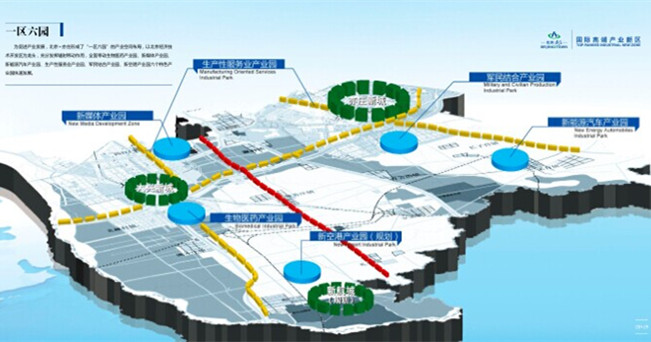 The Area with Six Parks
 Global Top 500