New industrial wave will boost economy
( China Daily )
 |
|
Workers install solar panels in Golmud, Qinghai province. [Photo/Xinhua] |
The nation's next wave of growth will be fueled by new industries such as biotechnology, clean energy and advanced manufacturing, according to a government think thank.
The transformation is expected to generate massive job opportunities by upgrading the skills of workers across the country's business sectors.
"Strategic emerging industries will help the world's second largest economy bottom out from the economic downturn cycle," said Zhao Changwen, director of the Department of Industrial Economy at the Development Research Center. The department is a government think tank affiliated to the nation's top economic planner, the National Development and Reform Commission.
Gross domestic product growth reached 6.9 percent in the first half of this year after decades of double-digit expansion.
In a move to plan for the future, the government has rolled out preferential policies to support the development of "strategic emerging industries" since 2009.
Key categories include biotechnology, advanced and high-end manufacturing, clean energy, information technology, digital industries, next generation IT and new energy projects, such as e-vehicles.
These sectors have been earmarked as strategic industries, the NDRC revealed earlier this year.
Boosting employment was a key component in the industrial shift, it said.
By the end of 2020, one million jobs are expected to be created by strategic emerging industries each year, according to the nation's 13th Five-Year Plan (2016-20).
"It is hard to make a precise calculation of how many jobs will be created," Zhao said. "The government has been expanding the catalogue (of new industries).
"But creating one million jobs a year is not a difficult target to achieve," he added. "We might achieve more than that."
Zhao stressed that employees would be retrained and switched from traditional businesses to new advanced sectors, as the country weans itself off heavy industries.
New emerging industries, such as next generation IT and information technology sectors, are already popping up, and creating job opportunities through internet integration.
Last year, about 5.85 million people were working on platforms related to the "shared economy".
This was up by 850,000 compared to 2015, a report by China e-Business Research Center showed earlier this year.
Still, emerging industries have yet to solve problems such as job losses amid economic restructuring. Zhao, though, is confident that will eventually change as emerging industries expand in the next a few years.
By 2020, the added value output of strategic emerging industries is expected to account for 15 percent of the nation's total GDP, up from 8 percent last year, according to the 13th Five-Year Plan.
During the same period, China wants five new pillar industries to each generate output of 10 trillion yuan ($1.47 trillion). This would include information technology, biotechnology, and green and low-carbon industries.
Official data showed profits made from key emerging industries jumped by 13.3 percent year-on-year in the first five months of 2017. This was 1.8 percentage points higher than the same period last year.
"While progress has been made, supervision and supportive measures need to be improved," said Fei Zhirong, deputy secretary general of the NDRC.
Increased investment and protection of intellectual property rights are needed to help expand the emerging industries sector, Fei said. The government also needed to address imbalances in regional development.
"Many high-tech emerging industries prefer to invest and build factories in the eastern part of China," Fei said. "It might become a concern leading to imbalanced growth."
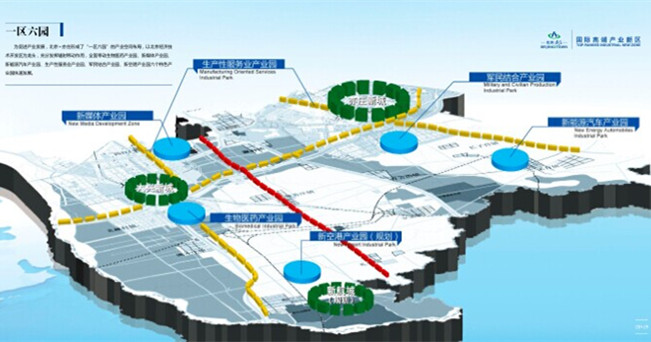 The Area with Six Parks
 Global Top 500