Hefei


Population:
As of the end of 2018, the registered population was 7.58 million, and the permanent resident population was 8.09 million with an urbanization rate of 74.97 percent.
Area: 11,445.1 square kilometers
Geography and climate
Hefei is located on the shore of Chaohu Lake, in the lower reaches of the Yangtze River in eastern China. There are three kinds of terrain in the city: hilly land, low mountains, and low-lying plains - but the hilly land is the main type. The Yangtze-Huai watershed runs from west to east across Hefei. The city's altitude is mostly between 15 and 80 meters, with an average altitude of 20 to 40 meters.
Located in a mid-latitude zone, Hefei has a humid, subtropical monsoon climate, featuring a monsoon period, four distinctive seasons, a mild climate, and moderate rainfall. The average annual temperature is 15.7° C, the average annual precipitation is about 1,000 mm, the annual sunshine time is around 2,000 hours, the average annual frost-free period is 228 days, and the average relative humidity is 77 percent.
History and culture
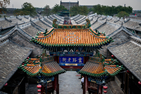
Hefei is located in the center of Anhui province and was named after the confluence of the Fei and Shi Rivers. It is a famous historical and cultural city in China. As early as the Neolithic Age, there were human activities here. It has a written record of more than 4,000 years. Hefei itself has a history of more than 2,200 years, from the establishment of the Qin Dynasty (221-206 BC). It is known as the "Site of the Three Kingdoms and the Hometown of Bao Zheng" (999-1062, known as Bao Gong, a figure of justice and integrity in China), and is also known as "Luyang" or “Luzhou”, since it has been the government site of Luzhou from the Sui to Ming and Qing Dynasties.
Economy
The central government has rolled out plans to build Hefei into one of the three national science centers in China, along with Shanghai and Beijing. Planning documents show Hefei will focus on information technology, new energy sources, life sciences and environmental protection. Scientists based in Hefei will also aim for research breakthroughs in quantum communications, nuclear fusion, smog prevention and cancer treatments.
Hefei's growing reputation as a scientific center has increased its appeal to foreigners. Hefei has been ranked alongside Shanghai and Beijing as the three cities that are the most attractive to foreigners who are living in China, according to an annual poll conducted by the State Administration of Foreign Experts Affairs.
Hefei’s GDP was 782.29 billion yuan ($112.35 billion) in 2018, an increase of 8.5 percent over the previous year after calculations of comparable prices. The added value of primary industry was 27.76 billion yuan, with an increase of 2.2 percent; the added value of secondary industry was 361.23 billion yuan, with an increase of 9.5 percent; and the added value of tertiary industry was 393.31 billion yuan, with an increase of 8.0 percent. The ratio of the three industrial sectors was 3.5: 46.2: 50.3, and the proportion of tertiary industry in GDP exceeded 50 percent for the first time. Per capita GDP was 97,470 yuan (US $14,729), with an increase of 9,014 yuan over the previous year.
By the end of 2018, 46 overseas World Top 500 companies had set up business in Hefei. A total of 140 foreign-funded enterprises settled in the city last year, with actually-used foreign direct investment reaching $3.23 billion. The export-import value was $30.813 billion, with the export value of hi-tech products accounting for 44.2 percent of the total.
Administrative divisions
Hefei currently has four counties (Feidong, Feixi, Changfeng, Lujiang), one municipality (county-level Chaohu City), four districts (Yaohai, Luyang, Shushan, Baohe), and four development zones (Hefei High-tech Industry Development Zone, Hefei Economic and Technological Development Zone, Hefei New Station High-tech Industrial Development Zone, and Hefei Chaohu Economic Development Zone)
Ethnic minorities
Hefei is a multi-ethnic city, including 43 ethnic minorities. The minority population is 48,000, accounting for about 0.6 percent of the city's total population. Hui are the most populous minority, and Manchu have a population of more than 3,000. Feidong County is the most centralized area for Manchus in Hefei. The distribution of ethnic minorities in the city is a "general scattering with local concentrations". All counties (cities), districts, and most townships and streets are populated by ethnic minorities, and nearly two-thirds live in remote villages.
Resources
Hefei is blessed with advantageous natural conditions and is rich in water, land, mineral, agricultural and tourism resources. Hefei is located in the subtropical monsoon climate area, featuring abundant rainfall, and plenty of available water resources at a low cost. The total natural water resources are 3.86 billion cubic meters. The surface water system is relatively developed. Hefei is bound by the Yangtze-Huai watershed: to the north is the Huaihe river system, and to the south is the Yangtze river system. The Chaohu Lake is one of the five largest freshwater lakes in the country, with a water area of 770 square kilometers.
The mineral resources of Hefei include dolomite, granite, phosphorus, iron, lead, zinc, silver, alum stone, gypsum, limestone, and mineral water. Feidong County's phosphate mineral reserves rank second in Anhui province. Lujiang County is known as the "underground cornucopia". The lead, zinc, pyrite, and alum stone reserves of Lujiang rank first in the province, and copper mines rank second. Lujiang’s pyrite reserves account for one-half of those of Anhui, and the iron ore reserves account for one-third of those of the province.
Hefei is an important production area for agricultural and sideline products in China. The main food crops are rice and wheat, and the main cash crops are oilseed rape, cotton, fruits, and vegetables. Hefei has a developed livestock and poultry breeding industry and abundant special agricultural products, which has led to it being given the title of "China’s Capital of Crayfish" and “China’s Capital of Roasted Seeds and Nuts”. The famous agricultural products in Hefei include Sangang’s sampling and flowers, Changfeng’s strawberries, Gaoliu’s white geese, Zhuxiang’s piglets, Chaohu’s silverfishes, Huaixiang’s rice, Daping’s oil, and Ketan’s organic tea, all of which are well-known in China.