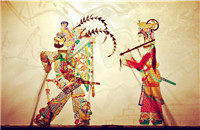
Four Treasures support two millennia of study


|
The Four Treasures of Study - brush, ink stick, paper and ink stone - are the great contributions to the Chinese culture. |

|
The compass made in Wan'an, Xiuning county, can be used for both Fengshui and navigation. |

|
The ink stick produced in Huizhou has a thousand years of history. |

|
The painted pottery of Jieshou features decoration with tricolor carvings. |

|
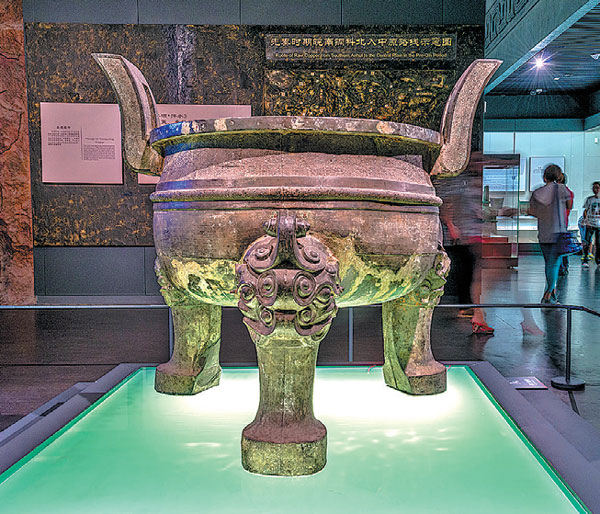
The Ding cauldron discovered in Anhui is evidence of the province's high level of bronze ware manufacturing technique during the Warring States period. |
|
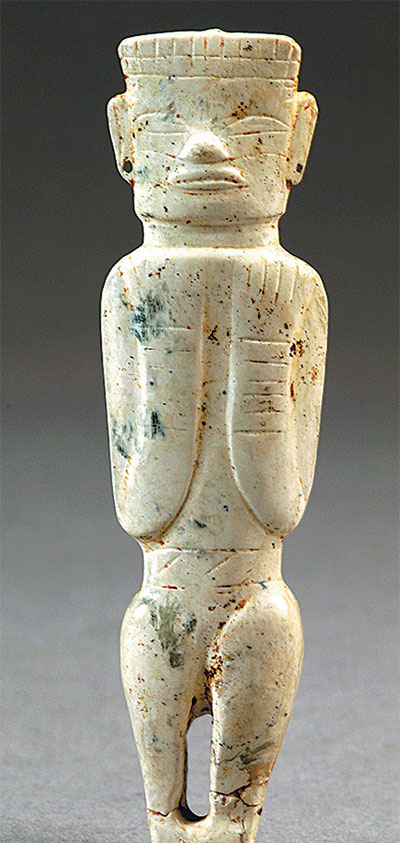
The discovery of this jade figure in Lingjiatan shows the locals' craftsmanship of more than 5,000 years ago. |
People who are familiar with Chinese calligraphic art should know the "Four Treasures of the Study". It is an expression used to denote the brush, ink stick, paper and ink stone.
The best of the "Four Treasures" products have been and are still produced in Anhui province.
Xuan Paper, known as Xuanzhi, was named after the origin of its production - Xuancheng, a city in southeastern Anhui province.
This particular form of paper upholds the marks made by Chinese brushes and ink.
Though soft and fine-textured, it has a high tensile strength and resistance to distortion and color changes, gaining it the reputation of "the paper of a thousand-year history".
The special processing methods of the paper determine its exceptional quality. The paper can be made unprocessed, half-processed or processed.
The various processes are used for controlling the amount of ink absorbed into the paper fiber, as well as the stiffness of the paper itself.
Unprocessed papers are very absorbent and quite malleable, whereas processed papers are far more resistant to absorption and stiffer.
The processing methods for Xuan Paper were listed in the first batch of national intangible cultural heritage items in 2006.
Paper and writing brushes are indispensable in calligraphic art. Xuancheng's brushes have also won fame over the past 2,000 years.
The brush is nothing like the pen we use today. It is soft because it is made of hair from animals such as rabbit, goat and wolf.
With elegant decoration, clean animal hair and neither too-soft nor too-hard brush points, the brushes of the best quality made in Xuancheng were exclusively supplied to emperors in the past.
The ink stick produced in Huizhou - today's Huangshan city - also has a thousand years of history. The ink stick is mainly made out of pine soot and 20 other materials, and is then glued together and pressed into the shape of a chocolate bar and allowed to dry.
The ink stick has a rich and thick color, subtle gloss and fragrant scent because of the precious ingredients. It also possesses antiseptic and moth-proofing properties.
The last treasure, the ink stone, is used to grind the ink stick into a powder to be mixed with water.
The She ink stones from Shexian in southern Anhui used to be regarded as one of the most famous ink stones in China.
The ink stones made there can keep the ink wet for a long time, while the smooth surface of the ink stone can protect the fragile point of brush.
The stones produced there are rich in natural texture, with a variety of texture patterns available, making each ink stone unique.
As one of the important cradles of Chinese culture, Anhui doesn't just have ink and paper.
Wuhu, another city in Anhui, produces a special kind of "painting" by using iron as ink, and a hammer as the pen.
Drawing on the experiences of Chinese folk art such as paper cutting, sculpture and mosaics, the painters depict landscapes, people, flowers, insects, fish, birds, animals and other figures out of iron materials.
The black iron material and the white background create a strong contrast, endowing the iron painting with the artistic characteristics of Chinese classical paintings made with ink and paper.
Huizhou carvings are the local art in Huizhou include brick, stone, wood and bamboo carvings. The carvings are used for residential buildings, ancestral temples, memorial halls and other types of building decorations as well as furniture, screens, pens and other craft production.
Jieshou, a city in northern Anhui, is renowned for its painted pottery.
Originating in the Sui (581-618) and Tang (618-907) dynasties, the painted pottery in Jieshou prevailed during the Ming (1368-1644) and Qing (1644-1911) dynasties. It inherited the style of Tang tri-colored pottery and adopted the exquisite techniques and styles from other artistic forms, such as Chinese paper cutting and new year woodcutting.
The main products are utensils for daily use, such as bottles, jars and jugs, decorated with tri-color carvings. The thick and primitive shape, vivid carvings and unique reddish brown, beige and white color scheme are the characteristics of Jieshou's painted pottery. Frequently used subjects for painting include characters from folk stories, landscapes, flowers, birds, fish and grass.
(China Daily 04/11/2017 page26)