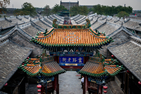
Chengdu Center plays on ancient past to stoke future growth


Chengdu, one of China’s most famous historical and cultural cities, is striving to restore its glory from the ancient past.
A key step is to build a series of cultural landmarks, such as the Chengdu Center.

The Chengdu Center will be built in the heart of Chengdu’s urban area, next to Tianfu Square in the city’s Qingyang district.
The Chengdu Center is designed to cover 115 hectares. It will mainly consist of three parts: the Donghuamen ruins park in the southeast, the Mohechi ruins park in the west and the Chengdu Sports Center in the northeast.
The Chengdu Center is located at what has been the center of Chengdu throughout history in terms of geography, politics, culture and education, said Xiao Ping, an expert on Chengdu history and deputy chief of the Chengdu Library.
The Donghuamen ruins park, covering 5.3 hectares, will protect relics discovered at the original site.
The ruins were excavated from 2013 to 2014, when archeologists discovered a number of relics dating back to the Han Dynasty (206 BC-AD 220) up to the Ming Dynasty (1368–1644), including city walls, streets, houses and yards, wells, ponds, as well as ceramics, coins and iron and bronze items.
“The discovery of the Donghuamen ruins is of vital importance. It proves that this area has been the center of Chengdu since the Han Dynasty,” said Xiao, adding that the discovery also helped Chengdu win recognition as one of China’s top-10 ancient capitals.
The Mohechi ruins park will restore part of Mohechi, a manmade lake and a popular spot for relaxation during the Tang Dynasty (618-907). The park will cover 10.3 hectares, 30 percent of which will be water.
The Chengdu Sports Center, which was put into use in 1992, will be upgraded into a complex for both cultural and sports activities. The number of seats at the center will be increased to 55,000.
The roof of the sports center will look like a blooming hibiscus flower, or the famous “Sun Bird” gold foil unearthed at the Jinsha Ruins in the city’s Qingyang district in 2001.
The hibiscus is the city flower of Chengdu. The “Sun Bird” gold foil, which dates back to 3,000 years ago, is a symbol of China’s cultural heritage.
The area surrounding the Chengdu Center will be mainly used to develop financial business.
“We expect the Chengdu Center to take its place among the world’s first-class downtown parks, just like Central Park in New York City and Hyde Park in London,” said Guan Lan, an official in charge of the Chengdu Center project.
He said the Chengdu Center, together with the cultural facilities around Tianfu Square, such as the Chengdu Museum, Sichuan Library and Sichuan Art Museum, will act as the “Reception Hall” of Chengdu to welcome guest from all around the world.
“Chengdu is developing into one of China’s most recognized, world-class cities. We hope the construction of the Chengdu Center can help realize our targets,” he said.
Zhen Xiaoping, chairman of the China Federation of Literary and Art Circles, said the Chengdu Center will not only be a showcase for culture, but also a pilot zone leading the integrated development of cultural industries and the cultural undertakings of Chengdu and even Sichuan.
“Through creative reconstruction, the Chengdu Center can create a new cultural ecosystem that boosts the development of the city’s cultural creative industries,” he said. He suggests the city fully make use of the Chengdu Center to develop technology, tourism and sports based on its cultural advantages, which will contribute to the economic restructuring, transformation and upgrading of Chengdu.
History of Mohechi
Mohechi was an artificial lake dug during the Sui Dynasty (581-618) when Yang Xiu, then the King of Shu, built the city walls using soil from the site, according to historical records.
Yang was the fourth son of Yang Jian, or Emperor Wen of the Sui Dynasty.
Mohechi used to cover an area of 33 hectares and functioned as the city’s “central park”.
During the Five Dynasties and Ten Kingdoms period (907- 960), it was converted into a royal garden.
The lake became a famous tourist spot for centuries.
Many famous poets, such as Du Fu and Xue Tao of the Tang Dynasty (618-907), Lu You of the Song Dynasty (960-1279) and Lady Huarui of the Five Dynasties and Ten Kingdoms, have written about the lake.
The lake got smaller after the Tang Dynasty. During the Ming Dynasty (1368-1644), Zhu Chun, the King of Shu, filled most of the lake to build a palace.
The palace was destroyed in the war during the late Ming Dynasty and early Qing Dynasty (1644-1911).
In 1914, the last part of the lake was filled to build a drill ground by the local military.
The site was rediscovered by Chengdu’s archaeologists in May 2014.
 |
|
The Chengdu Center plan involves building a city center embodying both the modern and ancient charms of Chengdu. [Photo provided to China Daily] |
 |
|
The Donghuamen ruins park (left) and its surrounding commercial, cultural and sports facilities give people a glimse of the past and present of Chengdu. |