"For the people, food is heaven," said Sima Qian, a historian in the Western Han Dynasty (206 BC-AD 24). Today, these words still ring true. The Chinese respect and passion for food is firmly entrenched in the cultural landscape, with a culinary scenery that reflects the vast geographical footprint of the world's most populous country. Pauline D. Loh offers a view from the table.
The Cantonese from southern China, pioneers of the diaspora, were the first to take the flavors of home abroad. In every Chinatown in almost every Western city, the introduction to Chinese food has often been dim sum, or dianxin, food that touches the heart, served piping hot in little bamboo steamers.
These delicate snacks and pastries are not the only dishes from the south. Guangdong province lies across the Pearl River Delta, a land of milk and honey brimming with mountain pleasures and marine treasures.
|
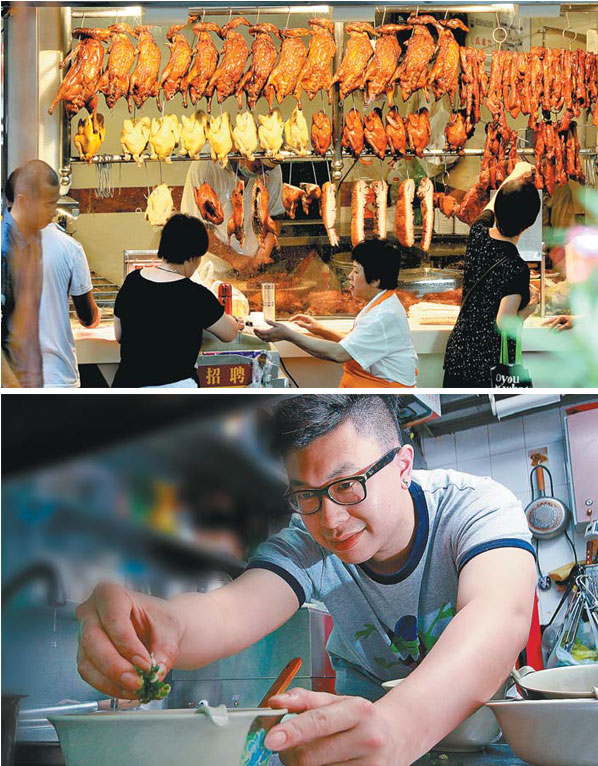
(Top) A shop sells Cantonese-style barbecue meats in Guangzhou. (Above) A chef adds a sprinkling of spring onion before serving a bowl of noodles. Photos provided to China Daily |

It is no accident that some of the best Chinese chefs working in international kitchens boast of being Cantonese. In a region rich in a variety of meat and known for its seafood, it is easy to cultivate a culinary pedigree that is recognized worldwide.
The flavors here focus on the natural and the seasonal. Spices are lightly used. Herbal aromatics such as ginger, spring onions and garlic are used instead to infuse the oil in stir-fries.
Fish and seafood have to be so fresh they must be alive minutes before cooking, and they are relished for their natural flavors, coaxed out lovingly and optimized by the mastery of the cooks.
Cantonese chefs are known for their barbecued meats such as the maltose-marinated fillets of pork known as chashao, and the five-spiced shaorou, which is roasted pork belly with crisp crackling and juicy layers.
Just as Beijing is known for its Peking duck, the Cantonese roast duck (or its larger cousin, the roast goose), enjoys equally formidable popularity.
These barbecued meats have also been successfully exported and are enjoyed in Chinese communities from Adelaide to Alaska. Accompanied by a steaming hot plate of rice, they have assuaged the hunger pangs and homesick blues of many a Chinese abroad.
The key word in Cantonese cooking is wok hei, the "spirit of the wok", otherwise known as sheer firepower. It is the intense heat that instantly seals the juices inside meat, the searing hot alchemy that immediately releases the fragrance of onion, ginger and garlic so that they totally infuse the food.
Most of all, it is the essence of kitchencraft honed by the flames of the open fire.
A simple dish of fried rice noodles with slices of tender beef, crunchy bean sprouts and slightly caramelized onions can test the skills of even the most accomplished cook.
Texture is also important to the Cantonese chef. Meat must be cooked just so, so that it retains its natural juiciness. This is best exemplified in a white-cooked chicken that is plunged into boiling broth, with the heat turned off as soon as the chicken hits the water. The timing must be such that the residual heat cooks the bird thoroughly.
A bird poached this way must have a thin film of juices that cools into a consomme jelly just under the skin before it is cut into serving portions and served with a spring onion and ginger dip scalded with chicken fat.
Vegetables are stir-fried until crisp but cooked, so that the diner can enjoy the sweetness and crunch. Cantonese cooks knew all about keeping vitamins intact long before they even knew what vitamins were.
The art of southern cooking is best displayed on the dim sum cart, where every little snack tells a story of creativity in the kitchen.
Barbecued pork is chopped up and stuffed into a bun, refreshing tired leftovers and creating a childhood favorite. Fresh prawns and bamboo shoots are encased in a transparent gluten-free pastry and steamed so that the pink shows through the white of the dumpling. Even the most intimidating little saucer of chicken feet steamed with a spicy bean paste is a taste sensation when you manage to get past the claws.
To wash it all down, the ubiquitous pot of Chinese tea must be present at the table, thus giving rise to the collective term the meal has adopted: yum cha, or to drink tea.
Usually, the tea is black pu'er, an aged fermented tea from Yunnan province that is reputed to dissolve the oils and improve digestion. That modern science has proved it has anti-cholesterol abilities only confirms the wisdom of China's southern gourmets.
Another popular choice is jasmine-scented green tea, or xiangpian, picked for its appetizing floral fragrance.
In southern China, no one goes hungry for long. Breakfast can start in the hours before sunrise, with late morning tea followed by lunch, an afternoon snack, the evening meal and, finally, supper.
Every meal has its own special array of things to eat.
Dishes you have to try:
Barbecued meats
A mixed platter of roast meats is the Cantonese idea of heaven on the table. It may include a skinny fillet of pork marinated in honey and maltose and roasted until the crust becomes crisp with a syrupy coat. Then, it should have a portion of duck or goose, with the characteristic red skin and gamey flesh. It should be topped by a slab of pork belly, its skin roasted to a perfectly puffed crackle.
Wanton noodles
This has nothing to do with loose morals; it is the name of a noodle dish that comes with dumplings so light you feel as if you've "swallowed a cloud". The wheat noodles are specially pressed with an enormous bamboo pole and give new meaning to al dente. The dumplings are shaped like swallows and stuffed with minced pork and prawns. The broth is flavored with a dried flatfish that is toasted and crushed before it is simmered in chicken stock.
Dim sum
If you have a Chinatown nearby, you need no introduction. But truly, you need to experience yum cha in Guangdong or Hong Kong to get the full impact of this delightful indulgence. Most popular dishes to order: shrimp dumplings (xiajiao), meat dumplings (shaomai), barbecued pork buns (chashao bao), chicken feet in bean sauce, beef balls flavored with citrus and cilantro (xiangxi niurou), and steamed rice rolls (changfen).
Next week: Culinary journey to the spicy west
(China Daily Africa Weekly 01/22/2016 page20)
A Frenchman in a coastal Chinese city has combined his zeal for work with passion for life, writes Raymond Zhou.

One of the potentially most traumatic things a girl has to go through is finding a new hairdresser.
Copyright 1995 - . All rights reserved. The content (including but not limited to text, photo, multimedia information, etc) published in this site belongs to China Daily Information Co (CDIC). Without written authorization from CDIC, such content shall not be republished or used in any form. Note: Browsers with 1024*768 or higher resolution are suggested for this site.
License for publishing multimedia online 0108263 Registration Number: 130349