Nine of Suzhou's gardens inscribed on UNESCO World Heritage list, Xu Xiao reports.
The classical gardens of Suzhou, Jiangsu province, which were former private estates, represent the highest level of China's traditional gardening and have set a benchmark for Chinese classical garden design.
The Suzhou gardens, which are renowned for their rich landscaping in a limited space, span thousands of years.
Historical documents said locals began to build gardens when the city, which was then known as Gusu, became the capital of the Wu Kingdom some 2,500 years ago.
The local gardening design matured in the Song Dynasty (960-1279) and flourished in the Ming (1368-1644) and Qing (1644-1911) Dynasties.
Today, there are more than 60 well-preserved classical gardens in Suzhou, 19 of which are open to the public.
The classical gardens feature landscapes mimicking natural scenery of rocks, hills and rivers, which also feature cleverly laid-out bridges, pavilions and pagodas as well as other structures - all in a very limited space of several hectares or less.
In 1997, nine of the gardens were included on the UNESCO World Heritage list. The following four represent the best of Suzhou's ancient gardening art.
Humble Administrator's Garden
The Humble Administrator's Garden is the largest classical garden in Suzhou and is considered the finest garden in all of southern China. It is regarded as one of the top four classical gardens in China along with the Summer Palace in Beijing, Chengde Mountain Resort in Chengde, Hebei province, and Lingering Garden in Suzhou.
In 1997, Zhuozheng Yuan, the Chinese name for the garden, along with another eight of Suzhou's classical gardens was proclaimed a UNESCO World Heritage Site.
In 1513, Wang Xiancheng, an imperial envoy and poet of the Ming Dynasty created a garden on the site of the dilapidated Dahong Temple in Suzhou. The garden was named after a verse by Jin Dynasty (265 AD-420) poet Pan Yue to express Wang's fine taste and his desire to retire.
The five-hectare garden highlights a waterscape with water features accounting for one-fifth of the total space.
The garden has a number of pavilions and bridges set among connected pools and islands, resembling a traditional Chinese painting inspired by simple yet poetic nature.
It consists of three major parts around a lake.
The eastern garden features a few buildings around a central lawn and pond.
The central part consists of many scenes arranged around the Surging Wave Pond. Within the pond, three islands recreate the scenery of the legendary Penglai islands of the "east sea".
The western garden is only half the size of the central space, and is also dominated by water. Although small, it is planned with meticulous care and precision.
Flower shows are a recent attraction of the garden, with an azalea festival in spring and a lotus flower festival in summer. In addition, there are also exhibitions of sculptures and porcelain artworks.
Lingering Garden
Built in 1593, Lingering Garden was the residence of Xu Taishi, a high-ranking official during the Ming Dynasty who was impeached but later exonerated.
In 1794, ownership of the estate passed to Liu Shu, an official during Emperor Qianlong's reign in the Qing Dynasty. After extensive renovation, he renamed the estate Cold Green Village.
In 1873, the garden was bought by retired Qing Dynasty official Sheng Kang and was renamed Liu Yuan - or Lingering Garden.
Sheng Kang's son Sheng Xuanhuai, a senior official in the ministry of industry during the late Qing Dynasty who was honored by later generations as the "father of China's modern industries", inherited the garden. During his ownership, the garden became the best known of all Suzhou's gardens.
In 1957, Lingering Garden was opened to the public. In 1964, it was listed by the State Council as one of China's four most famous classical gardens. In 1997, it was included on UNESCO's World Heritage Sites list.
The two-hectare garden is divided into three distinctly themed sections.
The central area is the oldest part of the garden, featuring the primary elements of any Chinese garden - hills and brooks. The eastern section mainly features buildings and other structures. A long corridor connects the two sections.
Mimicking natural and wild landscapes, the northwestern section is the quietest area of the garden.
Lion Forest Garden
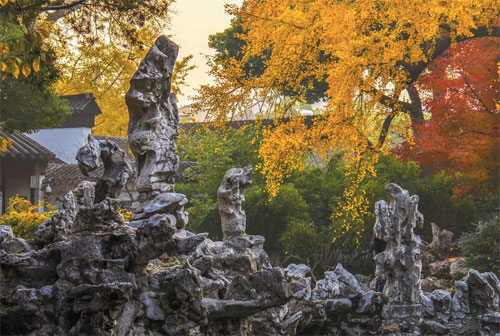
Lion Forest Garden was built in 1342 during the Yuan Dynasty (1279-1368) by a Zen Buddhist monk named Tianfu in memory of his teacher Zhongfeng. The name of the garden is derived from the lion-shaped rocks, which also resemble a lion in Buddhist sutras.
The garden set a benchmark for many of the key features of Suzhou's classical gardens, including pavilions, pagodas, courtyards, buildings and halls. It is also known for its ponds, lakes, hills and unusual rocks. It is nicknamed "the kingdom of artificial hills".
The garden's design attracted the attention of many noted visitors, such as Yuan Dynasty painter Ni Zan, who created Painting Scroll of Lion Forest in 1373. The Kangxi and Qianlong emperors of the Qing dynasty also visited the garden many times. Qianlong also had replicas of the garden both in the Summer Palace in Beijing and at Chengde Mountain Resort in Chengdu, Hebei province.
In 1918, renowned merchant Bei Runsheng purchased the garden. In 1953, it was opened to the public after renovation by the Suzhou city government. In 2000, it was named by UNESCO as a World Heritage site. In 2006, the State Council listed it as one of the country's major preserved sites.
Master-of-the-Nets Garden
The name of this garden is an allusion to the simple life of a fisherman, which was admired by many ancient officials and scholars who romanticized it as an escape from worldly worries.
Master-of-the-Nets Garden was built in 1174 during the Song Dynasty. It demonstrates Chinese garden designers' adept skill at synthesizing art, nature and architecture to create unique metaphysical masterpieces.
It is regarded as "the most exquisite Suzhou classical garden" among garden connoisseurs for its high achievement in the techniques of using relative dimension, contrast, foil, sequence and depth, as well as borrowed scenery. In 1997, it was included on the UNESCO World Heritage list.
The garden is divided into three halls. The main hall used to receive distinguished guests still displays a complete set of Qing Dynasty-styled furniture with skilled craftsmanship.
The gate tower outside the main hall has a history of over 280 years. Six meters tall and 3.2 m wide, the tower is exquisitely carved and considered "the best gate tower south of the Yangtze River."
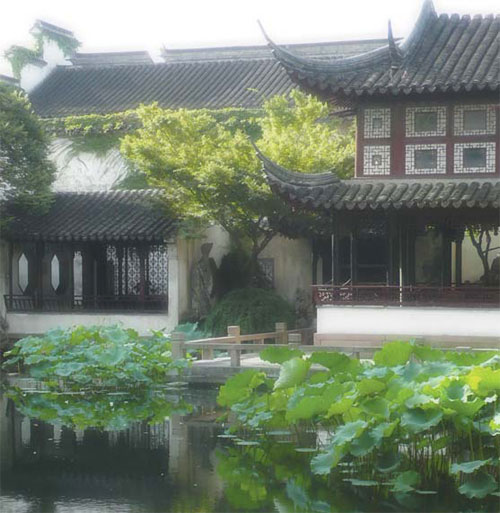
The garden is built around the Rosy Cloud Pool. Small buildings are set on rocks or piers directly over the water surface while large buildings are separated from the pool by yards planted with trees to obscure their size.
A wall separates the pool and the Dianchunyi courtyard located in the western corner of the garden. A replica of the courtyard's delicate and primitive design was exhibited in New York's Metropolitan Museum of Art in 1978.
Contact the writer at xuxiao@chinadaily.com.cn
|
Master-of-the-Nets Garden. Photos Provided to China Daily |
|
Humble Administrator's Garden |
|
Lingering Garden |
|
Lion Forest Garden |


Copyright 1995 - . All rights reserved. The content (including but not limited to text, photo, multimedia information, etc) published in this site belongs to China Daily Information Co (CDIC). Without written authorization from CDIC, such content shall not be republished or used in any form. Note: Browsers with 1024*768 or higher resolution are suggested for this site.
License for publishing multimedia online 0108263 Registration Number: 130349