Attraction of the lightning visit
Updated: 2014-04-11 10:14
(China Daily)
|
|||||||||||


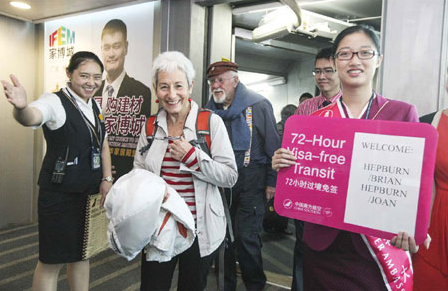 |
| Joan Hepburn and her husband Brian, from New Zealand, become the first foreigners landing at Guangzhou Baiyun International Airport to benefit from the city's 72-hour visa-free policy. Provided to China Daily |
Three-day visa-free entry seen as fillip to tourism industry
Jasper Parrott's schedule is hectic and often last minute, with frequent flights from England to various countries to arrange performances for the musicians he manages.
Parrott has been to China on such trips more than 20 times, and says the past year was particularly difficult. But relief is in sight for people like him as more Chinese cities introduce new rules allowing 72-hour stays without a visa.
"This could be very helpful," Parrott says. "It means I can make very short trips at short notice whereas that's very difficult under the existing rules, because you have to apply for the visa and plan the itinerary rather well in advance. Sometimes of course business is not like that. Sometimes you have to make a very quick trip on a somewhat emergency or urgent basis."
Since Aug 1 the city of Guangzhou in South China has allowed transit passengers 72-hour stays without a visa, becoming the third city after Beijing and Shanghai to adopt such a policy. Just before the Fortune Global Forum in Chengdu, southwestern China, in June the central government granted the city approval to introduce the 72-hour- free visa policy.
Tianjin, in the northeast, says it has applied to be able to let people enter the city for a limited time without visas, and Wuhan, in Central China, says it is also in the process of doing so.
Under the 72-hour policy, travelers from 45 countries who intend to travel to a third country, and who hold air tickets, will be able to stay in the cities for three days without a visa and will be allowed to visit anywhere in the city's jurisdiction during their trips. The nationals include Americans, Australians, Canadians, Japanese and New Zealanders.
Zhao Yufang, deputy governor of Guangdong, says Guangzhou expects the visa-fee policy will draw more foreigners to the city and has said exit and entry procedures will continue to be streamlined.
"The visa-free policy will cement Guangzhou's status as a key metropolis of China, an international aviation hub and a world-renowned tourist destination," Zhao says.
The first person to travel to Guangzhou on a visa free-visit was Brian Hepburn, 85, a New Zealander, who arrived at Guangzhou Baiyun International Airport on Aug 1. Hepburn, traveling with his wife, said the transit policy was convenient because it took only two to three minutes to complete the paperwork.
The couple, bound for London, planned to stay in Guangzhou for three days and wanted to visit the Chen Clan Academy and Sun Yat-sen Memorial Hall in the city and cruise the Pearl River at night.
Chen Shi'an, deputy head of Chengdu Tourism Bureau, says visa-free visits could provide a fillip to tourism in the city.
"Exactly when Chengdu's visas come into force has not been decided, but it will definitely be positive for the city's economy."
The city plans to heavily promote the policy, build a duty-free system and other supporting services, and encourage airlines, local travel agencies and hotels to offer customized services and products.
Michael Li, marketing manager of the Chengdu branch of the European Union Chamber of Commerce in China, says Chengdu has become an international city attractive to investors, so more companies will expand their business into the city.
The new policy is particularly good for those who need to make urgent or temporary business or travel arrangements, he says.
With the new visas, local governments and companies see the chance not only to promote tourism but also international business communications.
Last year, 132 million people traveled to the Chinese mainland, including 27.2 million foreign visitors and 105.2 million from Hong Kong, Macao and Taiwan.
Wang Yue, vice director of the Beijing Municipal Commission of Tourism Development, told Xinhua News Agency that previously foreign visitors had stayed in Beijing for three days and four nights on average, spending an average of $1,000 each, three times what visitors from within China spend.
Zhao Zhe, project manager of the Metallurgical Center for International Exchange and Cooperation, which puts on international conferences and exhibitions in many big Chinese cities, says short-term business communications will benefit most from the new visas.
"Beijing, Shanghai and Guangzhou are involved in international business all year round. Every year, millions of people come to attend international fairs, such as the Canton Fair, or to visit factories for a day or two. This policy saves them the trouble of going through complicated visa application procedures, making business easier.
"These cities are rich in tourism resources, too, including cultural heritage and their own particular cuisine, and these could be a great attraction for visitors."
China Southern Airlines, based in Guanghou, has been a keen promoter of the visa policy, believing it will help turn Guangzhou into an international aviation hub and a key driver of the city's competitiveness.
The airline says it handled 420,000 transit passengers last year and expects to handle more than 500,000 this year.
China Southern has stepped up its advertising to cash in on the new rules, using its latest aircraft, the Airbus A380 and the Boeing 787 Dreamliner, to fly in and out of Guangzhou, and is working with government departments to make transiting quicker.
Dun Jidong, a sales manager with the Chinese tourism operator Ctrip, says it has set up tourism desks in airports that receive three-day visa travelers to introduce the cities and offer tourism packages.
However, early indications from Beijing and Shanghai, which have had the visas since Jan 1, are that they may not be producing the tourism windfall that some have been hoping for.
Chao Xiaohui, who is in charge of inbound tourism with the Shanghai tourism administration, said 5,700 people had been granted the three-day visas in the first six months of the year, most of the visitors coming from the United States, with Australians in second place.
Wang Qing, head of the tourism environment and public service department of Beijing Municipal Commission of Tourism Development, says about 60 people a day have been granted the visas, or about 11,000 in six months
He Shengkang, deputy director of the inbound tourism department of China International Travel Service Limited, says the main reason for those low figures is that China is not yet a transport hub for global travelers, and is not attractive enough to draw foreign visitors. Tourists usually transit either because of a cheap air fare or the additional added value, for example a short trip to a third country.
"Air fares, number of airlines, international influence, transit times and flight punctuality and efficiency will all affect people's decisions on whether to choose to transit here. If they won't, it will be difficult to use the visa policy to attract them."
A lack of promotion for the policy is another reason for the low numbers, He says, and promotion needs to be carried out overseas.
Yang Jinsong, a professor in international tourism at the China Tourism Academy, says that in the case of Beijing, a lack of facilities and supporting measures is contributing to a lack of interest among potential tourists and tourism operators.
"Many of the tour packages were put together years ago, some even in the 1970s during reform and opening-up. We need to carefully look at the consumption habits of foreign tourists from the 45 countries and come up with specialized tour packages aimed at particular groups."
The China Tourism Academy says that of the more than 80 million visits to the capital last year, from home and abroad, only about 600,000, or less than 1 percent, were transit visits.
Zheng Caixiong contributed to this story.







Hot Topics
moon rover air defense identification zone CPC and reform China and Japan air pollution Cameron in China
Editor's Picks
|

|

|

|

|

|