Renewing the battle against POPs
Updated: 2013-11-08 13:56
(China Daily)
|
|||||||||||


NPC approves restriction or ban on 10 chemicals
China is staging a renewed battle against chemical pollution after the country's top legislative body passed two amendments to an international environmental treaty.
Included in the amendments are 10 polluting substances to be restricted or banned under the Stockholm Convention on Persistent Organic Pollutants.
The convention, signed in 2001 and effective from May 2004, aims to eliminate or restrict the production and use of organic pollutants including the notorious DDT. A total of 179 countries and regions had signed the convention by May 2013.
As the Standing Committee of the National People's Congress, or China's parliament, gave its nod on Aug 30, the amendments will come into force on the Chinese mainland, in Hong Kong and Macao in the near future.
Of the 10 newly added environment-threatening chemicals, China still produces and uses chemicals related to perfluorooctanesulfonic acid (PFOS), perfluorooctanesulfonyl fluoride (PFOSF) and endosulfan.
PFOS is a fluorosurfactant created by US company 3M in 1952 that is used in coatings. According to a study by the Environmental Directorate of the Organization for European Economic Development, "PFOS is persistent, bio-accumulative and toxic to mammalian species".
Though 3M announced the phase-out of its production in 2000, PFOS and PFOSF-related products are still made in China.
According to the Ministry of Environmental Protection, in China, PFOS is mostly used in the production of aqueous film-forming foam fire fighter, chrome plating fog inhibitor, pesticides and more recently oilfield recovery agent.
Endosulfan was extensively used as an agri-chemical to control insect pests. It later became controversial due to its acute toxicity, its potential for bio-accumulation and its role as an endocrine disruptor.
Because of the threat to human health and the environment, a global ban on the manufacture and use of endosulfan was negotiated under the Stockholm Convention in April 2011.
It is still produced and used in India, China and a few other countries. Second to India, China produces around a quarter of the world's endosulfan even though it has about 70 substitutes that can be used as pesticides.
Following the approval of the ban list, the Ministry of Environmental Protection, the Ministry of Science and Technology, the Ministry of Agriculture, and the Ministry of Industry and Information Technology have adopted a series of measures to control the use and production of the chemicals.
The ministries have investigated the chemicals' production and export and studied their economic and social effects as well as the threat to the environment.
The Ministry of Environmental Protection has been working to include PFOS, PFOSF and endosulfan in the National Implementation Plan of the Stockholm Convention as well as the country's overall plan for environmental protection.
In addition, the ministry will try to garner financial and technical support from domestic and international institutions to ensure the implementation of the plan.
Recent project
One example is an international project for monitoring PFOS and PBDE organized by the Ministry of Environmental Protection and co-sponsored by NIVA from Europe, Tsinghua University, the National Research Center for Environmental Analysis and Measurement, and environmental protection bureaus in Zhejiang, Hubei and Guangdong.
Designed to improve the provinces' ability in monitoring PFOS and PBDE, the project includes training locals to collect and analyze the pollutants as well as organizing anti-pollutant publicity campaigns.
lifusheng@chinadaily.com.cn
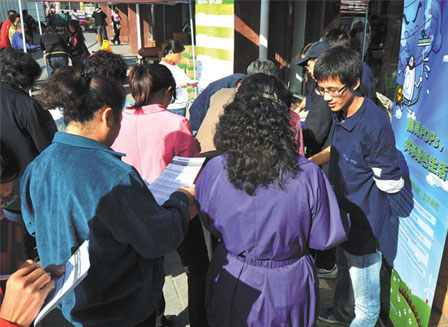 |
| Volunteers hand out information on 'persistent organic pollutants' at a local supermarket. |
 |
| Domestic and foreign researchers test and analyze PFOS at a lab. |
 |
| About 1,700 delegates from 178 countries, 24 international organizations and more than 60 non-governmental organizations convened in Geneva from April 28 to May 10, discussing new amendments to the Stockholm Convention. Photos Provided to China Daily |





Hot Topics
Editor's Picks
|

|

|

|

|

|

