Earlier this year, a group of friends and I were huddled by my apartment window wondering why we were starring out into a black canvas.
We shut off the lights and tried to find the Hai River that flowed below the apartment building.
Nothing.
The nearby pedestrian path virtually disappeared, along with neighbouring apartment buildings, street lamps, and even the 24/7 construction site across the street – everything was wiped out in sight.
A possible blackout, we thought?

As we leaned in closer, pressing our cheeks against the glass, we spotted a spec of light glowing from the street – a lone car with its high beams on, lighting up the dark, thick haze ahead.
At that moment, we quickly realized the possibility of a blackout was pure optimism.
The next day, @BeijingAir, the US embassy's Twitter feed monitoring particulate matter smaller than 2.5 micrometers (PM 2.5) in the capital, confirmed our thoughts: off-the-charts pollution. The PM2.5 index, capped at 500, shot up "beyond index" to a terrifying 755. Headlines across the globe dubbed it an "Airpocalypse" and the US embassy classified the reading, "Crazy Bad."
Though foreign health experts consider PM 2.5 more critical, China's Environmental Protection ministry, in contrast, releases air quality data in accordance to the larger, PM 10, or particulate matter smaller than 10 micrometers in diameter.
Weeks following that chart breaking night, "hazardous" days nearing the 500 mark or more were beginning to creep up, making Beijing's pollution problem harder to ignore.
But why? Where was this pollution coming from? Why was it so bad?
Dr. Jon Craig, International SOS medical director in Beijing, demystified some facts about China's air quality. Surprisingly, China was not the worst global polluter.
"One of the problems that Beijing has is we're in a bowl, surrounded by mountains so there's not significant airflow so [the air] is just sitting in the bowl," said Dr. Craig, who has been living in Beijing for almost three years.
He cited a World Health Organization (WHO) study that showed other cities located in Pakistan, India, Mongolia, Botswana and Iran, had significantly worse pollution than China.
Energy production, he says, is one of the main sources of pollution.
"In industrial heartlands, they're going to use a lot of energy for what they're doing," said Dr. Craig, adding that large, populated cities like Beijing and Tianjin burned a lot of fossil fuels to keep up their energy requirements.
Moreover, Beijing is located along the country's steel belt and right next door is coal-burning Hebei province. A country report this year ranked the heaviest polluted cities in China and 7 cities out of 10 were in Hebei province.
According to state newspaper, China Daily, Beijing annually burns 20 million metric tons of coal, Tianjin some 70 million tons and Hebei as many as 200 million tons.
In PM 10 readings, Dr. Craig says Lanzhou and Urumqi are one of the heaviest polluted cities in China.
"They're not that populated cities, but there are other factors including industrial activities and geography that make a difference," he said.
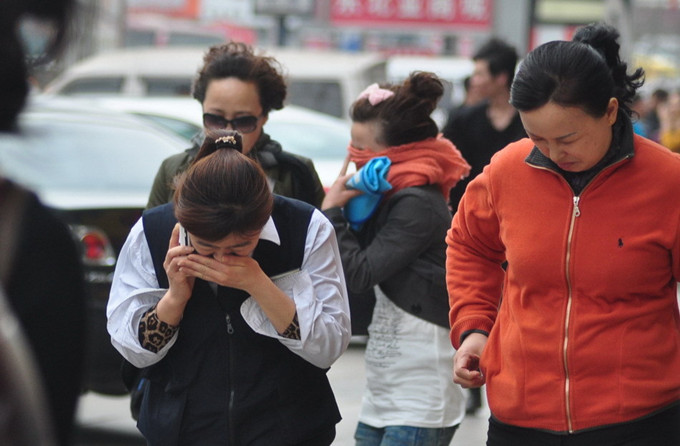
China's battle with pollution has raised the ire of many in China, prompting outraged citizens to demand for cleaner air.
In response, the Chinese Academy for Environmental Planning recently announced a 2.7 billion yuan investment to combat air pollution and high levels of PM 2.5 to the country's hardest hit regions such as: Beijing, Hebei and Tianjin, over the next five years. The government said it also plans to reduce air emissions by 25 per cent by 2017.
As a yardstick, Dr. Craig said health studies suggest living in Beijing is equivalent to smoking one-sixth of a cigarette per day.
In July, the US National Academy of Sciences published a report showing people living in Northern China lose 5.5 years of life, compared to those living in the South, mainly caused by coal pollution.
Last year, a joint study by Peking University and Greenpeace East Asia said 8,572 premature deaths were linked to pollution in Shanghai, Guangzhou, Xi'an and Beijing.
There has been limited empirical research done on the domestic level regarding the effects of China's air pollution on human health. However, there are known correlations between bad air days and people experiencing cardiovascular and respiratory problems, said Dr. Craig.
Recently, there have been a handful of articles written about the unprecedented number of expat exodus occurring in China's major cities due to deteriorating air quality, or more famously dubbed, "Why I'm leaving China" diatribes written by several well-known foreigners chronicling all the reasons why they were jumping back to the mother ship.
More seriously, expats, especially those with young children, are thinking twice about moving to China due to health considerations for their young families. A child's lungs, for instance, undergo their formative years during these early stages of life.
Despite how dreary living under a grey sky can be, we have to remember why we came to China in the first place and that there are ways to mitigate the risks.
Here are some tips to breathe easier:
- Limit outdoor activity on "Unhealthy" or "Hazardous" days.
-Wear a mask. Not the cloth masks, they do not block out the particulate matter. Get ones that seal the face such as a certified N95 (3M), Totobobo, or a Respro, which is great for cyclists.
-Air purifiers. Health experts suggest purifiers using HEPA filters are most effective. These purifiers can be quite expensive, but if you're concerned about indoor air quality, it won't hurt to invest in one. Torana Clean Air Center in Beijing, started by expat Chris Buckley, has a slew of air purifiers, humidifiers and masks. (www.toranacleanair.com)
Some online resources to track air quality in China:
-Twitter: @Beijing Air – The US embassy monitor in Beijing for PM 2.5. They use the US Environmental Protection Agency (EPA) Air Quality Index (AQI).
-For smartphone users, download: China Air Quality application
-www.aqicn.info – this unofficial website uses China's Ministry of Environmental Protection's (MEP) official data and calculates US EPA AQI using PM2.5.
- Beijing's Dr. Richard Saint Cyr has a great blog: www.myhealthbeijing.com, offering advice on how to stay healthy in China.