Arctic shipping lanes open up
Updated: 2013-03-14 08:50
By Zhou Siyu in Oslo(China Daily)
|
|||||||||||


|
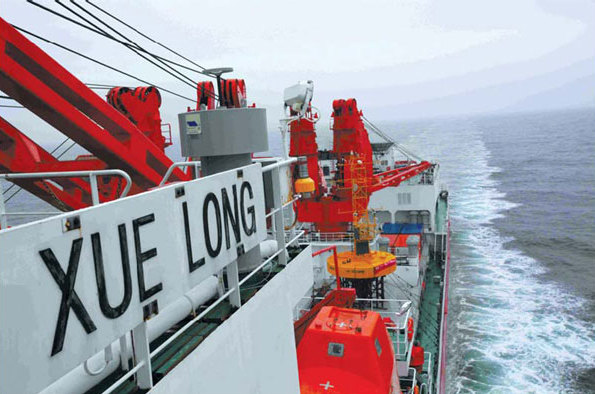
Chinese icebreaker Xue Long on an expedition in the Arctic Ocean. New Arctic shipping routes could greatly cut the cost of transporting goods between Chinese ports and European ports. [Photo/Xinhua] |
Routes between Asia and Europe to reduce fuel costs and CO2 emissions
The shrinking Arctic ice sheet is opening up new shipping routes for global trade, and China will be one of the main beneficiaries, according to the head of the country's leading polar research institute.
There are three main shipping routes across the Arctic region - the North East Passage, the North West Passage and the Central Route.
As the ice melts, the North East Passage opens from the end of July for four months or more, while the Central Route opens from the end of August for one month or more, explained Yang Huigen, director-general of the Polar Research Institute of China.
Yang witnessed this for himself last summer, aboard the Chinese icebreaker Xue Long, while leading its fifth official Arctic expedition.
Speaking at the Economist's Arctic Summit in Oslo on Wednesday, he said the increased accessibility of the Arctic routes will have a considerable effect on sea trade between Europe and Asia, which is considered the world's busiest trade route.
He said that the Xue Long trip to explore the route had "greatly encouraged" Chinese shipping companies.
"One commercial voyage by a Chinese shipping company may take place this summer," he told Reuters.
He added the latest research shows the new routes could cut shipping times between Asian and European ports by about one-third, which in turn could reduce fuel and other costs as well as CO2 emissions.
Given China remains the world's largest exporter, many of its major ports will benefit from the new routes, especially those in the northeast of the country, he told China Daily.
Currently 90 percent of China's trade is carried by sea. The Chinese government projects its trade to grow to $7.6 trillion by 2020, and Yang said that if 10 percent of China's trade was shipped through the Arctic routes by then, that could be worth $683 billion.
"The potential value (of goods traveling the Arctic routes) is simply too large to ignore," he added.
The new routes, meanwhile, are also likely to help promote commercial ties, especially between China and Russia.
Anton Vasiliev, ambassador-at-large for Arctic cooperation at the Russian Ministry of Foreign Affairs, said that of all the sectors which might benefit, "the (Russian) shipping industry will benefit the most", as it expands its use of Arctic waters, especially to China.
As well as trade, Yang said the opening up of the Arctic waters is likely to initiate a shift in Chinese polar research.
So far, Chinese scientists have focused on the climate change, but Yang said the scope of their research will now widen to the economic, political as well as environmental implications of the changes being seen in the region.
"The creation of these new shipping conditions mean the scientific community will have to take a more comprehensive approach to Arctic research," he said.
Ice coverage of the Arctic Ocean grows and shrinks throughout the year, reaching a maximum in March and a minimum in September.
In recent years, the minimum ice coverage has been receding at a rate of 10 percent every decade, according to a recent report by Det Norsk Veritas AS, one of the world's leading shipping industry classification societies and a risk management provider.
The melting ice cover is also allowing more room for other human activity which in turn, is generating increased concern over the environmental and ecological effects on waters, said the report, adding that if the trend continues, the Arctic Ocean could be almost ice-free within decades.
zhousiyu@chinadaily.com.cn