Wine pioneer Changyu has storied history, bright future
Updated: 2012-05-30 07:04
By Wang Qian and Zhao Ruixue(China Daily)
|
|||||||||||


|
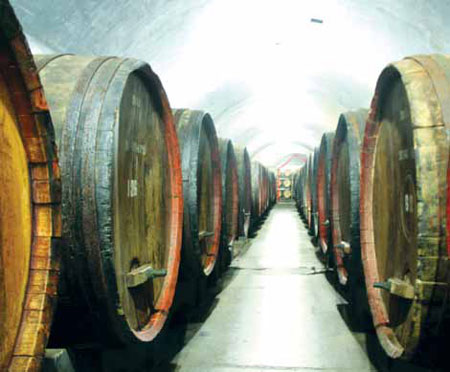
Changyu's cellars feature oak barrels that have witnessed the company's more than 100 years of development. Ju Chuanjiang / China Daily |
|
Zhang Bishi founded China's first winery, Changyu Pioneer Wine Co, in 1892. Provided to China Daily |

When Qing Dynasty (1644-1911) Zhang Bishi, an overseas Chinese from Indonesia, founded China's first winery, Changyu Pioneer Wine Co, in 1892, there was no way he could have dreamed that it would grow into one of the world's top vintners 120 years later.
Today, Changyu, based in Yantai, Shandong province, is China's answer to France's world-renowned Bordeaux winemaking region.
The company has developed 20,000 hectares of vineyards, accounting for one-quarter of China's grape-planting regions, and it operates 10 world-class chateaus throughout the globe.
Thanks to their quality, its products have become a common sight at state banquets, global summit meetings and also on store shelves internationally.
"Some 120 years ago we introduced grapes and winemaking techniques from overseas, but now we have developed our own viticulture to produce high-quality wines that can contend in the fiercely competitive international market," said Zhou Hongjiang, general manager of the company.
Changyu's growth
Zhou said Changyu's tradition goes way back to when Zhang Bishi founded China's first chateau in Yantai by introducing winemaking equipment and more than 120 types of grapes from Europe.
An 80-hectare vineyard was built on the mountains that sprawl along the city's coastal areas and lie on a latitude similar to that of Bordeaux and Italy's Tuscany. It has long been regarded as the best place in China for growing quality grapes, with adequate rain, abundant sunshine, a favorable soil type and the right humidity.
A 1,976-square-meter underground wine cellar was also built, equipped with 430 oak barrels imported from Italy and Austria to better mature the wines and give them a special aroma.
Established during the Self-Strengthening Movement period (1861-1895), in which Chinese learned advanced military and industrial technologies from the West, the company was granted many favorable policies from the very beginning.
It gained license and exemption from duty for three years from Li Hongzhang, a leading statesman of the late Qing Dynasty and a proponent of the movement.
To ensure the quality of Changyu's wine, Zhang once employed lots of professional winemakers from countries with long histories of making wines, including Italy, Austria and France.
The first one of them is Baron M. VonBabo, a seasoned winemaker from the Austro-Hungarian Empire (1867-1918), who helped Changyu develop 15 types of fine wines. He was appointed as Austro-Hungarian deputy-consul in Yantai and moved the consulate into the company. After that, Changyu's wine won the hearts of foreign diplomats and business leaders.
In 1915, Changyu wines won four gold medals and quality certificates at the Panama-Pacific International Exposition in San Francisco, California. This was the first time for a Chinese product to win an international exhibition award and made Changyu a globally known brand.
With a production history of more than 70 years, Changyu Jiebaina was rated as one of the world's top 30 wine brands in 2008 Salon International de l'Alimentation (SIAL) held in France.
Since 2005, the Changyu Jiebaina has been exported to some 28 countries across the world, including Germany, Italy and France. Now, it is available in more than 3,000 supermarkets, shops, five-star hotels in Europe, and even the first-class cabins of German Lufthansa Airlines.
Ranked 22nd, Changyu was the only Chinese wine to make the list of the World's Top 50 Brands for Spirits and Wine compiled by Brand Finance in 2011, a leading brand evaluation consultancy.
Now, thanks to Changyu, the coastal city of Yantai is the only Asian city to be recognized as an "International Grape and Wine City" status by the International Vine and Wine Office (OIV).
The city is home to more than 130 world-renown winemakers, with combined wine production accounting for one-third of the nation's total.
Changyu chosen by celebs
During its 120 years in business, Changyu has always had a connection with celebrities from home and abroad.
In 1927, Kang Youwei (1825-1927), a pro-reformist scholar, thinker and artist who advocated constitutional monarchy during the late Qing Dynasty period, wrote a poem for Changyu in the last year of his life, indicating Changyu wine was kind of a lifelong companion for him.
In the early part of the 20th century, when "developing industries to make the country strong" was a theme in China, Sun Yat-sen visited Changyu and praised the wine's top quality.
Such adulations also came from Zhang Xueliang (1901-2001), known as the Young Marshal who played a vital role in persuading Kuomintang leader Chiang Kai-shek to join hands with the Chinese Communist Party to fight the Japanese invaders in the 1930s and Song Ziwen (1894-1971), China's famous financier and diplomat.
Praises continued after the founding of the People's Republic of China in 1949.
In 1956, the late Chinese leader Mao Zedong once suggested that Changyu expand its wine production so that more ordinary people could enjoy it. Former Chinese Premier Zhou Enlai allocated 650,000 yuan to support the company's development.
In July 2010, Vice-Premier Li Keqiang encouraged Zhou Hongjiang, general manager of Changyu, to develop the company through innovation.
Going global
The aroma from Changyu wine has not only intoxicated Chinese but also foreign wine lovers.
In 2004, Jack Welch who is known as the "world's first CEO", gave a thumbs up to the wine made in Chateau Changyu-Castel, saying "Wonderful! The wine is very good!"
Jim Rogers, the US investment guru, had good experiences investing in Changyu, which according to him was one of his first major shareholdings.
UN Under-Secretary-General Sha Zukang collected Changyu wine on behalf of the United Nations in 2010, and it was the only China-made wine the UN collected.
Robert Tinlot is honorary president of OIV and now honorary head of Chateau Changyu AFIP Global.
The current president of OIV, Yves Benard, visited Changyu in 2009 and remarked that it is an example for international-class chateau wine.
Prime Changyu wine is also selected as state gift to foreign elites, such as former American President Bill Clinton, former Japanese Prime Minister Yasuo Fukuda and financier Warren Buffett.
Contact the writers at wangqian@chinadaily.com.cn and zhaoruixue@chinadaily.com.cn
(China Daily 05/30/2012 page15)