South Africa's role in BRICS
Updated: 2011-09-15 07:45
(China Daily)
|
|||||||||||


|
Standing tall: Presidents of the new global economies at the BRICS Leaders' Summit, which took place in Sanya, China, in April. Photos Provided to China Daily |

Nation steps onto the global stage and offers many benefits
South Africa's ascension into the BRICS club of emerging economies raised some eyebrows internationally, but there is no doubt that the country has the credentials to back its membership.
Perhaps the foremost advantage South Africa is able to offer its BRIC partners is access to 1 billion consumers living in Africa, as well as the vast mineral and agricultural opportunities the continent offers.
In December 2010, South Africa was formally invited to become the most recent member of the BRICS bloc - formerly BRIC - of powerful and influential emerging economies. These comprise Brazil, Russia, India, and China with the 'S' standing for South Africa.
Between them, this group accounts for nearly 20 percent of the world's GDP, illustrating just how formidable they have become. In three years' time, they are expected to account for 61 percent of the world's growth, according to the International Monetary Fund. It's an elite club and membership is strictly by invitation only.
It is by far the smallest economy to be admitted to this club, with a population of just 50 million people compared to the billion-plus populations of India and China. Likewise, South Africa's GDP is a fraction of that of China, the group's powerhouse economy.
We might therefore legitimately ask how the country has been able to pull off such a feat.
South Africa brings a lot to the BRICS table in its own right. As the gateway to Africa, it offers access to a market of a billion people in 61 territories and 54 countries - equivalent to 15 percent of the world's population.
Membership of the BRICS underlines the potential advantage available through its relationship with African economies, and the increased strategic importance given to Africa and its resources.
BRICS countries are growing rapidly, and to secure their growth, they need Africa's commodities. The BRICS intend to expand inter-trade amongst themselves to $500 billion by 2015.
Already, South African companies are keen to do their bit in helping the trade bloc to reach this target. After South Africa formally joined the club, Robbie Ragless, head of immigration specialist Global Visa in South Africa, said:
"In the space of a little over a week, we have seen a 38 percent increase in enquiries from corporate clients and individuals wanting visas and information on obtaining work permits for BRICS countries."
As the country's Minister of Finance Pravin Gordhan remarked in July, the BRICS nations are not only reflecting the shifting trends of the new global economic order but are increasingly shaping it.
South Africa's new allies are calling for change, such as reform of the world's financial bodies and the UN Security Council. Part of its job, as a BRICS member, will be to support these calls and add its own voice and diplomatic weight.
The BRICS countries share several global forums: the United Nations (UN), G20 and the India, Brazil and South Africa (IBSA) Dialogue Forum, which South Africa will host this year.
This year the BRICS will each serve on the UN Security Council as either permanent (China and Russia) or non-permanent (Brazil, India and South Africa) members in a move that augurs positively for enhanced cooperation.
Africa is the last frontier of the global economy and its third-largest market. It must have a voice in all major global forums including BRICS.
And it is in Africa's, and South Africa's, interests to call for a restructuring of international economic and political institutions, a more equitable and sustainable trade dispensations, and agreement on climate change. These agreements would ensure that all people are able to sustain and grow their livelihoods.
Bilateral trade
Although the US remains Africa's largest export market, Sino-African trade grew 10-fold between 2001 and 2008.
By 2009, trade values had grown by an incredible annual 53.9 percent, and overtaken the value of US-African trade, which dropped to second place.
Sino-African trade is two-way, with African economies importing almost as much from China as they export. China is now South Africa's premier trading partner, with trade between the two countries valued at 143.3 billion rand ($21.3 billion).
By contrast, US trade with Africa is more cyclically unstable than China's. In 2009, as commodity prices fell, US-Africa trade almost halved, while China-Africa trade dipped by a more modest 15 percent, illustrating its resilience.
South Africa is both a benefactor of better access to BRICS markets and, at the same time, a competitor or joint venture partner in the development of Africa. Africa grew at 4.5 to 5 percent last year and is expected to reach 5.5 to 5.7 percent this year. South Africa is set for a more modest 4 percent growth.
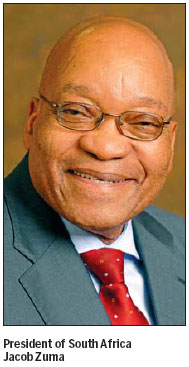
South African President, Jacob Zuma, has invited investors from BRICS countries to take up the major infrastructure and manufacturing opportunities in South Africa and on the African continent. Both the private and public sectors of the country, and the continent, stand to be leading beneficiaries of this offer.
Craig Bond, Standard Bank China's chief executive, said the bank was committed to connecting BRIC companies with African markets.
"The BRICS summit has provided us with a great platform for the emerging economic powers to discuss mineral beneficiation, infrastructure development, stimulating foreign investment as a means for supporting employment and job creation," he said.
"By formally engaging one another and understanding differing socioeconomic challenges, the need for BRICS partnership and cooperation will become more visible and manageable. The BRIC countries should also benefit from Africa's growing consumer markets."
In developing trade opportunities even further, South Africa's world-class transport and communications infrastructure will be critical.
Both local and international investors have been able to use the country as a springboard into the rest of the continent, and a sophisticated ports network is vital. South Africa is able to function as a hub for commercial traffic emanating from and destined for Europe, Asia, and the Americas, as well as the east and west coasts of Africa.
Creating value chains between South Africa and its neighbors will allow countries to share benefits from joint development projects. Past development projects have seen Tanzania and South Africa partnering to develop the East African country's tanzanite industry and sugar mills.
South Africa has also been involved in Mozambique's aluminium smelter, and more of these projects are likely, as 19 billion rand has been set aside to fund South African junior mining companies with interests in expanding into the rest of the continent.
For investors looking to develop business in Africa, South Africa will be a natural partner.
The country accounts for 25 percent of the continent's GDP, and two-thirds of its electricity. Its sophisticated banking and financial markets, political stability, and regulatory efficiency mean that it can be easier for foreign partners to invest there first before looking north of its borders.
Judging by recent economic activity, South Africa is already benefiting from its membership of BRICS.
In July, Tata Motors South Africa, a joint venture between India's Tata Motors and Tata Africa, opened a 100-million-rand truck assembly plant outside Pretoria, the South African capital.
Meanwhile US-based manufacturer Ford Motor Company in June completed a $500 million upgrade of its manufacturing and assembly plants in South Africa, which will enable locally-produced Ranger pickup trucks to be exported to 148 countries in Africa and Asia.
(China Daily 09/15/2011 page5)