Policies and Regulations
Chapter 3 Trademark Administrative Enforcement
Updated: 2010-04-22 15:27
 |
Large Medium Small |
In 2009, AIC at all levels further enhanced the administration of market orders, and as required by the State Council, launched special campaigns with a focus on protection of registered trademarks. Through these campaigns, AICs investigated trademark infringement and counterfeiting cases, focusing on the protection of well-known trademarks, foreign-related trademarks, agricultural trademarks and geographical indications. Meanwhile, protection of World Expo signs and Olympic logos after the Beijing 2008 Olympics was strengthened, creating a positive environment for China’s IPR protection.
1. Protecting logos for the success of the Shanghai World Expo and creating favorable circumstance for IPR protection. 2. Empowered by The Regulation on World Expo Logo Mark Protection issued by the China State Council on October 13, 2004, SAIC issued Methods of World Expo Logo Mark Filing on December 24 the same year. By the end of 2009, SAIC had approved 61 applications for filing from the Coordination Bureau of Shanghai World Expo Affairs, registered 45 special signs for the World Expo, and examined 229 ordinary trademark applications.
As the Shanghai World Expo was scheduled for 2010, SAIC issued the Action Plan on Serving for 2010Shanghai World Expo on June 26, 2009, so as to guide AIC to fulfill its roles and to protect the market orders during the World Expo. The Trademark Office was asked to enforce its trademark registration and protection and adopt effective measures to enhance IPR protection, especially the filing and protection of those related to the World Expo logos, thereby creating a friendly IPR protection environment for the Expo.
SAIC again issued the Action Plan for Protecting Exclusive Rights of World Expo in August 2009, asking AIC at all levels to start a one-and-a half-year special campaign to further protect the exclusive rights of World Expo signs, such as publicizing awareness of World Expo signs’ protection and combating all behaviors infringing on those rights.
On September 10,2009, the Shanghai AIC, together with the Coordination Bureau of Shanghai World Expo Affairs, convened a staff training conference, setting an example for all China’s AICs. September 10th, Shanghai Administration for Industry and Commerce (SHAIC) held a training conference on “Shanghai World Expo 2010 Logo Protection in Shanghai Administration for Industry and Commerce”.
On November 19 and 22, 2009, CTMO, Shanghai AIC and the Coordination Bureau of Shanghai World Expo Affairs held a nationwide training program on trademark strategy and the protection of World Expo signs in Shanghai. Present at the program were directors and key members of trademark departments from 31 provincial AICs, 15 deputy-provincial level AICs and over 40 city-level AICs.

To further spread knowledge about World Expo logo marks and their application and protection, the Trademark Office, Shanghai AIC and the World Expo Coordination Bureau jointly held a press conference in Shanghai on November 20. Mr. Zhao Gang, CMTO deputy director general; Chen Xuejun, deputy director general of Shanghai AIC; and Mr. Chen Xianjin, deputy director general of the Shanghai Coordination Bureau, answered questions from well-known Chinese media, including Xinhua News Agency, Oriental Morning Post and China IP News.
AIC s have investigated a number o f infringements of World Expo exclusive rights in recent years. In 2009, for example, SAIC and AICs dealt with 92 such cases, valued at 480,000 Yuan, and issued fines of 750,000 Yuan.
Shanghai AIC staff was examining the usage of World Expo logo. These efforts won positive comments both from home and abroad. Mr. Gonzalez Loscertales, Secretary General of the Bureau of International Expositions, wrote to Mr. Zhou Bohua, Minister of SAIC, to express BIE’s appreciation of SAIC’s efforts to carry out trademark strategy and to protect World Expo logos.

2. Further enforcing follow -up protection of Olympic logos.
AICs made dramatic contributions to the success of the Beijing 2008 Olympics and were praised in various circles at home and abroad. In 2009, SAIC issued the Circular on Rewarding Model Units and Individuals in Protecting Exclusive Rights of Olympic Signs. The document honored the Trademark Division of the Beijing Administration of Industry and Commerce as well as 99 other units and 207 individuals. SAIC also issued a comprehensive summary of Olympic exclusive rights protection during the Olympics period and issued the Notice on Summarizing the work of Protecting Exclusive Rights of Olympic Signs to AICs at local levels. In 2009, the Trademark Office approved 177 filings of logo marks of the 29th Olympic Organizing Committee to the International Olympics Committee.
In 2009, SAIC and AICs investigated 156 cases of the illegal use of Olympic signs, 340 Olympic sign infringement cases – valued at 3.55 million Yuan and 2.77 million Yuan, respectively – and fined them 1.16 million and 2.72 million Yuan.
3. Strengthening instruction to AICs on trademark enforcement.
In 2009, CTMO further strengthened instruction to local AICs in dealing with major and difficult trademark cases, such as giving instructions, coordinating, investigating and supervising cases like White Elephant, Blue Ribbon, Phoenix, Triangle, VJC, Jingwu, Miyan and Hometownof Libai. These efforts had effectively protected the legal rights of trademark holders. In 2009 CTMO tried to establish a long-term mechanism to effectively combat trademark infringement directly from the root. The office also instructed local AICs to strengthen trademark enforcement at exhibitions, supported regional coordination of local AICs in law enforcement, sent their staff to participate in seminar on coordination of six provincial offices and one city-level office in eastern China at trademark enforcement, workshop on trademark administrative protection in western China and symposium on protection of trademarks in Huaihai economic region. Officers of Guangzhou AIC in Guangdong Province performed enforcement inspection in Canton Fair. 4. Strengthening cooperation and exchange with other departments.
To solve the conflict between businesses’ names and trademarks, after fully consulting with the Bureau of Enterprises Registration under SAIC, CTMO issued the Notice of Solving Issues of Trademarks and Enterprises’ Names. It also supported SAIC in formulating the Provision on Internet Trade and Service Supervision in order to deal with infringement in Internet trade and presented suggestions to the Ministry of Public Security during its drafting of Issues on Applicable Laws in Handling IPR Infringement Cases, which made it consistent with SAIC documents.

5. Summary of the trademark cases investigated by AICs at all levels.
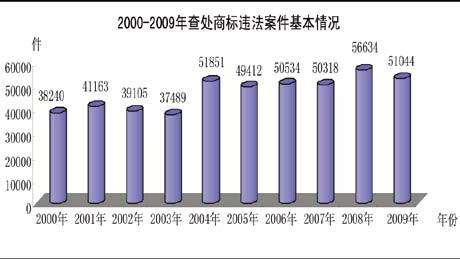
A total of51, 044 trademark cases were investigated in 2009. Among them, 7,448were ordinary trademark offences, 43,596 were trademark infringement and counterfeiting cases, and 10,461 involved foreign trademarks. The year also saw 13.534 million Pieces of various kinds of illegal logo marks dismantled and 92 cases, involving 109 suspects, transferred to judicial organizations.
The trademark cases investigated in 2009 were 9.87 percent fewer than 2008, a result of the implementation of the trademark strategy and improvement of awareness to trademark, self-protection from enterprises, and law enforcement from AICs at various levels. All these efforts also helped reduce ordinary trademark offenses by 22.33 percent compared to 2008. Following were the top 10 provinces and municipalities in handling trademark cases in 2009: Zhejiang (7,233), Guangdong (4,587), Henan (4,059), Fujian (3,824), Shandong (3,725), Shanghai (2,773), Shanxi (2,328), Anhui (2,247), Jiangu (2,026) and Hebei (1,805) – all together 34,607, 67.8 percent ofChina’s total. Quality issues continued to be of paramount importance in relation to registered trademarks. A total of 762 cases of “selling shoddy products with inferior quality to cheat consumers” were handled, 67.43% of all registered trademark application cases, a little bit higher than in 2008; cases of “unauthorized alteration to registered trademark” totaled 145, accounting for 12.83 percent; cases of “unauthorized alteration to the name, address or any other registered items of a registered trademark” totaled 196,17.35 percent; cases of “unauthorized assignment of registered trademarks” totaled 27, accounting for 2.39 percent.
Among all cases related to unregistered trademark, a majority were counterfeit registered trademarks, totaling 3,941 cases or 86.16 percent of the total, nearly the same as in 2008; cases of “selling shoddy products with inferior quality to cheat consumers” totaled 527, or 11.52 percent of the total; cases violating Article 6 and Article 10 of the Trademark Law were both 53, 1.16 percent of the total.
In terms of trademark infringement, cases of selling products infringing upon the exclusive rights of registered trademarks took 75.64 percent, totaling 26,191, 15 percent more than 2008; cases of using a trademark similar to the registered one on identical products, or using the same or similar trademarks on similar products without authorization from the registrant of that trademark accounted for 19.21% of the total, totaling 6,653; another 924 cases belonged to using a mark identical with or similar to the registered trademark of others as the name or decoration of identical or similar products to mislead the public, accounting for 2.67%.
In term of trademark counterfeiting cases, a total of8, 971 were handled in 2009, a little bit fewer than 2008. Among them, 3,136were using a trademark identical to a registered trademark on identical products without authorization from the registered trademark owner, 4,885 were knowingly selling products bearing counterfeited registered trademarks, 34.96% and 54.45%of the total, respectively. In 2009, AICs handled 10,461 cases involving foreign trademarks, 6.11 percent down compared with 2008 . Trademark in fringement and counterfeiting were still the majority of such cases, totaling 10,259, 98.07 percent of the total, while ordinary cases were only 202.
In 2009 complaints of trademark violations lodged by trademark rights’ holders again exceeded 10,000, reaching 13,220, representing25.0 percent of all handled trademark cases. Among them, 1,360 were complaints of ordinary offenses, 10.29 percent of the total; 11,860 were complaints of trademark infringement or counterfeiting, 89.71 percent. There were 9,488 cases from domestic trademark owners, accounting for 71.77 percent of the total, whereas 3,732 were from foreign owners, accounting for 28.23 percent.