For Xie Zhanyuan, getting in and out of his house had been a major challenge until now.
The 52-year-old resident of Daju Hutong in Beijing's Dongcheng district suffered from infantile paralysis and uses crutches. The high doorsill and uneven ground were a problem for him. He no longer has to worry.
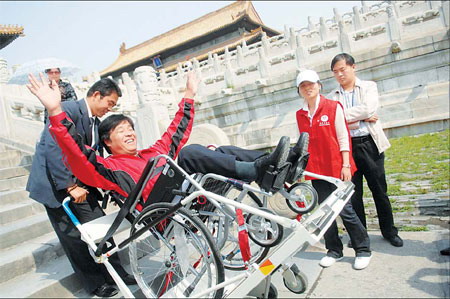
Wheelchair-bound tourists are able to visit the Palace Museum in Beijing with new barrier-free services being made available. [China Daily]
|
By the end of this November, about 5,000 Beijingers with disabilities will have free handicap accessible equipment installed in their homes.
On July 1 this year, the amended Law of the People's Republic of China on the Protection of Persons with Disabilities took effect. It benefits the nation's 83 million disabled.
It mandates measures for a barrier-free environment, the building and retrofitting of accessible facilities, eliminating barriers in information and communications, facilitating access to public information for persons with disabilities, and research and development of new technologies and products to help the disabled.
Cities like Beijing and Shanghai have gone further.
The city of Shanghai became the first city in the country to invest resources to make life easier for its 942,000 disabled residents. Besides retrofitting public facilities to make them handicap accessible, the government has also helped retrofit the homes of 30,000 disabled persons.
The city of Beijing has 999,000 disabled residents. The retrofitting project in the capital city targets the seriously disabled and those in poor living conditions.
Some districts including Dongcheng, where Xie lives, and Fengtai have completed the installation.
"Getting in and out of the house is the biggest problem that disabled people have to face," Xie said. "I am so glad that the project has sorted this out."
Guo Fengzhen echoed Xie's sentiments. For years, she has had to wrestle with getting her husband, Geng Yingmao, in and out of the house, in a wheelchair.
Now, the elderly couple doesn't have to struggle, as a wheelchair ramp has been built outside the house. Geng can even go out alone in a wheelchair without her help.
"It has lightened my big burden, " Guo said of the new ramp.
Besides wheelchair ramps, the handicap access project includes building handicap accessible bathrooms and yellow handrails in bathrooms.
Hao Qing lost his left arm and leg during the Korean War (1950-1953). Despite having an artificial limb, it's still hard for the 84-year-old to stand up from a flush toilet. A handrail has been of great help.
When asked why he didn't install one himself earlier, Hao admitted that he didn't "want to spend the money on it".
Xie did have a handrail installed earlier. "Installing handicap accessible equipment requires professional knowledge," he said. "This is not something ordinary carpenters can do."
"I had a handrail installed in the bathroom long ago," he added, "but I prefer the new one."
According to residential community officer Zhang Wei, designs for handicap accessible bathrooms vary because each disabled person has different needs and different houses.
Xie, who is an area supervisor for handicap access, points out that the single storey houses where many disabled people live in the Dongcheng district cannot be retrofitted for handicap accessible equipment. Some don't even have private bathrooms.
It is also important to raise the awareness of disabled people about handicap accessible equipment, he said.
"We owe a big thank you to the 2008 Beijing Paralympics Games for drawing people's attention to the disabled," Xie said. "It has helped promote the use of handicap accessible equipment."
For Shen Genxi, it was the opening day of the Beijing Olympics on August 8 that was most memorable. On that day, his small apartment in an old building in Shanghai was retrofitted.
Shen, who was born with dwarfism, is only 99 centimeters tall.
"Now, my home has furniture which is my size, " Shen said. For the first time, he can take a shower by himself. Every day, a household helper comes to his home to help him clean and to go out to the park to meet friends and bask in the sun.
Outings are no longer a dream for Shen. He has a special motorized tricycle and has ridden as far as Wuxi in neighboring Jiangsu Province.
"Life is becoming much easier for us disabled," Shen said. "I am happy with my life. "
Chen Lianfang, in Shanghai's Baoshan District, said that after a wheelchair ramp was built at the gate of his apartment building, he and his wife, both wheelchair-bound, can go out whenever they want.