China's progress: Could it happen in the US?
The opinions expressed here are those of the writer and do not represent the views of China Daily and China Daily website.
Last month, I had the opportunity to attend the Five Years On exhibition with several of my colleagues, as well as foreign media and diplomats from around the world. The exhibit, running before, during and after the 19th National Congress of the Communist Party of China, sets out to detail the achievements of the Chinese people over the last five years.
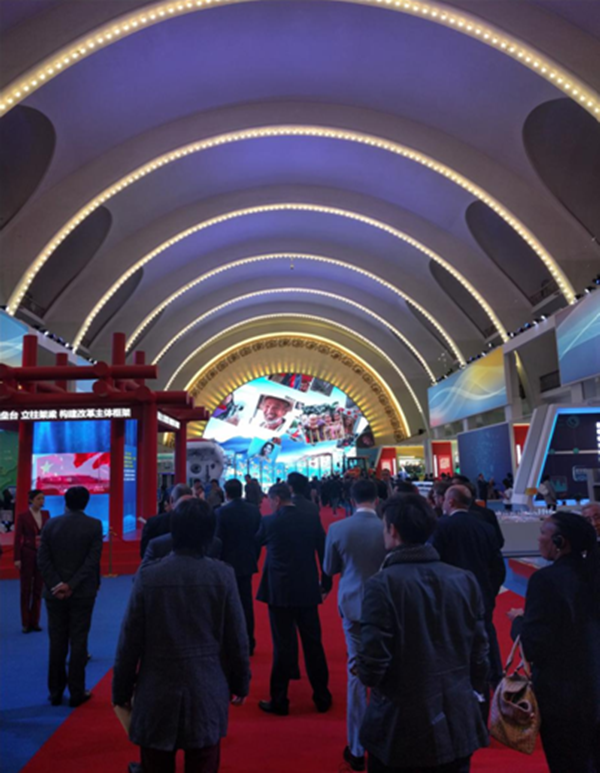
In that regard there's no shortage of material. The exhibition hall was stuffed with images and information on the evolution of China in the last half-decade, featuring enormous displays on the country's poverty reduction campaign, its development of green technology and continuing modernization since the last congress in 2012.
Images of the Chinese people are projected in the central hall of the Five Years On exhibit in Beijing on Oct 13, 2017. [Photo: Ian Goodrum]
Well, the obvious reply would be "no", since it hasn't happened yet. But let's put that aside for a moment. Knowing what we know about political and economic realities in the US, is there a realistic hope the country could achieve what China has in as short a time?
I'm tempted to still say "no", and there are a number of reasons why. Most of all, what the exhibition drove home for me was a difference in priorities between the two countries.
Take the poverty alleviation campaign as an example. Since 1981, the percentage of rural Chinese people living in poverty has plummeted from nearly 99 percent to 4.5 in 2016, with almost 90 million people lifted above the poverty line since 2012 alone.
Compare this to the poverty rate of the United States, the largest economy in the world through most of the last century. According to University of California Davis' Center for Poverty Research, the country's all-time low was around 11 percent. Since a large drop in 1965, the rate has zigzagged between 11 and 15 percent, with no signs of change. With a total poverty rate of 6.5 percent and dropping, China has halved the US' best-ever performance with regard to its poor and the campaign isn't even finished yet.
How can this stark contrast be explained? For starters, the Chinese government made the eradication of poverty an explicit goal, and the last time this happened in the United States was — yep, you guessed it — 1965, when Lyndon Johnson's War on Poverty programs were in full swing. The Communist Party of China understands it’s not enough to simply say you want to make poverty a thing of the past; action is also required. With targeted campaigns to address specific concerns of rural people and earmarking billions to this end, the Party has been able to accomplish what politicians in the US have hemmed and hawed about for decades.
The differences between the two countries are even clearer when it comes to green technology investment. Despite an overall smaller economy, China has poured double the money the US has into wind, solar and hydroelectric energy according to a January report from the Institute for Energy Economics and Financial Analysis. This consistent emphasis on clean energy stands in sharp opposition to the United States, where political discontinuity means the signing of the Paris climate agreement during one presidential administration and the abandonment of that agreement in another.
Showing the world it does not honor its agreements is no way for a global power to act, least of all on an issue which endangers the future of the human race. Yet again, China provides an alternative, with huge increases in green technology manufacturing and firm pollution reduction pledges directed — as with poverty reduction — by government policy.
What makes the Chinese government different? For starters, the ruling party, the CPC, leads on behalf of the whole people. It is able to set ambitious objectives and achieve them by marshalling vast resources in targeted ways, allowing a laser-guided approach to development. Countries like the United States can use all the rhetoric they want, but when it comes to making things happen, in many cases there isn't much the government can actually do. Instead, they must rely solely on the fickle whims of capital.
More importantly, Party unity means individuals in leadership positions may change, but the country's broader mission does not. The principle of democratic centralism guarantees overall harmony in action combined with extensive input from all sectors of society. When a long-term plan is formulated this way, the process ensures approval from a vast majority, allowing the government to operate with confidence. Details may change over time, but the large-scale objectives remain constant.
Meanwhile, political squabbling in the US safeguards stagnation and maintains an equilibrium where infighting and voter apathy leave infrastructure crumbling and millions out of work. With hundreds of interest groups and factions fighting amongst themselves for relevancy and resources, there's no place for unified action.
With all this in mind, the question remains: Could the United States enjoy a five-year period as productive as China's? At present, unlikely. It would require a massive coalition, one able to unite a huge base of like-minded people, ready and willing to help the poorest among them and invest in the future. It would require a new way of doing business in Washington, with a people-centric politics taking prominence. And it would require a rejection of short-term thinking driven purely by profit.
In other words, it would require major changes — the kind that take a lot longer than five years.
The author is a copy editor with chinadaily.com.cn.
- China reports highest industrial capacity utilization in five years
- Five-years-on in Jilin
- Booming film industry in past five years: Fast development
- Cause of CPC, nation sees 'historic shifts' in past five years: Xi
- Foreign experts visit exhibition on China’s achievements in the past five years
- Five years of accomplishments