'Indo-Pacific' an 'America First' ploy
Editors' note: Just before and during his maiden trip to Asia as US president, Donald Trump reiterated the importance of promoting a free and open "Indo-Pacific region", a term rarely used by his predecessors. Three experts share their views on Trump's "subtle shift" in language with China Daily's Cui Shoufeng. Excerpts follow:
Controversial regional body under close watch
Zhang Zhixin, head of American Political Studies at the Institute of American Studies, China Institutes of Contemporary International Relations
The change in Washington's rhetoric-from Asia-Pacific to Indo-Pacific-carries mixed signals for the region. In his remarks at the Asia-Pacific Economic Cooperation meeting in Da Nang, Vietnam, Trump again mentioned Indo-Pacific. It is "an honor to be here in Vietnam-in the very heart of Indo-Pacific", he said.
India, US, Japan and Australia held their first officials' meeting on the sidelines of ASEAN summit on Sunday.
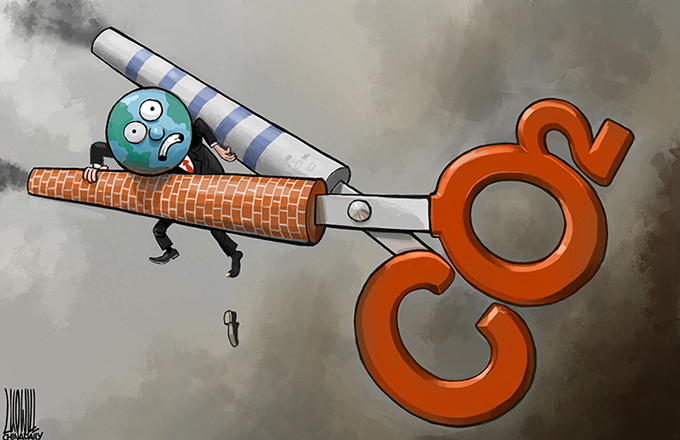
The quadrilateral "alliance", which the United States, India, Japan and Australia plan to build to strengthen their "Indo-Pacific ties", however, would not affect the economic interdependence of Asian economies nor would it serve the purpose of containing China, if there is one. In fact, with more countries joining the Beijing-proposed Belt and Road Initiative, it seems an unwise move to miss the reciprocal nature of President Xi Jinping's vision and exclude China from regional economic governance.
Among the four likely partners in the "quad", Japan has been the most enthusiastic about forging a quasi Indo-Pacific alliance, probably to accelerate its pursuit of wider geopolitical influence and build a full-fledged military. India, too, wants to reinforce its dominance in South Asia and believes it is a good idea to get closer to the US and Japan. And neither Japan nor India has shown any interest in the Belt and Road projects.
But Australia, which enjoys decent economic ties with China, may be less keen to push forward the new grouping.
Trump's call for "free and reciprocal trade" suggests the "America First" policy remains high on his agenda. Whether and how Trump will elaborate on his "Indo-Pacific" vision should be watched closely.
Move may have little impact on projects
Lin Minwang, a researcher at the Institute of International Studies, Fudan University, Shanghai, and a senior research fellow at Pangoal Institution
India has long been open to the idea of an Indo-Pacific region, for obvious reasons. Being just an observer in the Asia-Pacific Economic Cooperation, its geopolitical focus has always been the Indian Ocean, and an Indo-Pacific alliance could enhance its role as a regional power.
Rex Tillerson's speech during his trip to India last month offers a glimpse into Washington's "Indo-Pacific" policy, as he called for India to play a bigger role in Asia's new and developing security architecture in the Indo-Pacific region, which also includes Japan and Australia. He also wanted the US and India to use their economic prowess to facilitate connectivity and growth in the Indo-Pacific region.
Over the past few months, the Trump administration has paid unparalleled attention to US-India relations while taking a tougher stance against Pakistan. It has also endorsed India's "Act East policy", designed to deepen economic and strategic relations with Southeast Asian nations, and may include it in the Indo-Pacific arrangements.
But despite being a known advocate of the Indo-Pacific vision, India may refrain from going too far because such a quasi quadrilateral military alliance would have unwanted implications for the China-Pakistan Economic Corridor and could force Pakistan to take counter measures.
US policy: Buy our arms to build an alliance
Chen Yang, a PhD candidate at the Graduate School of Sociology of Toyo University, Japan
Despite Trump's blunt complaint against decades of "massive trade deficits" with Japan, Japanese Prime Minister Shinzo Abe may still find some relief in the fact that Washington is on board for the Indo-Pacific alliance that Tokyo has long envisioned.
While the US looks set to "include" the Indo-Pacific in its traditional Asia-Pacific strategy, Japan's role in regional affairs may expand and its participation in military drills in the Indian Ocean gain more "legitimacy".
Tokyo could also be emboldened to compete with the 21st Century Maritime Silk Road, the sea route of the Belt and Road Initiative, which Japan and India have refused to join, and keep challenging Beijing over the South China Sea issue.
Besides, the Abe administration also feels the urge to capitalize on the US' interest in building an Indo-Pacific security framework, as China still matters a lot more to the US than Japan when it comes to international and regional affairs. That's why Abe has extended full support for the likely shift in the US' Asia-Pacific policy.
But the highlighting of the term "Indo-Pacific" by US officials before and during Trump's trip to Asia does not mean the Trump administration, which focuses more on the domestic economy and bilateral trade deals, will carry it through. Rather than using the bulk of its diplomatic resources in the Indo-Pacific region, Washington is more likely to urge Canberra, New Delhi and Tokyo to do more and persuade them to buy more weapons from the US as a "display of unity".